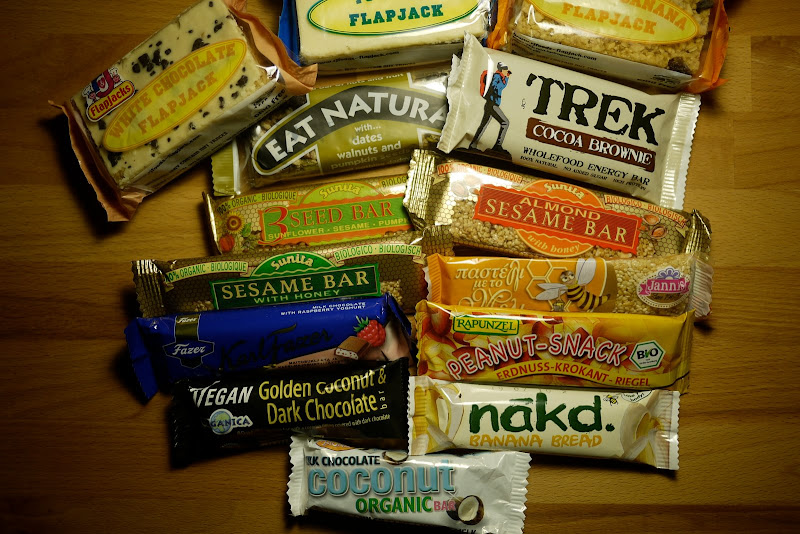
Like many who go backpacking, I pack bars - chocolate, cereal (or Müsli as we say in German) and variations thereof - for the time between breakfast and dinner. Usually I don't bother with lunch, as I am too busy walking and taking photos, so my bars need to give me enough energy to walk for six to eight hours. So as the dedicate UL backpacker I am, I sat down, took the weight of the bars, listed their calories and fat and made a chart of it.
Nam nam!
This was a fun exercise and definitely something different from the normal gist. It included me buying many, many different bars (which I would have needed either way =) and also doing some research, as not all of those bars list their calories and fat on the packaging. And often if they do, they do it for a 100 g bar, so it is distorted. Anyhow, here's the chart I came up with:

Click to see it bigger.
Calories are in kilojoule (kJ). The most important column for you to look at is the "Calories to Weight Ratio" column, here I simply divided the calories of each bar by its weight (including packaging, I didn't want to eat ten bars in one go). The higher this number, the better, as it means you get more calories per gram carried. There are some differences, though.
The Biona, Fazer and Vegan Organica bars are chocolate bars, thus will give you pretty much an instant boost of energy, but not for long. If you need the energy divided over a longer amount of time, you might want to grab a Flapjack, Eat Natural, Suunita, Jannis or Rapunzel bar. And then you got the nakd and Trek bars, who are at the lower end of the calories to weight ratio, but have more of that energy which will go into your system over time.
If you divide the price column and compare it with the calories to weight ratio, you also can see which bar gives you the most energy for your money. That I have done here:
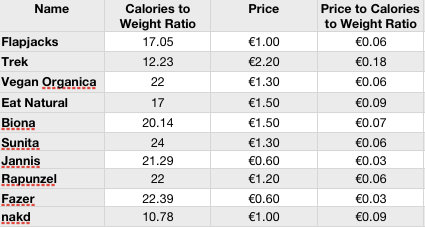
The smaller the number in the "Price to Calories to Weight Ratio" column, the better.
The clear winners here are the Fazer chocolate bar and the Jannis Sesame with Honey bar, who both are 0,60€. While the Sunita bars are the clear winners if it comes to calories to weight, they are double the price of one Jannis bar, so I usually take the Jannis, who are also very tasty. Speaking of taste, you will see that there's a lot of coconut there, I really like coco so it is usually what I like to take along for a trip. But there's a wide variety of different flavours available for most of the listed bars, so you likely would find something to suit your taste (I like them all, otherwise I wouldn't buy them). And besides the Fazer and Jannis bar, all others are either Fair Trade, Vegan, Soil Association or similar approved, so you can snack with a good conscience.
Here a list of links to the websites of the manufacturers, often with the possibility to order a box of the bars, as well as some subjective comments from me about the taste. Worth to check out, especially for the UK readers (somehow a whole bunch of those companies are from the UK!).
Flapjacks: They're like a meal, seriously. I often can only eat half of them in one go, so these are basically for me two bars in one. Tasty and in a lot of different flavours.
Trek: Good but expensive, at least here in Finland. Given their low calories to weight ratio score, I probably won't buy these anymore.
Vegan Organica: I love these. I carry one for every day I go out with me, and savour every bite.
Eat Natural: Very nice and fruity, with many different flavours.
Biona: Another one of those awesome coconut bars. I usually take the Vegan Organica ones though, as they're a bit cheaper.
Sunita: I like Sesame, its very tasty, and if you're looking for the most calories per gram, this is your go-to bar.
Jannis: Cheap and tasty, I usually always have one per day with me.
Rapunzel: Great energy provider, good taste.
Fazer: From Finland, many different, great flavours, cheap, and tasty quick energy.
nakd: They're good, but otherwise they have a low energy to weight ratio and are expensive. Probably not going to buy these again.
Yeps, I hope this was also an interesting excursion for you, and helped you to see where you might be able to save weight in the food department. Taking lightweight, high calorie bars for the trail is the way to go in my opinion. We often fuss around how we can save 100 g for our tarp by taking it in Cuben, when cheap and easy savings can be made with very basic items like these presented here. I hope it inspires you to have a look at the food you carry!
Like many who go backpacking, I pack bars - chocolate, cereal (or Müsli as we say in German) and variations thereof - for the time between breakfast and dinner. Usually I don't bother with lunch, as I am too busy walking and taking photos, so my bars need to give me enough energy to walk for six to eight hours. So as the dedicate UL backpacker I am, I sat down, took the weight of the bars, listed their calories and fat and made a chart of it.

Nam nam!
This was a fun exercise and definitely something different from the normal gist. It included me buying many, many different bars (which I would have needed either way =) and also doing some research, as not all of those bars list their calories and fat on the packaging. And often if they do, they do it for a 100 g bar, so it is distorted. Anyhow, here's the chart I came up with:

Click to see it bigger.
Calories are in kilojoule (kJ). The most important column for you to look at is the "Calories to Weight Ratio" column, here I simply divided the calories of each bar by its weight (including packaging, I didn't want to eat ten bars in one go). The higher this number, the better, as it means you get more calories per gram carried. There are some differences, though.
The Biona, Fazer and Vegan Organica bars are chocolate bars, thus will give you pretty much an instant boost of energy, but not for long. If you need the energy divided over a longer amount of time, you might want to grab a Flapjack, Eat Natural, Suunita, Jannis or Rapunzel bar. And then you got the nakd and Trek bars, who are at the lower end of the calories to weight ratio, but have more of that energy which will go into your system over time.
If you divide the price column and compare it with the calories to weight ratio, you also can see which bar gives you the most energy for your money. That I have done here:

The smaller the number in the "Price to Calories to Weight Ratio" column, the better.
The clear winners here are the Fazer chocolate bar and the Jannis Sesame with Honey bar, who both are 0,60€. While the Sunita bars are the clear winners if it comes to calories to weight, they are double the price of one Jannis bar, so I usually take the Jannis, who are also very tasty. Speaking of taste, you will see that there's a lot of coconut there, I really like coco so it is usually what I like to take along for a trip. But there's a wide variety of different flavours available for most of the listed bars, so you likely would find something to suit your taste (I like them all, otherwise I wouldn't buy them). And besides the Fazer and Jannis bar, all others are either Fair Trade, Vegan, Soil Association or similar approved, so you can snack with a good conscience.
Here a list of links to the websites of the manufacturers, often with the possibility to order a box of the bars, as well as some subjective comments from me about the taste. Worth to check out, especially for the UK readers (somehow a whole bunch of those companies are from the UK!).
Flapjacks: They're like a meal, seriously. I often can only eat half of them in one go, so these are basically for me two bars in one. Tasty and in a lot of different flavours.
Trek: Good but expensive, at least here in Finland. Given their low calories to weight ratio score, I probably won't buy these anymore.
Vegan Organica: I love these. I carry one for every day I go out with me, and savour every bite.
Eat Natural: Very nice and fruity, with many different flavours.
Biona: Another one of those awesome coconut bars. I usually take the Vegan Organica ones though, as they're a bit cheaper.
Sunita: I like Sesame, its very tasty, and if you're looking for the most calories per gram, this is your go-to bar.
Jannis: Cheap and tasty, I usually always have one per day with me.
Rapunzel: Great energy provider, good taste.
Fazer: From Finland, many different, great flavours, cheap, and tasty quick energy.
nakd: They're good, but otherwise they have a low energy to weight ratio and are expensive. Probably not going to buy these again.
Yeps, I hope this was also an interesting excursion for you, and helped you to see where you might be able to save weight in the food department. Taking lightweight, high calorie bars for the trail is the way to go in my opinion. We often fuss around how we can save 100 g for our tarp by taking it in Cuben, when cheap and easy savings can be made with very basic items like these presented here. I hope it inspires you to have a look at the food you carry!
Trail Food: Cereal and Chocolate Bars
HI Hendrik, a very informative post. It is interesting how the sesame bars are highly ranked as sesame bars have been around for a very long time and are readily available almost anywhere. And if you read Sierra Prime: Off Trail in California's High Country on BPL.com you will see that Alan and Don also enjoyed honey Sesame Bars, they also talk about calorie dense foods which supports your comments as well. I will be looking for bars for my trip next week, so will keep an eye out for these brands as well as the local equivalents.
ReplyDeleteThanks
Informative and helpful. I do like flapjacks and energy bars. Thing is a less calorie dense bar that tastes great cab be a real boost on a bad weather day. I expect you could make your own very nice and energy packed flapjacks to a size that suits you.
ReplyDeleteI demand chemical analysis of each to ensure labeling is true.
ReplyDeleteIf maximizing calories per weight is the thing, then just go for vegetable oil? ;-)
ReplyDeleteInteresting post Hendrik. If you have some extra time, say 1,5 hours, I suggest you try to make your own energy bars. It is surprisingly easy and the result is often more tasty than the ones you buy. Here is the recipe that I have used: (In swedish unfortunately):
ReplyDeletehttp://www.loparlarsson.se/content/view/34/57/
The recipe is extremely easy and it is easy to add whatever you like to the mix, like raisins, dried apricots chocolate or whatever. Essentially the recipe contains oatmeal and toffee in parts 1 to 7 (Although I make them sweeter by having one 1 to 5). The hardest part is cooking the toffee. I takes a long time, about 45 minutes. If these cakes are good enough for Rune Larsson when he is runnning 240km in 24 hours they are good enough for me!
Hej Hendrik!
ReplyDeleteNice reading. I went hungry directly :-)
You know the recepie we where chatting abt. Gustav mention the same. Cheap, tasty and easy to make. Have to say the truth abt my last "baking" of Rune-kakan. Most of it was used at home, together with coffe.
Will make a new set of bars for my april trip.
Roger
RogerB, yeah, those Sesame bars are available nearly anywhere, cheap and have high energy, good stuff. I think calorie dense foods are a must for backpacking in general, although I know there are people who carry vegetables into the outdoors to cook - that likely ain't UL =)
ReplyDeleteMartin, you're right with the tasty but less energy dense bars as a motivator, that's the Trek bar for me! I might try to make my own Flapjacks - do you have a recipe you can recommend?
Volgar, I think that goes over my time and financial requirements ;)
Litekayaker, nice to see you here! Olive or vegetable oil would then certainly be the way to go if you want to maximize calories to weight, but is it as tasty as any of the bars above? I doubt it!
Hej Gustav, thanks for that link (no worries about it being in Swedish, I understand that pretty well). How long do those self-made bars stay good?
Tak Roger, yeah, as I saw Gustav's recipe I guessed it is the same as you mentioned. If you make them for your April trip, please document it and make a post of it, would be great to see - or you can make a cooking video out of it :D
Snickers! Tasty, cheap and you can buy them everywhere. Toffee is quick, peanuts slower. Calories to weight ratio is 19.7.
ReplyDeleteI usually have two for lunch when backpacking.
Useful to know. I'd be wary of calorie counting though as fat has twice as much calories as carb. And fat is harder to absorb, and slows the absorption of carb. I focus on carb but then I have to being an insulin controlled diabetic :)
ReplyDeleteI was a recipe once for some stuff that was home made energy bar/spread. Simply honey, peanut butter and corn flour...
Hang on a minute... A Fazer bar can't have over 1000 calories! So I'm assuming that is the value for 100g. If you calculate the calories for a bar (1030g/100*46g) that gives you 473.8 calories per bar (which still seems a little high). That, in turn, gives a calorie to weight ratio of 10.3.
ReplyDeleteAs for the flapjack, 2762 calories per bar would be crazy - that's way over the recommended calories for men per day.
Maths isn't my forte, but the figures don't quite seem to add up...
Unless I'm missing something. But the pizza I', cooking at the moment has about 300 calories - for the whole thing. So 1080 for a small chocolate bar can't be right.
Hei Mark,
ReplyDeleteI have the bar you see above in the photo in front of me, a Fazer Raspberry & Yoghurt bar. According to the Nutritional information on the back, the energy for 100 g are 2340 kJ, which would be (2340/100)*44 = 1029,6 rounded up to 1030 kJ for the 44 g bar.
Flapjack nutritional information where not that easy to find, though I found this source: http://www.explosivenutrition.co.uk/classic-flapjacks-x24 I took the value for the Chocolate bar, and again calculated (1954/100)*145 =2762 kJ.
My maths are right, and I am far from a maths wizard, though I think my numbers are right! I know it seems much, and in comparison to your pizza huge, but I reckon you pizza has flour, water, tomatoes, some cheese, and other veggies on top, that are less calorie dense ingredients as those used in the bars (Flapjacks eg contain oats, sugar syrup, vegetable oils, white chocolate topping, sultanas, cocoa powder...).
My point is more that you eat these when you go backpacking and want to skip cooking lunch, as I do. Then a Flapjack, with their huge amount of calories, can replace your lunch and keeps you going.
Lars, Snickers sounds good, yes! I try to buy ecological/ Fair Trade, though, and I believe Snickers doesn't score in that area!
Baz, good point. I'm not a nutritional expert, and took kJ because they represent the energy your body uses when on the go. I did list the fats too, but didn't want to go into too much detail (because Im no nutritional expert =)!
Thanks for the good discussion, keep them coming!
Will make a batch of Rune-kakan tonight. Blog post will follow. Have no idea how to calculate the energy/nutrition...
ReplyDeleteHendrik - Ah, you were talking about kJ - I thought from the column headings you were listing calories. I think that's where the confusion lay!
ReplyDeleteYou should do a Jerky test next! They have recently released delicious Tanka bars in the US - made by Native Americans pounding bison and cranberries into delightfully chunky bars.
But if you keep this up, you are going to get very very fat!
DIY Energy bars ready. Two hours in total for making 33 bars. And all the small left overs was very tasty to my evening cup of tea.
ReplyDeletehttp://trinisla.blogspot.com/2010/03/diy-energy-bars-runekakor.html
That's a great assortment, I'm pretty envious - the best we get in Japan is Calorie Mate (which is good stuff, but can't beat a flapjack!).
ReplyDeleteI'm a devotee of carb-gel, home made. Great stuff, keeps you on your feet all day:
http://i-cjw.com/blog/2008/08/06/carbohydrate-days/
I have no good figure on how long "Runekakan" stays good. But, I can definitely say that two weeks or so should not be a problem. I can't really tell you about longer times because all the biscuits tend to be consumed by then!
ReplyDeleteHa ha!
ReplyDeleteSame for me Gustav. Store my bars in the fridge.
Gustav and Roger an interesting recipe for Rune-kakan (or equivalent names), I will have to try it.
ReplyDeleteThere are also a lot of recipes at Recipe Czar ( http://www.recipezaar.com/recipes.php?s_type=%2Frecipes.php&q=granola+bars&Search=Search&Searcht= ) which may be of interest to some.
Still trying to understand what is meant by the term Syrup in the Rune-kakan recipe, honey of maple syrup or molasses or ??
With "Sirap" (Swedish) he means the english "molasses", a liquid sticky , brownish sugar product.
ReplyDeleteRoger Brown, we have from Dansuger this Sirap, and I believe it is sold also in Denmark (the packaging is in Finnish, Swedish, Norwegian and Danish). In the Netherlands they sell "Stroop" which is a kind of maple syrup, which you could try - or then just maple syrup!?
ReplyDeleteDrool.
ReplyDeletewhere did you get all those,theres quite many bars i havent even heard of,ever in my life,man.Im huge fan of food you know,and those sesame bars havent ever let me down,theyre tasty stuff,and not too dry.
BTW i found some odd foil pack,that had several dry survival nutrition cookies from the Teerilampi cabin,im pretty damn sure that some lapland burners left them there during ww 2,or maybe you:).
Moro Hendrik! This is a great blog, thanks for it! A late answer to your post:
ReplyDeleteI am just starting all this walking business, it has been bikesports and travelling by bicycle up to now. But Satakunta (and some national parks to the west ;) ) offers such great forests ...
As far as energy supply goes, I would recommend skipping the sweets department and going for real Müsli bars (in the cookies isle in Suomi).
Sweets (candy bars) contain loads of fat and pure sugar. Everybody who is not in danger of becomeing too thin has enough body fat to burn, so fat is not what you need to supply.
Carbs are what most people need in moderate sports. But what carbs? Pure sugar kicks the blood sugar level through the roof -> the body releases vast amounts of insuline -> the blood sugar level crashes into the ground, to a lower level than before eating. The insuline regulation will thank you for the hard ups and downs with diabetes one day. So the right carbs to go with are not refined sugar, but more natural as in the mentioned bars. The carbs are digested more slowly, rise the blood sugar level more slowly and supply you with energy over a longer time with less stress to the body. I usually eat a müsli bar for every hour of sports.
Pure sugar as in sweets, coke or gel is used for sprinting the last part of a competition on a high energy level. But it exhausts the body and would not be my choice to skip a meal!
Kauraa&Kuita Mustikka or Välipalakeksi have a kJ/g ratio of around 18. Fat is at 4-6g per dosage. Buy the 30g bars in convenient 8- or 10-packs for some euros. If I bake my own with muromysliä, I might send you some :)
Just some thoughts. I noticed that lots of Finnish food is optimized towards high energy content; I guess in winter time you just have to gobble in as many calories as possible if you spend a night outside ... we'll see :D
Drool.
ReplyDeletewhere did you get all those,theres quite many bars i havent even heard of,ever in my life,man.Im huge fan of food you know,and those sesame bars havent ever let me down,theyre tasty stuff,and not too dry.
BTW i found some odd foil pack,that had several dry survival nutrition cookies from the Teerilampi cabin,im pretty damn sure that some lapland burners left them there during ww 2,or maybe you:).
Roger Brown, we have from Dansuger this Sirap, and I believe it is sold also in Denmark (the packaging is in Finnish, Swedish, Norwegian and Danish). In the Netherlands they sell "Stroop" which is a kind of maple syrup, which you could try - or then just maple syrup!?
ReplyDeleteHa ha!
ReplyDeleteSame for me Gustav. Store my bars in the fridge.
Hang on a minute... A Fazer bar can't have over 1000 calories! So I'm assuming that is the value for 100g. If you calculate the calories for a bar (1030g/100*46g) that gives you 473.8 calories per bar (which still seems a little high). That, in turn, gives a calorie to weight ratio of 10.3.
ReplyDeleteAs for the flapjack, 2762 calories per bar would be crazy - that's way over the recommended calories for men per day.
Maths isn't my forte, but the figures don't quite seem to add up...
Unless I'm missing something. But the pizza I', cooking at the moment has about 300 calories - for the whole thing. So 1080 for a small chocolate bar can't be right.
Interesting post Hendrik. If you have some extra time, say 1,5 hours, I suggest you try to make your own energy bars. It is surprisingly easy and the result is often more tasty than the ones you buy. Here is the recipe that I have used: (In swedish unfortunately):
ReplyDeletehttp://www.loparlarsson.se/content/view/34/57/
The recipe is extremely easy and it is easy to add whatever you like to the mix, like raisins, dried apricots chocolate or whatever. Essentially the recipe contains oatmeal and toffee in parts 1 to 7 (Although I make them sweeter by having one 1 to 5). The hardest part is cooking the toffee. I takes a long time, about 45 minutes. If these cakes are good enough for Rune Larsson when he is runnning 240km in 24 hours they are good enough for me!
Hei Mark,
ReplyDeleteI have the bar you see above in the photo in front of me, a Fazer Raspberry & Yoghurt bar. According to the Nutritional information on the back, the energy for 100 g are 2340 kJ, which would be (2340/100)*44 = 1029,6 rounded up to 1030 kJ for the 44 g bar.
Flapjack nutritional information where not that easy to find, though I found this source: http://www.explosivenutrition.co.uk/classic-flapjacks-x24 I took the value for the Chocolate bar, and again calculated (1954/100)*145 =2762 kJ.
My maths are right, and I am far from a maths wizard, though I think my numbers are right! I know it seems much, and in comparison to your pizza huge, but I reckon you pizza has flour, water, tomatoes, some cheese, and other veggies on top, that are less calorie dense ingredients as those used in the bars (Flapjacks eg contain oats, sugar syrup, vegetable oils, white chocolate topping, sultanas, cocoa powder...).
My point is more that you eat these when you go backpacking and want to skip cooking lunch, as I do. Then a Flapjack, with their huge amount of calories, can replace your lunch and keeps you going.
Lars, Snickers sounds good, yes! I try to buy ecological/ Fair Trade, though, and I believe Snickers doesn't score in that area!
Baz, good point. I'm not a nutritional expert, and took kJ because they represent the energy your body uses when on the go. I did list the fats too, but didn't want to go into too much detail (because Im no nutritional expert =)!
Thanks for the good discussion, keep them coming!
If you are looking into moving into a condominium
ReplyDeletein Mississauga, you are going to be faced with
the choice between finding Mississauga
condos for rent or for sale. They both have significant advantages and
disadvantages, so you will have to really have to weigh which one is more
convenient for you. Either way, there will always be condos available for rent
and Mississauga Condos
For Sale.
http://www.mississaugacondos4sale.com
Mississauga Condos
Mississauga is the creating town with functions. Hence, most of the individuals are preferred to buy awesome Mississauga condos. The apartments existing over there are extremely magnificent and creates you to cause a peaceful lifestyle. Select the best condos that meets and cause an awesome lifestyle and try to be different from others.
ReplyDelete