In my effort to lighten my load, I decided to try out tarps. It took me a while to decide, after all we are so used nowadays to be inside that it seems very common to stay inside if it comes to shelters when backpacking. By the time I made the decision the temperatures were already under zero and the earth was covered in snow. Not being shy or scared of a challenge, I decided to try them out just then in winter, because I might as well collect these experiences right then and there - after all, tarping in summer is relatively easy.
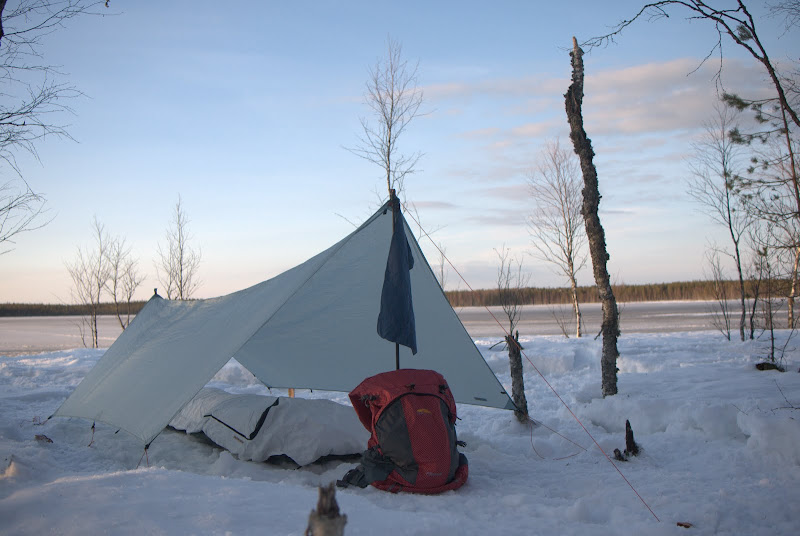
Besides the aim of going lighter it was also the idea of being closer to nature and enjoying the views. Being in a tent, even a tarptent, puts you in a confined space away from nature and your surroundings. That can be a nice thing when the air is buzzing with insects or if a snowstorm is going down, but only very few folks will find themselves in the latter conditions outside and for the former there are also solutions when tarping available.
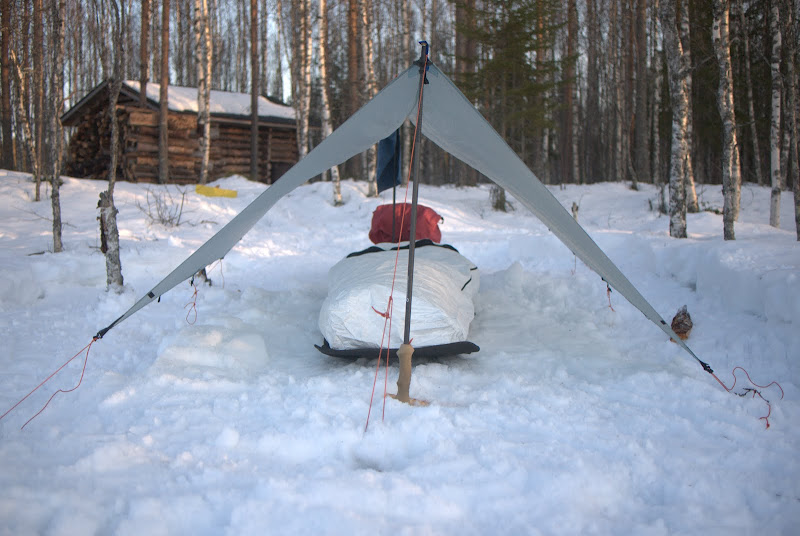
A palace for one.
So I got a Gossamer Gear SpinnTwinn, which is including guylines 282 g. Lets put that into perspective with this list of shelters I own (I reckon I will get rid of some of them soon, no need for that much):
It is thus fairly light, but to be honest one needs to add to the SpinnTwinn the pegs and the poles. Now, I am not a big user of trekking poles - I rather walk hands free - but for crossing streams and for pitching a tarp they are mighty useful. The poles I have for the SpinnTwinn are 80 g for front and rear pole, versus 200 g for a pair of Gossamer Gear LT4 trekking poles, the difference ain't too bad and the user of trekking poles will certainly use them. Add in your favourite set of pegs, which can be anywhere between 5 to 33 g for a peg, and you're looking at a trail weight of about 400 - 450 g for the SpinnTwinn, which is over two thirds less than the above two tents and half of the LightHeart Gear Solo tent.
I had some time on my hands during my spring trip to the north and made this little video of how I set it up on snow, have a look.
Watch it in HD - click the link and choose 720p from the drop down menu.
Its fairly easy to set up with the two poles, with the trekking poles I find it less straight forward because you'd need to find the right height for them - I don't carry a tape measure with me outdoors, so it is by trial and error that I find the correct height. Other than that I can nowadays pitch it in about three to five minutes until it is nearly perfect.
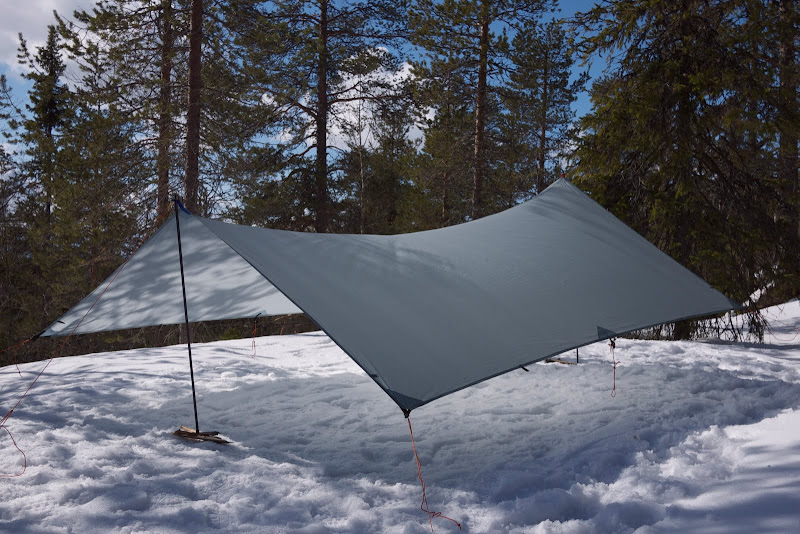
Mucho espacio!
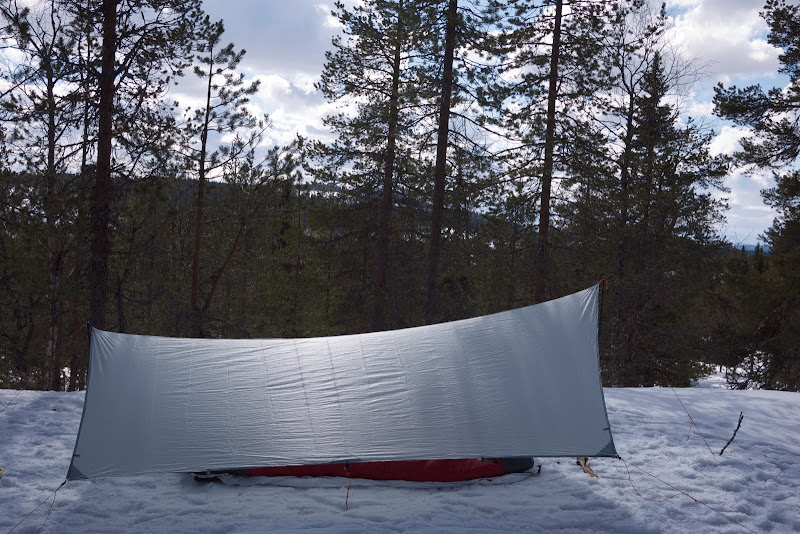
Side view, pitched high.
So how do I like tarping? Short answer: I love it. It is absolutely fabulous, I sleep far better than in a tent, I enjoy that I can right away see and hear everything that is happening around me, the fresh air, minimal condensation, lots of space - there is plenty to like about tarping.
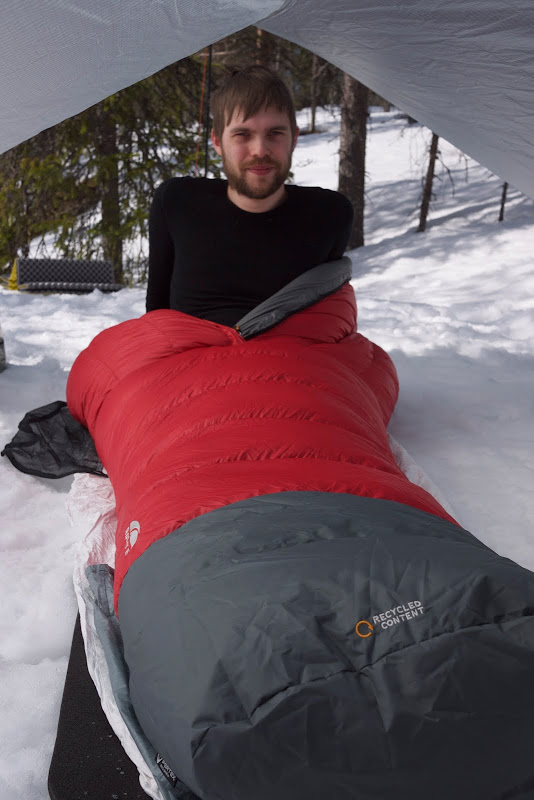
Sitting under the SpinnTwinn in my sleeping bag.
The SpinnTwinn is a fantastic shelter. Fantastic, because at 175 dollars it is very affordable and allows the beginner as well as the pro to gain a great shelter made of Spinnaker. Spinnaker is lighter than Silnylon and does away with the sagging that is so common of silnylon shelters. I also find it very resistant against abuse, it is not easily pierced through, and there's also not any problems with water spraying through it. My subjective feeling is that it sits right between cuben and silnylon and combines the best of both: affordability of silnylon, lightness, zero sagging, no water spraying and the abrasion resistance of cuben.
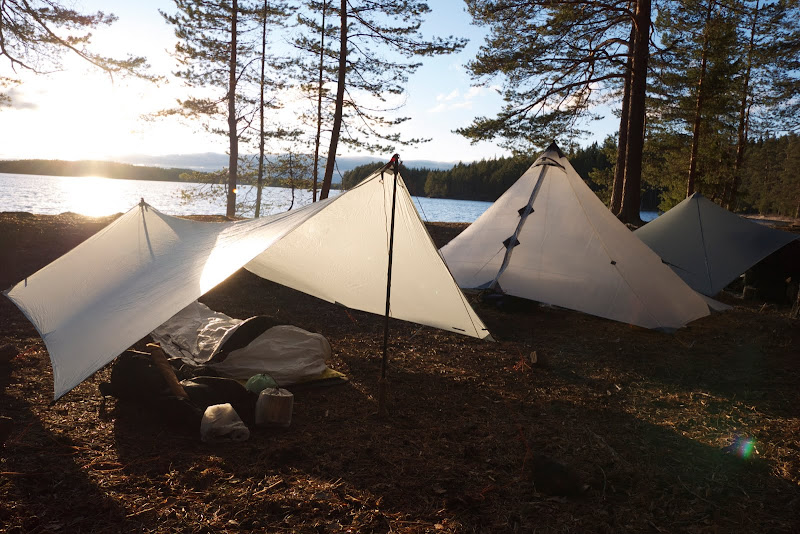
SpinnTwinn next to a MLD Cuben DuoMid and a MLD Silnylon Trailstar.
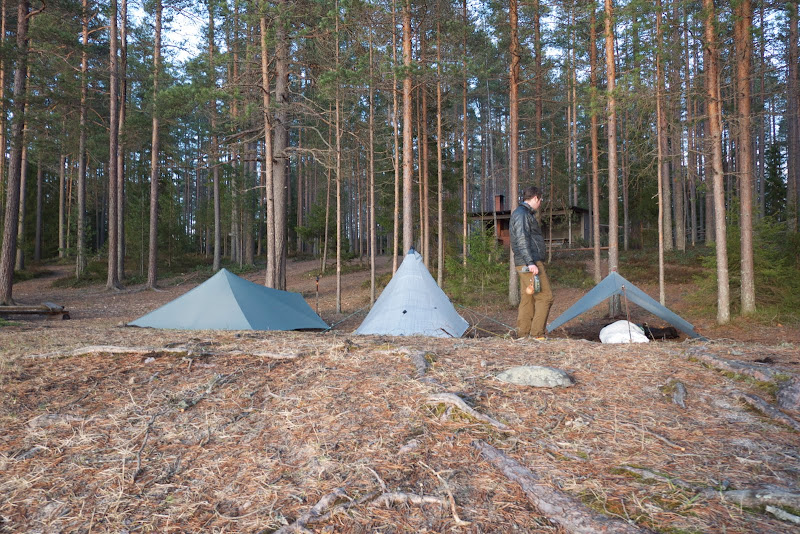
Same shelters, different view. Phil checking out the SpinnTwinn.
I know that some stay away from tarps because they life in areas with heaps of insects, especially the blood sucking kind. In those environments you're glad if you can stay in a shelter where you can keep your sanity and blood. Going lightweight doesn't mean that you can not stay away from the insects and need to go mad. The solution is a bivy or a bug net, the latter being a simple tent made of mesh, giving you that insect free zone. Another argument against tarps is that they can't stand adverse weather conditions.
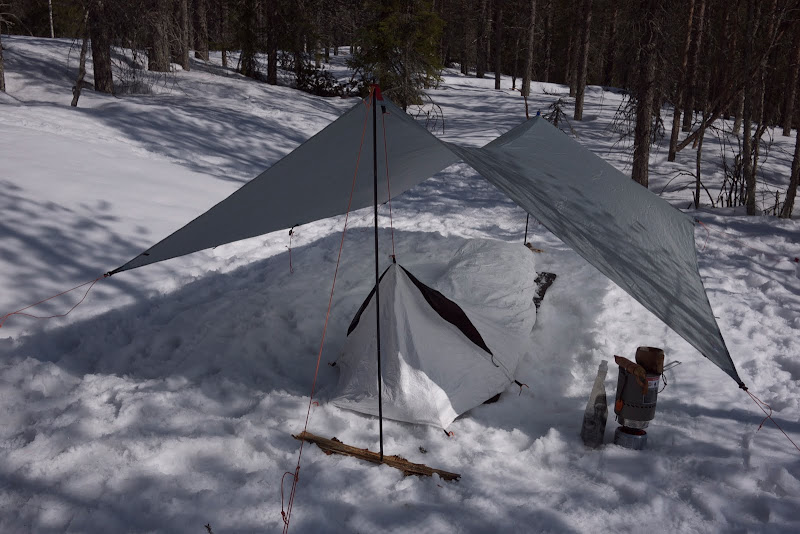
My tyvek bivy protects my sleeping bag from eventual snow or rain which might be blown under the tarp, or insects in the summer.
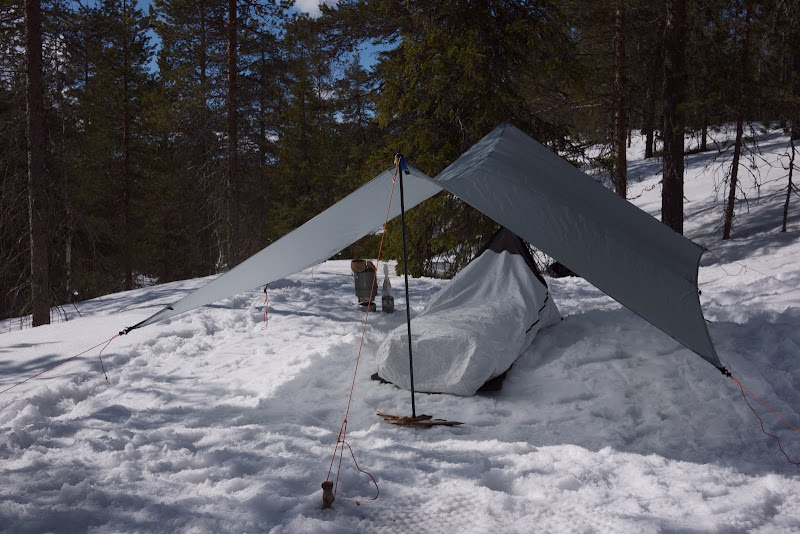
Inside loops allow for the hanging of a line, or as in my case, an attachment point for my bivy.
I get that. In Finland, and much of the Nordic countries, we have plenty of forests which are great for keeping the wind at bay and thus allow one to often find a sheltered camping spot. The scenery is different in the north, though, where treeless fjells will allow the wind and elements to run free and you won't find any protection besides your shelter. That is where the majority of folks will take their "bombproof" shelters, because the wind and rain/ snow could make life hard. Not having camped under those conditions yet, I nevertheless believe that the SpinnTwinn would be just fine and offer sufficient protection from the elements - if pitched correctly. That would mean to pitch low and with one side into the wind, make sure your pegs are well dug in and don't come out, and you hopefully have a bivy to protect your down quilt from rain/ snow.
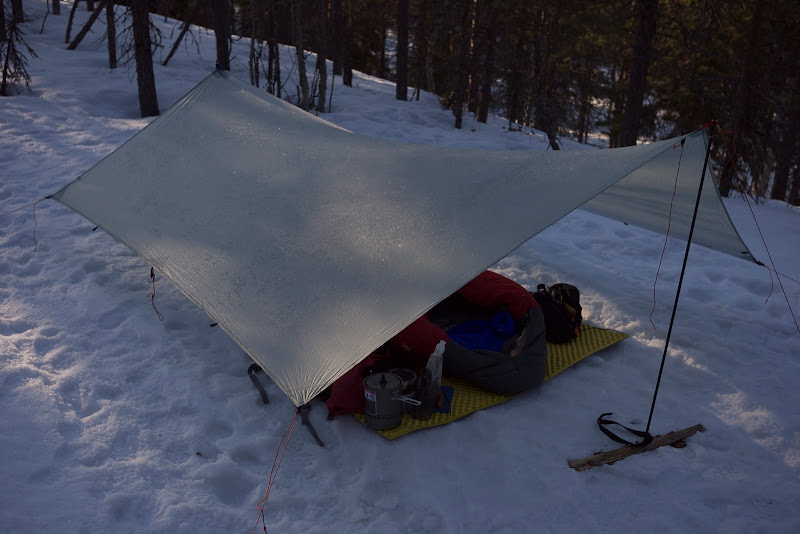
Morning view.
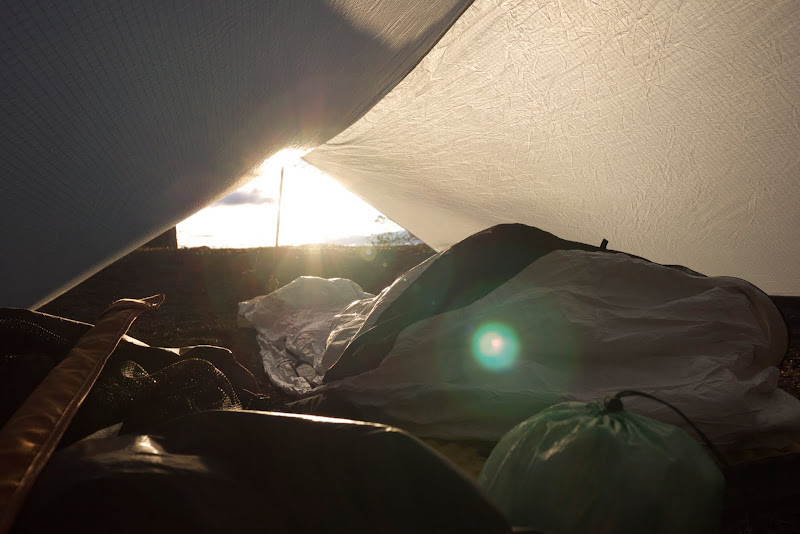
Evening view.
There will be those who might disagree, and because of my lack of experience of tarping in the fjells I can only speak hypothetically. And I would trust the SpinnTwinn (or any other tarp) to protect me also in more adverse conditions when out on the fjell. I will keep this opinion until I have gathered sufficient experience to proof this right or wrong, but for me UL backpacking has as much to do with skills as it has to do with the gear.
Back to the SpinnTwinn. As you can see from the photos, I have used the tarp during winter and spring, on snow and on earth, in rain & snow and in sunshine, with strong winds going and without even a breeze. Once I learned to pitch it correctly - that took pitching it once or twice - it is easy and fast to set up. While it is a two person tarp I haven't yet tried it with someone else, but I am very confident that two could be very comfortable under it, even in the rain. As you can see above, it offers sufficient head room in the front (I'm 175 cm tall, no idea how tall I am when sitting) and changing clothes or packing your rucksack is no problem.
I also like that it packs very small, and it fits perfectly in the front pocket of my LAUFBURSCHE huckePACK besides all the other stuff, where it can dry out when it is wet - that allows me to take it without stuff sack as well, saving a further 11 g!
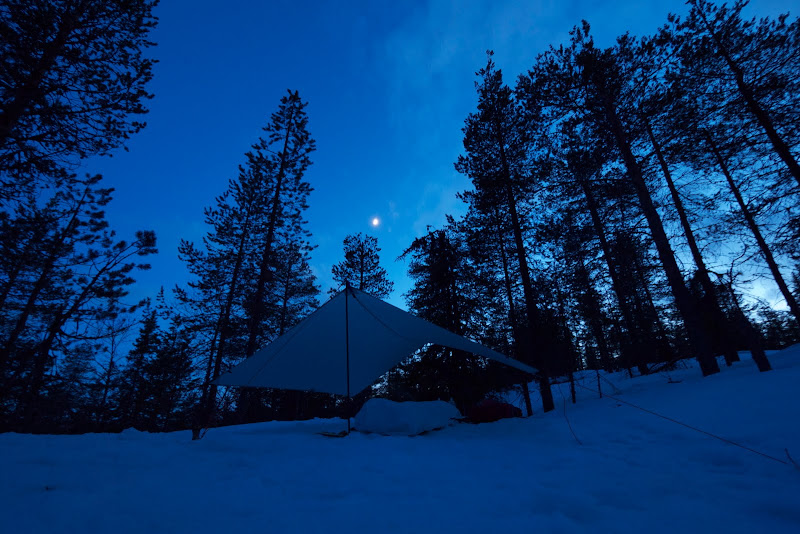
As you can see, I like this tarp a lot. For the price you're hard pressed to find something lighter which has so much features. And as far as I know Gossamer Gear is one of the two companies which makes tarps out of Spinnaker (the other one being MLD which have usually an eight week waiting queue), and the benefits of the material I already discussed above. My conclusion is: If you're looking for a light tarp which is affordable, doesn't sag and offers a lot of space, look no further than the Gossamer Gear SpinnTwinn. It is your cheapest start into lightweight tarping (MYOG aside) and lets you find out in the best way if tarping is something for you. I really love it =)
In my effort to lighten my load, I decided to try out tarps. It took me a while to decide, after all we are so used nowadays to be inside that it seems very common to stay inside if it comes to shelters when backpacking. By the time I made the decision the temperatures were already under zero and the earth was covered in snow. Not being shy or scared of a challenge, I decided to try them out just then in winter, because I might as well collect these experiences right then and there - after all, tarping in summer is relatively easy.
Besides the aim of going lighter it was also the idea of being closer to nature and enjoying the views. Being in a tent, even a tarptent, puts you in a confined space away from nature and your surroundings. That can be a nice thing when the air is buzzing with insects or if a snowstorm is going down, but only very few folks will find themselves in the latter conditions outside and for the former there are also solutions when tarping available.
A palace for one.
So I got a Gossamer Gear SpinnTwinn, which is including guylines 282 g. Lets put that into perspective with this list of shelters I own (I reckon I will get rid of some of them soon, no need for that much):
It is thus fairly light, but to be honest one needs to add to the SpinnTwinn the pegs and the poles. Now, I am not a big user of trekking poles - I rather walk hands free - but for crossing streams and for pitching a tarp they are mighty useful. The poles I have for the SpinnTwinn are 80 g for front and rear pole, versus 200 g for a pair of Gossamer Gear LT4 trekking poles, the difference ain't too bad and the user of trekking poles will certainly use them. Add in your favourite set of pegs, which can be anywhere between 5 to 33 g for a peg, and you're looking at a trail weight of about 400 - 450 g for the SpinnTwinn, which is over two thirds less than the above two tents and half of the LightHeart Gear Solo tent.
I had some time on my hands during my spring trip to the north and made this little video of how I set it up on snow, have a look.
Watch it in HD - click the link and choose 720p from the drop down menu.
Its fairly easy to set up with the two poles, with the trekking poles I find it less straight forward because you'd need to find the right height for them - I don't carry a tape measure with me outdoors, so it is by trial and error that I find the correct height. Other than that I can nowadays pitch it in about three to five minutes until it is nearly perfect.
Mucho espacio!
Side view, pitched high.
So how do I like tarping? Short answer: I love it. It is absolutely fabulous, I sleep far better than in a tent, I enjoy that I can right away see and hear everything that is happening around me, the fresh air, minimal condensation, lots of space - there is plenty to like about tarping.
Sitting under the SpinnTwinn in my sleeping bag.
The SpinnTwinn is a fantastic shelter. Fantastic, because at 175 dollars it is very affordable and allows the beginner as well as the pro to gain a great shelter made of Spinnaker. Spinnaker is lighter than Silnylon and does away with the sagging that is so common of silnylon shelters. I also find it very resistant against abuse, it is not easily pierced through, and there's also not any problems with water spraying through it. My subjective feeling is that it sits right between cuben and silnylon and combines the best of both: affordability of silnylon, lightness, zero sagging, no water spraying and the abrasion resistance of cuben.
SpinnTwinn next to a MLD Cuben DuoMid and a MLD Silnylon Trailstar.
Same shelters, different view. Phil checking out the SpinnTwinn.
I know that some stay away from tarps because they life in areas with heaps of insects, especially the blood sucking kind. In those environments you're glad if you can stay in a shelter where you can keep your sanity and blood. Going lightweight doesn't mean that you can not stay away from the insects and need to go mad. The solution is a bivy or a bug net, the latter being a simple tent made of mesh, giving you that insect free zone. Another argument against tarps is that they can't stand adverse weather conditions.
My tyvek bivy protects my sleeping bag from eventual snow or rain which might be blown under the tarp, or insects in the summer.
Inside loops allow for the hanging of a line, or as in my case, an attachment point for my bivy.
I get that. In Finland, and much of the Nordic countries, we have plenty of forests which are great for keeping the wind at bay and thus allow one to often find a sheltered camping spot. The scenery is different in the north, though, where treeless fjells will allow the wind and elements to run free and you won't find any protection besides your shelter. That is where the majority of folks will take their "bombproof" shelters, because the wind and rain/ snow could make life hard. Not having camped under those conditions yet, I nevertheless believe that the SpinnTwinn would be just fine and offer sufficient protection from the elements - if pitched correctly. That would mean to pitch low and with one side into the wind, make sure your pegs are well dug in and don't come out, and you hopefully have a bivy to protect your down quilt from rain/ snow.
Morning view.
Evening view.
There will be those who might disagree, and because of my lack of experience of tarping in the fjells I can only speak hypothetically. And I would trust the SpinnTwinn (or any other tarp) to protect me also in more adverse conditions when out on the fjell. I will keep this opinion until I have gathered sufficient experience to proof this right or wrong, but for me UL backpacking has as much to do with skills as it has to do with the gear.
Back to the SpinnTwinn. As you can see from the photos, I have used the tarp during winter and spring, on snow and on earth, in rain & snow and in sunshine, with strong winds going and without even a breeze. Once I learned to pitch it correctly - that took pitching it once or twice - it is easy and fast to set up. While it is a two person tarp I haven't yet tried it with someone else, but I am very confident that two could be very comfortable under it, even in the rain. As you can see above, it offers sufficient head room in the front (I'm 175 cm tall, no idea how tall I am when sitting) and changing clothes or packing your rucksack is no problem.
I also like that it packs very small, and it fits perfectly in the front pocket of my LAUFBURSCHE huckePACK besides all the other stuff, where it can dry out when it is wet - that allows me to take it without stuff sack as well, saving a further 11 g!
As you can see, I like this tarp a lot. For the price you're hard pressed to find something lighter which has so much features. And as far as I know Gossamer Gear is one of the two companies which makes tarps out of Spinnaker (the other one being MLD which have usually an eight week waiting queue), and the benefits of the material I already discussed above. My conclusion is: If you're looking for a light tarp which is affordable, doesn't sag and offers a lot of space, look no further than the Gossamer Gear SpinnTwinn. It is your cheapest start into lightweight tarping (MYOG aside) and lets you find out in the best way if tarping is something for you. I really love it =)
Awesome shelter, can't wait for mine to arrive and thanks for loaning me yours! I'll find out if such minimal shelters work in the mountains very soon...
I'm curious about the poles you were using. What heights are they? You said you were pitching it high, so, as the poles are fixed length, did you achieve that simply through the longer guys?
I've not tried mine yet in Lapland (obviously) but I believe when pitched low and appropriately it could handle much of what might get thrown at it.
You should do a video on how to tie that knot you used.
Joe, looking forward to your review, and if it works in the Norwegian mountains.
phrakture, it is a Laufbursche prototype bivy. You could make on yourself, they're fairly easy ;)
Thanks Mark. I used the GG Aluminum poles for the SpinnShelter and the GG LT4 trekking poles. With the Alu poles there were no problems, as they are the correct hight, with the trekking poles - as they don't have any markings - it takes a bit of guess work to find the correct length. Pitching high was indeed achieved through the longer guylines and staking out further. Good to hear that you're positive of it standing up to Lapland conditions! And I can think about that video of the knot :D
Thanks for the review - I think this is exactly what we needed and I'll link it if that's ok. I am very interested in the MLD Soul bivy with a 70D base coupled with a GG SpinnTwinn or SpinnShelter - I have not decided which I want to try out yet, but I have to say that the whole experience I think will get me closer to the wilderness I am in, in a way that no dual skin tent can accomplish.
I've put markings on my LT4s with a silver marker (a Sharpie, no less) for the appropriate heights for the SpinnTwinn and DuoMid. A simple solution. I can also then extend them by approximately equal amounts, and still maintain the correct difference in height between the two for even more headroom.
I'm not sure I agree that this is "your cheapest start into lightweight tarping (MYOG aside)" - I'd suggest a cheap lightweight silnylon tarp may be more appropriate?
I've got a 2420 x 1520mm tarp that I got from an army surplus store for £30 that weighs 300g without pegs and line. Quality is fine, and I'd really struggle to justify the $175 plus post and taxes for a quite minor weight saving.
I realise that the SpinnTwinn is a two person tarp, and larger than the example above, but cheap?
I'm a bit undecided about Spinnaker as a fabric actually - I just can't quite see the point of it (though my yacht spinnaker is delightful) now that cuben is ubiquitous. If cuben is too expensive, then silnylon seems to be a decent compromise. Why would you choose spinnaker instead? That's not rhetorical - I'm genuinely interested :-)
Yes, tarps are very nice and they do let you be close to the nature around you. Waking up in the middle of a summers night looking at a fabric wall can be nice if the birds are singing, but I definitely prefer being able to look outside, perhaps at distant mountains, perhaps at nearby bushes. They are equally marvelous if you take your time. And then you can go back to sleep...
Mark, thank you, that was the useful advice I hoped someone wold give me! Sometimes it is so easy to overcome these little problems =)
Maz, sure it is OK! If you want to save your wallet a bit I do recommend to try and sew your own tyvek bivy, it is the one of the most breathable materials and fairly cheap.
Phil, valid point. I strongly believe in buying high quality. In my experience that would mean going for Spinnaker or Cuben, but the latter is prohibitively expensive for most, and if you add in the waiting time you often have when getting a cuben tarp (no Idea if Team IO has waiting times). Thus, as said above, Spinnaker has the best of both worlds: (Relatively) Cheap but better functionality. And cuben is not ubiquitous in my opinion, not as long as only one company manufacturers it. And 175$ is cheap for me, with the stronger Euro it is very affordable. To conclude thus: I choose spinnaker because it has more advantages than silnylon while it is cheaper than cuben. That is, of course, my own subjective opinion!
Have you tried to pitch it in another configuration than the A-frame? I am wondering if it is easy to have the tarp properly put up... I would really like to save some weight with this design, but wonder if it would be half as versatile as a rectangular tarp. I'm still undecided.
Brilliant stuff Hendrik... I feel I have been 'working up' to using a tarp for a year or so now given that my shelter system is now composite.(Shangrila 3 and bivvy) Would really like to give this system a go.
As usual I enjoyed your tarp review very much – your observations are well noted and you are, as always, never afraid to admit to things you have yet to try.
Some observations and comments on what you have written – you said: ”In Finland, and much of the Nordic countries, we have plenty of forests which are great for keeping the wind at bay and thus allow one to often find a sheltered camping spot. “
Yes, your forests are that lovely mosaic of species and age groups something lacking here in the North of Scotland except for a few notable exceptions. But on to this: “The scenery is different in the north, though, where treeless fjells will allow the wind and elements to run free and you won't find any protection besides your shelter. That is where the majority of folks will take their "bombproof" shelters, because the wind and rain/ snow could make life hard. Not having camped under those conditions yet, I nevertheless believe that the SpinnTwinn would be just fine and offer sufficient protection from the elements - if pitched correctly. That would mean to pitch low and with one side into the wind, make sure your pegs are well dug in and don't come out, and you hopefully have a bivy to protect your down quilt from rain/ snow.”
The wonderful treeless (or nearly treeless) fjells are, in my opinion, the best of Finnish landscape and the terrain is somewhat similar to our treeless (or nearly treeless) Scottish landscape. As a tarp user I can assure you that a tarp is perfectly adequate in such terrain.
“There will be those who might disagree, and because of my lack of experience of tarping in the fjells I can only speak hypothetically. And I would trust the SpinnTwinn (or any other tarp) to protect me also in more adverse conditions when out on the fjell.”
Your confidence is well founded as you will discover!
And this:
“I will keep this opinion until I have gathered sufficient experience to proof this right or wrong, BUT FOR ME UL BACKPACKING HAS AS MUCH TO DO WITH SKILLS AS IT HAS TO DO WITH THE GEAR.”
I have capitalised what I think is your most important statement of all – and rightfully so as emphasis should correctly be on skills as kit without skills is as useful as a stove without fuel.
Oh, I nearly forgot you said “I know that some stay away from tarps because they life in areas with heaps of insects, especially the blood sucking kind. In those environments you're glad if you can stay in a shelter where you can keep your sanity and blood. Going lightweight doesn't mean that you can not stay away from the insects and need to go mad. The solution is a bivy or a bug net, the latter being a simple tent made of mesh, giving you that insect free zone.”
I happen to be one of those totally mad old sods who use a tarp in Scotland in the summer in midge season! There is no totally insect free zone – well I haven’t found one but in camp, before retiring to my sleeping bag and head net, I take solace for 45-50 minutes with a Romeo y Julieta No.2 cigar, the smoke is wonderful, they keep midges away, but at £222 a box of 25 a wee bit expensive…but you only live once!
Change of subject - soon it will be the time of the mushroom and berry picking season. If you haven’t already got a berry picker, buy one!
I don’t know if you have Mauri Korhonen’s book Sienestäjän – if you haven’t get a copy as it is probably one of the best books on mushrooms in the Finnish language. The book has gone through several editions, mine is old from 1978 but his book was the “gold standard”.
Soon it will be time for Keltavahvero (Canttharellus cibarius) which we have here in too in Scotland in profusion. In August you will have all the various tatti, my favourites being Herkkutatti (Boletus edulis). My all time favourite tatti is Ruskotatti (Boletus badius) but, unfortunately here in my part of Scotland it is not that common. For 8 years I lived in the county of Kent in England and Ruskotatti was very common and of course delicious!
Back in the Spring you missed the best mushroom of all…Korvasieni (Gyrometra esculenta) and, as you will know almost every “mushroom sauce” served in Finnish restaurants is made from Korvasieni. Of course it is also one of the most deadliest of mushrooms!!! My advice is do not prepare this mushroom unless you have been shown how to prepare it by a Finn who has many years experience of preparing this mushroom for the table. The preparation is comparatively lengthy but it is such a wonderful mushroom. You can encourage it to grow in your garden as this mushroom seems to have quite a symbiotic relationship with humans! Here in Scotland it is very common and can be found alongside most woodland trails in the Spring.
Xavier, I haven't tried but don'e see a problem why it wouldn't work. The Catline might be a little problem, but I have pitched it for example with the front corners up (so three poles in the front, one in the back. That worked nicely. But when I have it back (currently on loan with Joe) I can give it a try.
Northern Walker, thank you! If you have been using the Shangri-La 3 + bivy I am sure you'll feel comfortable in using a tarp like the SpinnTwinn!
Pit, I have Clamcleats but don't like them at all. I find the knot is a lot faster and better. But that is surely a personal thing, I know many like the Clamcleats.
Family Guy, the Tyvek bivy is 205 g. It is not added to the shelter, as it is not always necessary. The info as above is in my opinion a valid comparison, because it is solely about shelters.
Robert, thanks for the great comment! I'm glad to read your experience in using a tarp in the fjell, and I agree that it is probably one of the most beautiful landscapes Finland has to offer (too bad it is a pain to travel up there, 12+ hours are just too long to go on a "weekend" trip and flying is a tad expensive). I'm very happy that you picked out the note about the skills, I think you hit the nail on its head - also in my opinion it is the most important bit. Your solution for a midge free space sounds excellent! I had a very dear uncle once who used to smoke cigars, and I always loved the smell of it! You got a good taste with Romeo y Julieta No.2! (OT: I pick berries usually the old style, by hand! Might get a berry picker, though, as it is a lot faster. I don't have the Korhonen book, but a couple of other ones - might look that one up, though. I like Suppilovahvero (Cantharellus tubaeformis) and Mustatorvisieni (Craterellus cornucopioides), last year we found a lot of them and really enjoyed them - even on some trip: http://www.hikinginfinland.com/2009/09/paroonin-taival-pirkan-taival-trail.html =) When are you coming the next time to Finland? Maybe we can arrange a little walk together?!)
I have eaten Cantharellus tubaeformis many times in Finland, collected by a friend in Jyväskyla and he also brought some he dried to us here in the U.K. Another friend in Kouvola also picks these delicious mushrooms.
I have found Craterellus cornucopides in North Wales but not here in my neck of the woods in Scotland. I know there are present here it is just that I haven’t found them! Cantharellus tubaeformis usually comes out later in the summer or early autumn and I think I am not seeing it due to the leaf litter.
Thanks for the link , first I must say how superb the photos are, I particularly like the one with the butterfly and another showing the cobwebs.
The soup you made looks delicious and I commend you on making it. I know that throughout most of Europe, Northern Europe, Central Europe, Southern Europe, the Nordic and Scandinavian countries and Russia mushroom picking is part of the culture, mainly I think due to the fact that so many people are closer to nature – most certainly that is true in Finland which I have visited frequently and also Sweden and Norway which I have only occasionally visited. Unfortunately in my country fewer people are connected to nature, and although mushroom picking has become more popular most of those I have met have been professional pickers for the restaurant trade. Twenty five years ago the only other people I met picking were Italians picking for the London restaurants and they only picked Boletus edulis and were amazed at the variety that I had in my basket.
Aye, the North fell country is a long way from Tampere – it needs a proper holiday to do it justice, a week minimum really.
I am not sure when I will be next in Finland but thanks for the walk invite! If you come to Scotland I can take you in to the hills and mountains as I am only a short drive from the Cairngorms.
Interesting. Well, I might argue that you can pitch some of the tents you mentioned without the inner (and just a footprint). If you don't include the bivy in shelter weight when comparing the tarp to the shelters you mention, then you could compare the weight of just the tarp to the 'fast fly' set up of the other shelters. Still lighter, but not much if you include a dedicated groundsheet and trekking poles.
Family Guy, valid point. I could do that at some point maybe, if I have enough time - the main reason why it is a bit more silent here at the moment. Re: groundsheet, I never use one as I find is not practical.
I just took a more thorough look at your blog when gathering info on what new shelter to buy after I sold my Hilleberg Akto. Do you have any more time with this Gossamer Gear SpinnTwinn shelter now during the summer? How do you cope with the bugs? At least in the Turku area we have an unusual amount of mosquitoes this summer, and I have found a simple bivy bag with a head net to be somewhat suboptimal in these conditions.
I did actually go ahead and order a Tarptent Double Rainbow, but I would still be interested in your answer. Most people here just use tents.
Hei Yeti, there are bug tent solutions offered (www.alpinlite.com and also from www.gossamergear.com, among others) but I haven't tried these. I think if you own a mosquito net you could just make something like the bugtents yourself and save some money.
I usually sleep with a down pullover with hood, and find that that keeps the mosquitos at bay. A headnet, bugtent or the bivy are then common ways to get the mosquito-free zone, and the bivy works for me. Great blog you have, btw!
Hendrik - have you noticed that provided guy cords slip in the lineocs when pitched very tight? I think I might have to switch mine out for slightly thicker ones.
Hi Hendrik, nice blog and very useful gear reviews, thank you. This could be another option for the bug problem: http://www.mountainlaureldesigns.com/shop/product_info.php?cPath=22&products_id=55 (Did not try, but looks usefully)
Hendrik - Have you experience this in high winds yet - here in NZ above the bushline I would worry about that. I am wondering how it would fare in a gust. Also the Tyvek biv - what/where does that come from - I have an OwareUSA biv and their Cat2 tarp but if going above the bushline take my SixMoons Solo Enhanced tent. Rob
redrobin, I have limited experience in high wind with the SpinnTwinn, but there are those who have used it in those conditions and found it to be a perfect shelter also for those conditions.
Hendrik - For snow, what are you putting down under your bag/bivy? I think I see the Multimat Adventure in the pictures. Are you also using a Multimat Summit?
I live in Washington State and we get LOTS of rain and, typically, dense snow (and of course, quite a bit of wind). Staying dry could become a daunting task. Suggestions?
Tyson, Washington sounds a lot like the South Island of NZ - A good shelter for you to check out is The One from Gossamer Gear. I'm trying to decide if I will get this or Glen's SpinnTwin Tarp - Just sold my Solo Enhanced Tent and Oware biv to go lighter.
Just wondering, is the LAUFBURSCHE tyvek bivy that so many of us have been asking about made of hard or soft structure TyVek? The Softer material is much more porous, the hard much stiffer, like paper-sort of.
JW, the bivy is made of the soft tyvek (at least I think so). It is very soft and breaths very well. Recommend making one yourself, as I am not certain that Laufbursche will be offering them just yet.
Tyson, indeed I am using the Multimat Adventure and the Multimat Summit. I used an Exped Groundmat instead of the Adventure on my last trip, which did very well but was a bit more heavy. I can recommend both to stay dry and warm, the Exped is useful if you have gear which you want to keep dry as well, the Adventure if you don't need extra dry space.
This is probably a good product for the summer usage in a way you are using it, but for the winter you should adjust the setup of your tarp, especially if you talk about skills :)
Negative C temperature, light snowing, light wind and the snow starts to pile against your bivy and gear. It's really not a matter of "must have walls around me" when people in Finland traditionally have pitched their light shelters in the form of "laavu", "loue" or "erätoveri" instead of "katos" (=tarp). Walls from 2-3 sides give much protection from the weather without actually causing that much more weight (btw, you are surrounded by walls inside your bivy, too). Walls also serve as a reflector for the heat from an open fire if your fabric allows a fire nearby. The heating option is great if you need to fix your gear without your gloves on (broken binding of a ski, or broken ski pole are typical), happen to get yourself wet or other accidents happen. But the main purpose is of course to keep the snow away from you and your gear.
This could actually be even lighter setup, as 2-3 walls make the bivy unncessary unless your sleeping bag/quilt absolutely requires it. I'm not sure if there is enough material on your tarp to alter the setup for 2-3 sides touching the snow, but even one side is better than none. Just hope you guessed the direction right if the wind arises.
You could also use the snow itself to add some protection, but that pretty much requires a shovel.
Antti, does the weather on those photos look like it needed to be pitched low ;) The SpinnTwinn can be pitched with both sides to the ground. As it is a Cat tarp it is best in a A-frame pitch, though with some endurance and trying you also can realize other pitches.
I have yet to see Finns using any of the shelters you named, except the people who do a Eräopas education. On trail I have never yet met a Finn not sleeping not in a tent or laavu/ autiotupa, either. You can thank the crap lehti Retki for that!
A fire is nice for cooking and warming up again. If you have the skills to make a proper long-log fire which burns the whole night, then that too is fine. But a normal fire is just more of a hinderance at night than a blessing, as I personally never fall properly asleep and always keep an eye on the fire. I rather have no fire and sleep than a fire and not sleep - YMMV.
If you go to Nuuksio National Park in a summer weekends, you can find scouts staying in laavu shelters that have been made from cloth. One of my former colleges at work, uses them on winter hiking trips. Then there are those laavus that have been made out of timber. I've seen them used couple times and I've used them personally in Riisitunturi national park in summer 2008, because nights were so close to freezing point that I did not have to worry about mosquitos. What comes to tarp vs. tent, I guess it partly depends on how much privacy you want in hiking trails, does forecast promise good weather for the whole trip, etc. Even Chris Townsends seems to prefer tent over tarp in Scandinavia (source: http://www.fjaderlatt.se/2010/07/scandinavia-end-to-end-with-townsend.html) What comes to Antti's suggestions, Savotta's lean-to shelters weight 1.1kg (without poles) ... for someone like me, tent weighs bit more, but looks and feels like more well thought product that is easier to setup in all conditions on solo trip or with my wife.
Hendrik; IMO the skill is to maximize your comfort and sleep with the gear and weather you have. If you wake up because weather changed and can continue your sleep only after re-adjusting the tarp, you made a basic error that could have been avoided completely by preparing for worse in the beginnging. Of course you cannot prepare for everything, but if it takes no extra time or gear, it's a good idea. I would say none of the pictures show the tarp "low enough" for my preference, but maybe you are lucky ;) My luck for that ran out last saturday night, I would have gotten lots of snow in my gear and sleeping bag - and I could not see it coming when I pitched it up. But like you said, MMMV from others.
About fire; I mostly agree. But I really like the option when fixing broken gear or drying up something that got wet - not sleeping at the same time that is. For some reason I seem to break lots of stuff in the winter hikes, and those metallic ski bindings are PITA to fix without fire to keep your fingers warm.
Your absolutely right about Retki and they have gotten worse over the years I think :(
Juha: I think for 1.1kg you talk about completely different product even when the basic design happens to be the same. Savotta and lightweight do not fit in same sentence that well :)
Antti, great to have a discussion on tarps with Finns!
I agree, maximize comfort through skill and anticipating/ knowing the weather to come. In the video is towards the end a bit where I illustrate that one also can pitch the SpinnTwinn low, close to the ground, it takes no extra work and if the weather looks like you mentioned, then that certainly is the way forward. I just like the extra views, and I take the Tyvek bivy (205 g) to protect from snow drift/ wind, it is a good "insurance".
For the next trips I will try the GG SpinnShelter which can be seen as a completely closed shelter, front and back closed and low on the sides, but even more excited I am about trying out the DD Hammocks 3x3 Tarp!
I like the fire, in case that didn't come through above, just not for sleeping. Perfect for cooking and sitting around, and fixing as you said. What skis do you use (I'm still looking for some light Metsäsukset & normal X Country skis)?
Retki, they now "buy" a bit into lightweight and stuff, but I find it interesting to se how the companies which spend big bucks with them on advertisements also usually are the ones with the "Editors Award" in the tests.
Juha, I meant wood laavus, as I also have used them. My problem with them is that 99% of the laavu's built in Finland are of the idiotic design where the fireplace is in front of the laavu, and not inside - check here (Photo 7, "Peekaboo in the laavu...") that is how laavus should be built, but instead they are built as in photo 4. 80% of heat is lost and not used because of such dumb design.
One can have privacy in a tarp as well. Privacy in Riisitunturi is likely easier to find than on the Karhunkierros, but also on the latter one can look for a more private place to pitch his tarp.
Concerning Chris, there are plenty more people living in the Nordics and using tarps & shelter - Nordic Lightpacking is a good example. Also "laavu", "loue", "erätoveri" and "katos" are traditional Sami/ Finnish designs (plus Kota), so are more than adequate for the Nordic.
Savotta and light, I don't know =) The Vihe shelters from Tampere are about 300 - 400 g lighter than Savotta, and hand-made in Finland!
What comes to wooden laavus, I've seen couple of those 'Peekaboo in the laavu's in Lempäälä (on Birgitan Polku hiking trail). Then there are wooden kota shelters in Lapland (at least on UKK trail from Hautajärvi to Sallatunturi).
In Lapland they also have 3rd common design, which they refer as laavu and looks a lot like Loue ( http://matka.kuvat.fi/kuvat/Juha/Kuusamo-Lappi/Lapland-Camp-2009/Laavu+3141.jpg ).
I wrote a long reply but it got lost somewhere :( Anyway, I'm using smoot bottomed skis made by Järvinen. They are a bit short for me at 240cm but bigger ones would cause storage problems for me. I think the same model is sold as "Lapponia" nowdays. The model is ok for forest use, but frozen and hard snow of the Lappland could be troublesome as they have no metallic edges.
I think Juha's 3rd design is often called as puolikota/half-kota when people talk about it.
I wrote a long reply but it got lost somewhere :( Anyway, I'm using smoot bottomed skis made by Järvinen. They are a bit short for me at 240cm but bigger ones would cause storage problems for me. I think the same model is sold as "Lapponia" nowdays. The model is ok for forest use, but frozen and hard snow of the Lappland could be troublesome as they have no metallic edges.
I think Juha's 3rd design is often called as puolikota/half-kota when people talk about it.
Antti, great to have a discussion on tarps with Finns!
I agree, maximize comfort through skill and anticipating/ knowing the weather to come. In the video is towards the end a bit where I illustrate that one also can pitch the SpinnTwinn low, close to the ground, it takes no extra work and if the weather looks like you mentioned, then that certainly is the way forward. I just like the extra views, and I take the Tyvek bivy (205 g) to protect from snow drift/ wind, it is a good "insurance".
For the next trips I will try the GG SpinnShelter which can be seen as a completely closed shelter, front and back closed and low on the sides, but even more excited I am about trying out the DD Hammocks 3x3 Tarp!
I like the fire, in case that didn't come through above, just not for sleeping. Perfect for cooking and sitting around, and fixing as you said. What skis do you use (I'm still looking for some light Metsäsukset & normal X Country skis)?
Retki, they now "buy" a bit into lightweight and stuff, but I find it interesting to se how the companies which spend big bucks with them on advertisements also usually are the ones with the "Editors Award" in the tests.
Juha, I meant wood laavus, as I also have used them. My problem with them is that 99% of the laavu's built in Finland are of the idiotic design where the fireplace is in front of the laavu, and not inside - check here (Photo 7, "Peekaboo in the laavu...") that is how laavus should be built, but instead they are built as in photo 4. 80% of heat is lost and not used because of such dumb design.
One can have privacy in a tarp as well. Privacy in Riisitunturi is likely easier to find than on the Karhunkierros, but also on the latter one can look for a more private place to pitch his tarp.
Concerning Chris, there are plenty more people living in the Nordics and using tarps & shelter - Nordic Lightpacking is a good example. Also "laavu", "loue", "erätoveri" and "katos" are traditional Sami/ Finnish designs (plus Kota), so are more than adequate for the Nordic.
Savotta and light, I don't know =) The Vihe shelters from Tampere are about 300 - 400 g lighter than Savotta, and hand-made in Finland!
Hendrik; IMO the skill is to maximize your comfort and sleep with the gear and weather you have. If you wake up because weather changed and can continue your sleep only after re-adjusting the tarp, you made a basic error that could have been avoided completely by preparing for worse in the beginnging. Of course you cannot prepare for everything, but if it takes no extra time or gear, it's a good idea. I would say none of the pictures show the tarp "low enough" for my preference, but maybe you are lucky ;) My luck for that ran out last saturday night, I would have gotten lots of snow in my gear and sleeping bag - and I could not see it coming when I pitched it up. But like you said, MMMV from others.
About fire; I mostly agree. But I really like the option when fixing broken gear or drying up something that got wet - not sleeping at the same time that is. For some reason I seem to break lots of stuff in the winter hikes, and those metallic ski bindings are PITA to fix without fire to keep your fingers warm.
Your absolutely right about Retki and they have gotten worse over the years I think :(
Juha: I think for 1.1kg you talk about completely different product even when the basic design happens to be the same. Savotta and lightweight do not fit in same sentence that well :)
As usual I enjoyed your tarp review very much – your observations are well noted and you are, as always, never afraid to admit to things you have yet to try.
Some observations and comments on what you have written – you said: ”In Finland, and much of the Nordic countries, we have plenty of forests which are great for keeping the wind at bay and thus allow one to often find a sheltered camping spot. “
Yes, your forests are that lovely mosaic of species and age groups something lacking here in the North of Scotland except for a few notable exceptions. But on to this: “The scenery is different in the north, though, where treeless fjells will allow the wind and elements to run free and you won't find any protection besides your shelter. That is where the majority of folks will take their "bombproof" shelters, because the wind and rain/ snow could make life hard. Not having camped under those conditions yet, I nevertheless believe that the SpinnTwinn would be just fine and offer sufficient protection from the elements - if pitched correctly. That would mean to pitch low and with one side into the wind, make sure your pegs are well dug in and don't come out, and you hopefully have a bivy to protect your down quilt from rain/ snow.”
The wonderful treeless (or nearly treeless) fjells are, in my opinion, the best of Finnish landscape and the terrain is somewhat similar to our treeless (or nearly treeless) Scottish landscape. As a tarp user I can assure you that a tarp is perfectly adequate in such terrain.
“There will be those who might disagree, and because of my lack of experience of tarping in the fjells I can only speak hypothetically. And I would trust the SpinnTwinn (or any other tarp) to protect me also in more adverse conditions when out on the fjell.”
Your confidence is well founded as you will discover!
And this:
“I will keep this opinion until I have gathered sufficient experience to proof this right or wrong, BUT FOR ME UL BACKPACKING HAS AS MUCH TO DO WITH SKILLS AS IT HAS TO DO WITH THE GEAR.”
I have capitalised what I think is your most important statement of all – and rightfully so as emphasis should correctly be on skills as kit without skills is as useful as a stove without fuel.
Oh, I nearly forgot you said “I know that some stay away from tarps because they life in areas with heaps of insects, especially the blood sucking kind. In those environments you're glad if you can stay in a shelter where you can keep your sanity and blood. Going lightweight doesn't mean that you can not stay away from the insects and need to go mad. The solution is a bivy or a bug net, the latter being a simple tent made of mesh, giving you that insect free zone.”
I happen to be one of those totally mad old sods who use a tarp in Scotland in the summer in midge season! There is no totally insect free zone – well I haven’t found one but in camp, before retiring to my sleeping bag and head net, I take solace for 45-50 minutes with a Romeo y Julieta No.2 cigar, the smoke is wonderful, they keep midges away, but at £222 a box of 25 a wee bit expensive…but you only live once!
What comes to wooden laavus, I've seen couple of those 'Peekaboo in the laavu's in Lempäälä (on Birgitan Polku hiking trail). Then there are wooden kota shelters in Lapland (at least on UKK trail from Hautajärvi to Sallatunturi).
In Lapland they also have 3rd common design, which they refer as laavu and looks a lot like Loue ( http://matka.kuvat.fi/kuvat/Juha/Kuusamo-Lappi/Lapland-Camp-2009/Laavu+3141.jpg ).
I'm not sure I agree that this is "your cheapest start into lightweight tarping (MYOG aside)" - I'd suggest a cheap lightweight silnylon tarp may be more appropriate?
I've got a 2420 x 1520mm tarp that I got from an army surplus store for £30 that weighs 300g without pegs and line. Quality is fine, and I'd really struggle to justify the $175 plus post and taxes for a quite minor weight saving.
I realise that the SpinnTwinn is a two person tarp, and larger than the example above, but cheap?
I'm a bit undecided about Spinnaker as a fabric actually - I just can't quite see the point of it (though my yacht spinnaker is delightful) now that cuben is ubiquitous. If cuben is too expensive, then silnylon seems to be a decent compromise. Why would you choose spinnaker instead? That's not rhetorical - I'm genuinely interested :-)
Your site is tidy, your reviews are thorough, your photo's are crisp and your vids are honest informative - keep up the good work.
My tarp is home-built a la Ray Jardine [from the plans in the book]. Not sure of weight but it's less than 800g and sleeps 3 comfortably [best way to go lite is to share].
Anyway, it's a cold cloud-free night so I'm going to take a nip of whisky and sleep on the moors in the heather. Fully clothed/Buffalo 4 season outer/closed cell foam mat and no shelter will do me fine tonight.
Check my tarp page here: http://beantinblog.blogspot.com/search/label/Tarp
I like your pages and comments. I have a Larger Kelty Tarp, I have used it in California , in the Sierra Nevada's. Thru Sun, Rain and BUGS.. A mosquito head net was a God send. My tarp is a little large, soon I will make my own SpinnTwinn. In full snow storms I am not brave enough to use my Tarp other than a cooking cover. a none storm day I might try now seeing your pics and page.
Hiking in Finland is licensed under a Creative Commons license. If you want to use or reference anything you see here, please contact me.
You're going out on your own responsibility. If you try out something that I write about here, and it goes horribly wrong, don't come crying to me. Know your limits. Use common sense.
Awesome shelter, can't wait for mine to arrive and thanks for loaning me yours! I'll find out if such minimal shelters work in the mountains very soon...
ReplyDeleteWhere did you get the Tyvek bivy? I want one!
ReplyDeleteNice review and pics, as usual Hendrik.
ReplyDeleteI'm curious about the poles you were using. What heights are they? You said you were pitching it high, so, as the poles are fixed length, did you achieve that simply through the longer guys?
I've not tried mine yet in Lapland (obviously) but I believe when pitched low and appropriately it could handle much of what might get thrown at it.
You should do a video on how to tie that knot you used.
Joe, looking forward to your review, and if it works in the Norwegian mountains.
ReplyDeletephrakture, it is a Laufbursche prototype bivy. You could make on yourself, they're fairly easy ;)
Thanks Mark. I used the GG Aluminum poles for the SpinnShelter and the GG LT4 trekking poles. With the Alu poles there were no problems, as they are the correct hight, with the trekking poles - as they don't have any markings - it takes a bit of guess work to find the correct length. Pitching high was indeed achieved through the longer guylines and staking out further. Good to hear that you're positive of it standing up to Lapland conditions! And I can think about that video of the knot :D
I meant to also say that the Tyvek Bivy looks very 'Winter War commando'! Awesome!
ReplyDeleteThanks for the review - I think this is exactly what we needed and I'll link it if that's ok. I am very interested in the MLD Soul bivy with a 70D base coupled with a GG SpinnTwinn or SpinnShelter - I have not decided which I want to try out yet, but I have to say that the whole experience I think will get me closer to the wilderness I am in, in a way that no dual skin tent can accomplish.
ReplyDeleteI've put markings on my LT4s with a silver marker (a Sharpie, no less) for the appropriate heights for the SpinnTwinn and DuoMid. A simple solution. I can also then extend them by approximately equal amounts, and still maintain the correct difference in height between the two for even more headroom.
ReplyDeleteI'm not sure I agree that this is "your cheapest start into lightweight tarping (MYOG aside)" - I'd suggest a cheap lightweight silnylon tarp may be more appropriate?
ReplyDeleteI've got a 2420 x 1520mm tarp that I got from an army surplus store for £30 that weighs 300g without pegs and line. Quality is fine, and I'd really struggle to justify the $175 plus post and taxes for a quite minor weight saving.
I realise that the SpinnTwinn is a two person tarp, and larger than the example above, but cheap?
I'm a bit undecided about Spinnaker as a fabric actually - I just can't quite see the point of it (though my yacht spinnaker is delightful) now that cuben is ubiquitous. If cuben is too expensive, then silnylon seems to be a decent compromise. Why would you choose spinnaker instead? That's not rhetorical - I'm genuinely interested :-)
Yes, tarps are very nice and they do let you be close to the nature around you. Waking up in the middle of a summers night looking at a fabric wall can be nice if the birds are singing, but I definitely prefer being able to look outside, perhaps at distant mountains, perhaps at nearby bushes. They are equally marvelous if you take your time. And then you can go back to sleep...
ReplyDeletevery cool
ReplyDeleteMark, thank you, that was the useful advice I hoped someone wold give me! Sometimes it is so easy to overcome these little problems =)
ReplyDeleteMaz, sure it is OK! If you want to save your wallet a bit I do recommend to try and sew your own tyvek bivy, it is the one of the most breathable materials and fairly cheap.
Phil, valid point. I strongly believe in buying high quality. In my experience that would mean going for Spinnaker or Cuben, but the latter is prohibitively expensive for most, and if you add in the waiting time you often have when getting a cuben tarp (no Idea if Team IO has waiting times). Thus, as said above, Spinnaker has the best of both worlds: (Relatively) Cheap but better functionality. And cuben is not ubiquitous in my opinion, not as long as only one company manufacturers it. And 175$ is cheap for me, with the stronger Euro it is very affordable. To conclude thus: I choose spinnaker because it has more advantages than silnylon while it is cheaper than cuben. That is, of course, my own subjective opinion!
Thanks for the comments Jörgen & Anonymous!
Have you tried to pitch it in another configuration than the A-frame? I am wondering if it is easy to have the tarp properly put up...
ReplyDeleteI would really like to save some weight with this design, but wonder if it would be half as versatile as a rectangular tarp. I'm still undecided.
Great review, great tarp - love mine.
ReplyDeleteBrilliant stuff Hendrik... I feel I have been 'working up' to using a tarp for a year or so now given that my shelter system is now composite.(Shangrila 3 and bivvy) Would really like to give this system a go.
ReplyDeleteHave you tried camcleats.........
ReplyDeletehttp://www.clamcleat.com/cleats/cleats.asp?menuid=7
In my experience are much more faster than knots....
Hyvää päivää Henrik,
ReplyDeleteAs usual I enjoyed your tarp review very much – your observations are well noted and you are, as always, never afraid to admit to things you have yet to try.
Some observations and comments on what you have written – you said: ”In Finland, and much of the Nordic countries, we have plenty of forests which are great for keeping the wind at bay and thus allow one to often find a sheltered camping spot. “
Yes, your forests are that lovely mosaic of species and age groups something lacking here in the North of Scotland except for a few notable exceptions. But on to this:
“The scenery is different in the north, though, where treeless fjells will allow the wind and elements to run free and you won't find any protection besides your shelter. That is where the majority of folks will take their "bombproof" shelters, because the wind and rain/ snow could make life hard. Not having camped under those conditions yet, I nevertheless believe that the SpinnTwinn would be just fine and offer sufficient protection from the elements - if pitched correctly. That would mean to pitch low and with one side into the wind, make sure your pegs are well dug in and don't come out, and you hopefully have a bivy to protect your down quilt from rain/ snow.”
The wonderful treeless (or nearly treeless) fjells are, in my opinion, the best of Finnish landscape and the terrain is somewhat similar to our treeless (or nearly treeless) Scottish landscape. As a tarp user I can assure you that a tarp is perfectly adequate in such terrain.
“There will be those who might disagree, and because of my lack of experience of tarping in the fjells I can only speak hypothetically. And I would trust the SpinnTwinn (or any other tarp) to protect me also in more adverse conditions when out on the fjell.”
Your confidence is well founded as you will discover!
And this:
“I will keep this opinion until I have gathered sufficient experience to proof this right or wrong, BUT FOR ME UL BACKPACKING HAS AS MUCH TO DO WITH SKILLS AS IT HAS TO DO WITH THE GEAR.”
I have capitalised what I think is your most important statement of all – and rightfully so as emphasis should correctly be on skills as kit without skills is as useful as a stove without fuel.
Oh, I nearly forgot you said “I know that some stay away from tarps because they life in areas with heaps of insects, especially the blood sucking kind. In those environments you're glad if you can stay in a shelter where you can keep your sanity and blood. Going lightweight doesn't mean that you can not stay away from the insects and need to go mad. The solution is a bivy or a bug net, the latter being a simple tent made of mesh, giving you that insect free zone.”
I happen to be one of those totally mad old sods who use a tarp in Scotland in the summer in midge season! There is no totally insect free zone – well I haven’t found one but in camp, before retiring to my sleeping bag and head net, I take solace for 45-50 minutes with a Romeo y Julieta No.2 cigar, the smoke is wonderful, they keep midges away, but at £222 a box of 25 a wee bit expensive…but you only live once!
Hyvästi
Rob fae Craigellachie
Hyvää päivää Henrik,
ReplyDeleteChange of subject - soon it will be the time of the mushroom and berry picking season. If you haven’t already got a berry picker, buy one!
I don’t know if you have Mauri Korhonen’s book Sienestäjän – if you haven’t get a copy as it is probably one of the best books on mushrooms in the Finnish language. The book has gone through several editions, mine is old from 1978 but his book was the “gold standard”.
Soon it will be time for Keltavahvero (Canttharellus cibarius) which we have here in too in Scotland in profusion. In August you will have all the various tatti, my favourites being Herkkutatti (Boletus edulis). My all time favourite tatti is Ruskotatti (Boletus badius) but, unfortunately here in my part of Scotland it is not that common. For 8 years I lived in the county of Kent in England and Ruskotatti was very common and of course delicious!
Back in the Spring you missed the best mushroom of all…Korvasieni (Gyrometra esculenta) and, as you will know almost every “mushroom sauce” served in Finnish restaurants is made from Korvasieni. Of course it is also one of the most deadliest of mushrooms!!! My advice is do not prepare this mushroom unless you have been shown how to prepare it by a Finn who has many years experience of preparing this mushroom for the table. The preparation is comparatively lengthy but it is such a wonderful mushroom. You can encourage it to grow in your garden as this mushroom seems to have quite a symbiotic relationship with humans! Here in Scotland it is very common and can be found alongside most woodland trails in the Spring.
Hyvästi
Rob fae Craigellachie
What does the Tyvek Bivvy weigh? You would have to add that to the weight of your 'shelter' to make a valid comparison. Or did you do that already?
ReplyDeleteXavier, I haven't tried but don'e see a problem why it wouldn't work. The Catline might be a little problem, but I have pitched it for example with the front corners up (so three poles in the front, one in the back. That worked nicely. But when I have it back (currently on loan with Joe) I can give it a try.
ReplyDeleteNorthern Walker, thank you! If you have been using the Shangri-La 3 + bivy I am sure you'll feel comfortable in using a tarp like the SpinnTwinn!
Pit, I have Clamcleats but don't like them at all. I find the knot is a lot faster and better. But that is surely a personal thing, I know many like the Clamcleats.
Family Guy, the Tyvek bivy is 205 g. It is not added to the shelter, as it is not always necessary. The info as above is in my opinion a valid comparison, because it is solely about shelters.
Robert, thanks for the great comment! I'm glad to read your experience in using a tarp in the fjell, and I agree that it is probably one of the most beautiful landscapes Finland has to offer (too bad it is a pain to travel up there, 12+ hours are just too long to go on a "weekend" trip and flying is a tad expensive). I'm very happy that you picked out the note about the skills, I think you hit the nail on its head - also in my opinion it is the most important bit. Your solution for a midge free space sounds excellent! I had a very dear uncle once who used to smoke cigars, and I always loved the smell of it! You got a good taste with Romeo y Julieta No.2! (OT: I pick berries usually the old style, by hand! Might get a berry picker, though, as it is a lot faster. I don't have the Korhonen book, but a couple of other ones - might look that one up, though. I like Suppilovahvero (Cantharellus tubaeformis) and Mustatorvisieni (Craterellus cornucopioides), last year we found a lot of them and really enjoyed them - even on some trip: http://www.hikinginfinland.com/2009/09/paroonin-taival-pirkan-taival-trail.html =) When are you coming the next time to Finland? Maybe we can arrange a little walk together?!)
Hi Henrik,
ReplyDeleteI have eaten Cantharellus tubaeformis many times in Finland, collected by a friend in Jyväskyla and he also brought some he dried to us here in the U.K. Another friend in Kouvola also picks these delicious mushrooms.
I have found Craterellus cornucopides in North Wales but not here in my neck of the woods in Scotland. I know there are present here it is just that I haven’t found them! Cantharellus tubaeformis usually comes out later in the summer or early autumn and I think I am not seeing it due to the leaf litter.
Thanks for the link , first I must say how superb the photos are, I particularly like the one with the butterfly and another showing the cobwebs.
The soup you made looks delicious and I commend you on making it. I know that throughout most of Europe, Northern Europe, Central Europe, Southern Europe, the Nordic and Scandinavian countries and Russia mushroom picking is part of the culture, mainly I think due to the fact that so many people are closer to nature – most certainly that is true in Finland which I have visited frequently and also Sweden and Norway which I have only occasionally visited. Unfortunately in my country fewer people are connected to nature, and although mushroom picking has become more popular most of those I have met have been professional pickers for the restaurant trade. Twenty five years ago the only other people I met picking were Italians picking for the London restaurants and they only picked Boletus edulis and were amazed at the variety that I had in my basket.
Aye, the North fell country is a long way from Tampere – it needs a proper holiday to do it justice, a week minimum really.
I am not sure when I will be next in Finland but thanks for the walk invite! If you come to Scotland I can take you in to the hills and mountains as I am only a short drive from the Cairngorms.
Cheers,
Rob fae Craigellachie
Hey Hendrik,
ReplyDeleteNice post, I have a question about the Laufbursche bivi bag: Is the bivi bag glued or sewn together? Being Tyvek both is possible.
Interesting. Well, I might argue that you can pitch some of the tents you mentioned without the inner (and just a footprint). If you don't include the bivy in shelter weight when comparing the tarp to the shelters you mention, then you could compare the weight of just the tarp to the 'fast fly' set up of the other shelters. Still lighter, but not much if you include a dedicated groundsheet and trekking poles.
ReplyDeleteNibe, the LB bivy is sewn.
ReplyDeleteFamily Guy, valid point. I could do that at some point maybe, if I have enough time - the main reason why it is a bit more silent here at the moment. Re: groundsheet, I never use one as I find is not practical.
Hello,
ReplyDeleteI just took a more thorough look at your blog when gathering info on what new shelter to buy after I sold my Hilleberg Akto. Do you have any more time with this Gossamer Gear SpinnTwinn shelter now during the summer? How do you cope with the bugs? At least in the Turku area we have an unusual amount of mosquitoes this summer, and I have found a simple bivy bag with a head net to be somewhat suboptimal in these conditions.
I did actually go ahead and order a Tarptent Double Rainbow, but I would still be interested in your answer. Most people here just use tents.
Hei Yeti, there are bug tent solutions offered (www.alpinlite.com and also from www.gossamergear.com, among others) but I haven't tried these. I think if you own a mosquito net you could just make something like the bugtents yourself and save some money.
ReplyDeleteI usually sleep with a down pullover with hood, and find that that keeps the mosquitos at bay. A headnet, bugtent or the bivy are then common ways to get the mosquito-free zone, and the bivy works for me. Great blog you have, btw!
Hendrik - have you noticed that provided guy cords slip in the lineocs when pitched very tight? I think I might have to switch mine out for slightly thicker ones.
ReplyDeleteMark, not really encountered that problem yet, sorry.
ReplyDeleteHi Hendrik,
ReplyDeletenice blog and very useful gear reviews, thank you.
This could be another option for the bug problem:
http://www.mountainlaureldesigns.com/shop/product_info.php?cPath=22&products_id=55
(Did not try, but looks usefully)
Awesome video! I don't get a lot of practice setting up in snow.
ReplyDeleteHendrik - Have you experience this in high winds yet - here in NZ above the bushline I would worry about that. I am wondering how it would fare in a gust.
ReplyDeleteAlso the Tyvek biv - what/where does that come from - I have an OwareUSA biv and their Cat2 tarp but if going above the bushline take my SixMoons Solo Enhanced tent. Rob
redrobin, I have limited experience in high wind with the SpinnTwinn, but there are those who have used it in those conditions and found it to be a perfect shelter also for those conditions.
ReplyDeleteThe tyvek bivy is a Laufbursche prototype.
Hendrik - For snow, what are you putting down under your bag/bivy? I think I see the Multimat Adventure in the pictures. Are you also using a Multimat Summit?
ReplyDeleteI live in Washington State and we get LOTS of rain and, typically, dense snow (and of course, quite a bit of wind). Staying dry could become a daunting task. Suggestions?
Cheers.
Tyson, Washington sounds a lot like the South Island of NZ - A good shelter for you to check out is The One from Gossamer Gear. I'm trying to decide if I will get this or Glen's SpinnTwin Tarp - Just sold my Solo Enhanced Tent and Oware biv to go lighter.
ReplyDeleteHendrik,
ReplyDeleteJust wondering, is the LAUFBURSCHE tyvek bivy that so many of us have been asking about made of hard or soft structure TyVek? The Softer material is much more porous, the hard much stiffer, like paper-sort of.
Thanks,
JW.
JW, the bivy is made of the soft tyvek (at least I think so). It is very soft and breaths very well. Recommend making one yourself, as I am not certain that Laufbursche will be offering them just yet.
ReplyDeleteTyson, indeed I am using the Multimat Adventure and the Multimat Summit. I used an Exped Groundmat instead of the Adventure on my last trip, which did very well but was a bit more heavy. I can recommend both to stay dry and warm, the Exped is useful if you have gear which you want to keep dry as well, the Adventure if you don't need extra dry space.
ReplyDeleteThis is probably a good product for the summer usage in a way you are using it, but for the winter you should adjust the setup of your tarp, especially if you talk about skills :)
ReplyDeleteNegative C temperature, light snowing, light wind and the snow starts to pile against your bivy and gear. It's really not a matter of "must have walls around me" when people in Finland traditionally have pitched their light shelters in the form of "laavu", "loue" or "erätoveri" instead of "katos" (=tarp). Walls from 2-3 sides give much protection from the weather without actually causing that much more weight (btw, you are surrounded by walls inside your bivy, too). Walls also serve as a reflector for the heat from an open fire if your fabric allows a fire nearby. The heating option is great if you need to fix your gear without your gloves on (broken binding of a ski, or broken ski pole are typical), happen to get yourself wet or other accidents happen. But the main purpose is of course to keep the snow away from you and your gear.
This could actually be even lighter setup, as 2-3 walls make the bivy unncessary unless your sleeping bag/quilt absolutely requires it. I'm not sure if there is enough material on your tarp to alter the setup for 2-3 sides touching the snow, but even one side is better than none. Just hope you guessed the direction right if the wind arises.
You could also use the snow itself to add some protection, but that pretty much requires a shovel.
Antti, does the weather on those photos look like it needed to be pitched low ;) The SpinnTwinn can be pitched with both sides to the ground. As it is a Cat tarp it is best in a A-frame pitch, though with some endurance and trying you also can realize other pitches.
ReplyDeleteI have yet to see Finns using any of the shelters you named, except the people who do a Eräopas education. On trail I have never yet met a Finn not sleeping not in a tent or laavu/ autiotupa, either. You can thank the crap lehti Retki for that!
A fire is nice for cooking and warming up again. If you have the skills to make a proper long-log fire which burns the whole night, then that too is fine. But a normal fire is just more of a hinderance at night than a blessing, as I personally never fall properly asleep and always keep an eye on the fire. I rather have no fire and sleep than a fire and not sleep - YMMV.
If you go to Nuuksio National Park in a summer weekends, you can find scouts staying in laavu shelters that have been made from cloth. One of my former colleges at work, uses them on winter hiking trips.
ReplyDeleteThen there are those laavus that have been made out of timber. I've seen them used couple times and I've used them personally in Riisitunturi national park in summer 2008, because nights were so close to freezing point that I did not have to worry about mosquitos.
What comes to tarp vs. tent, I guess it partly depends on how much privacy you want in hiking trails, does forecast promise good weather for the whole trip, etc.
Even Chris Townsends seems to prefer tent over tarp in Scandinavia (source: http://www.fjaderlatt.se/2010/07/scandinavia-end-to-end-with-townsend.html)
What comes to Antti's suggestions, Savotta's lean-to shelters weight 1.1kg (without poles) ... for someone like me, tent weighs bit more, but looks and feels like more well thought product that is easier to setup in all conditions on solo trip or with my wife.
Hendrik; IMO the skill is to maximize your comfort and sleep with the gear and weather you have. If you wake up because weather changed and can continue your sleep only after re-adjusting the tarp, you made a basic error that could have been avoided completely by preparing for worse in the beginnging. Of course you cannot prepare for everything, but if it takes no extra time or gear, it's a good idea. I would say none of the pictures show the tarp "low enough" for my preference, but maybe you are lucky ;) My luck for that ran out last saturday night, I would have gotten lots of snow in my gear and sleeping bag - and I could not see it coming when I pitched it up. But like you said, MMMV from others.
ReplyDeleteAbout fire; I mostly agree. But I really like the option when fixing broken gear or drying up something that got wet - not sleeping at the same time that is. For some reason I seem to break lots of stuff in the winter hikes, and those metallic ski bindings are PITA to fix without fire to keep your fingers warm.
Your absolutely right about Retki and they have gotten worse over the years I think :(
Juha: I think for 1.1kg you talk about completely different product even when the basic design happens to be the same. Savotta and lightweight do not fit in same sentence that well :)
Antti, great to have a discussion on tarps with Finns!
ReplyDeleteI agree, maximize comfort through skill and anticipating/ knowing the weather to come. In the video is towards the end a bit where I illustrate that one also can pitch the SpinnTwinn low, close to the ground, it takes no extra work and if the weather looks like you mentioned, then that certainly is the way forward. I just like the extra views, and I take the Tyvek bivy (205 g) to protect from snow drift/ wind, it is a good "insurance".
For the next trips I will try the GG SpinnShelter which can be seen as a completely closed shelter, front and back closed and low on the sides, but even more excited I am about trying out the DD Hammocks 3x3 Tarp!
I like the fire, in case that didn't come through above, just not for sleeping. Perfect for cooking and sitting around, and fixing as you said. What skis do you use (I'm still looking for some light Metsäsukset & normal X Country skis)?
Retki, they now "buy" a bit into lightweight and stuff, but I find it interesting to se how the companies which spend big bucks with them on advertisements also usually are the ones with the "Editors Award" in the tests.
Juha, I meant wood laavus, as I also have used them. My problem with them is that 99% of the laavu's built in Finland are of the idiotic design where the fireplace is in front of the laavu, and not inside - check here (Photo 7, "Peekaboo in the laavu...") that is how laavus should be built, but instead they are built as in photo 4. 80% of heat is lost and not used because of such dumb design.
One can have privacy in a tarp as well. Privacy in Riisitunturi is likely easier to find than on the Karhunkierros, but also on the latter one can look for a more private place to pitch his tarp.
Concerning Chris, there are plenty more people living in the Nordics and using tarps & shelter - Nordic Lightpacking is a good example. Also "laavu", "loue", "erätoveri" and "katos" are traditional Sami/ Finnish designs (plus Kota), so are more than adequate for the Nordic.
Savotta and light, I don't know =) The Vihe shelters from Tampere are about 300 - 400 g lighter than Savotta, and hand-made in Finland!
What comes to wooden laavus, I've seen couple of those 'Peekaboo in the laavu's in Lempäälä (on Birgitan Polku hiking trail). Then there are wooden kota shelters in Lapland (at least on UKK trail from Hautajärvi to Sallatunturi).
ReplyDeleteIn Lapland they also have 3rd common design, which they refer as laavu and looks a lot like Loue ( http://matka.kuvat.fi/kuvat/Juha/Kuusamo-Lappi/Lapland-Camp-2009/Laavu+3141.jpg ).
I wrote a long reply but it got lost somewhere :( Anyway, I'm using smoot bottomed skis made by Järvinen. They are a bit short for me at 240cm but bigger ones would cause storage problems for me. I think the same model is sold as "Lapponia" nowdays. The model is ok for forest use, but frozen and hard snow of the Lappland could be troublesome as they have no metallic edges.
ReplyDeleteI think Juha's 3rd design is often called as puolikota/half-kota when people talk about it.
I wrote a long reply but it got lost somewhere :( Anyway, I'm using smoot bottomed skis made by Järvinen. They are a bit short for me at 240cm but bigger ones would cause storage problems for me. I think the same model is sold as "Lapponia" nowdays. The model is ok for forest use, but frozen and hard snow of the Lappland could be troublesome as they have no metallic edges.
ReplyDeleteI think Juha's 3rd design is often called as puolikota/half-kota when people talk about it.
Antti, great to have a discussion on tarps with Finns!
ReplyDeleteI agree, maximize comfort through skill and anticipating/ knowing the weather to come. In the video is towards the end a bit where I illustrate that one also can pitch the SpinnTwinn low, close to the ground, it takes no extra work and if the weather looks like you mentioned, then that certainly is the way forward. I just like the extra views, and I take the Tyvek bivy (205 g) to protect from snow drift/ wind, it is a good "insurance".
For the next trips I will try the GG SpinnShelter which can be seen as a completely closed shelter, front and back closed and low on the sides, but even more excited I am about trying out the DD Hammocks 3x3 Tarp!
I like the fire, in case that didn't come through above, just not for sleeping. Perfect for cooking and sitting around, and fixing as you said. What skis do you use (I'm still looking for some light Metsäsukset & normal X Country skis)?
Retki, they now "buy" a bit into lightweight and stuff, but I find it interesting to se how the companies which spend big bucks with them on advertisements also usually are the ones with the "Editors Award" in the tests.
Juha, I meant wood laavus, as I also have used them. My problem with them is that 99% of the laavu's built in Finland are of the idiotic design where the fireplace is in front of the laavu, and not inside - check here (Photo 7, "Peekaboo in the laavu...") that is how laavus should be built, but instead they are built as in photo 4. 80% of heat is lost and not used because of such dumb design.
One can have privacy in a tarp as well. Privacy in Riisitunturi is likely easier to find than on the Karhunkierros, but also on the latter one can look for a more private place to pitch his tarp.
Concerning Chris, there are plenty more people living in the Nordics and using tarps & shelter - Nordic Lightpacking is a good example. Also "laavu", "loue", "erätoveri" and "katos" are traditional Sami/ Finnish designs (plus Kota), so are more than adequate for the Nordic.
Savotta and light, I don't know =) The Vihe shelters from Tampere are about 300 - 400 g lighter than Savotta, and hand-made in Finland!
Hendrik; IMO the skill is to maximize your comfort and sleep with the gear and weather you have. If you wake up because weather changed and can continue your sleep only after re-adjusting the tarp, you made a basic error that could have been avoided completely by preparing for worse in the beginnging. Of course you cannot prepare for everything, but if it takes no extra time or gear, it's a good idea. I would say none of the pictures show the tarp "low enough" for my preference, but maybe you are lucky ;) My luck for that ran out last saturday night, I would have gotten lots of snow in my gear and sleeping bag - and I could not see it coming when I pitched it up. But like you said, MMMV from others.
ReplyDeleteAbout fire; I mostly agree. But I really like the option when fixing broken gear or drying up something that got wet - not sleeping at the same time that is. For some reason I seem to break lots of stuff in the winter hikes, and those metallic ski bindings are PITA to fix without fire to keep your fingers warm.
Your absolutely right about Retki and they have gotten worse over the years I think :(
Juha: I think for 1.1kg you talk about completely different product even when the basic design happens to be the same. Savotta and lightweight do not fit in same sentence that well :)
Hyvää päivää Henrik,
ReplyDeleteAs usual I enjoyed your tarp review very much – your observations are well noted and you are, as always, never afraid to admit to things you have yet to try.
Some observations and comments on what you have written – you said: ”In Finland, and much of the Nordic countries, we have plenty of forests which are great for keeping the wind at bay and thus allow one to often find a sheltered camping spot. “
Yes, your forests are that lovely mosaic of species and age groups something lacking here in the North of Scotland except for a few notable exceptions. But on to this:
“The scenery is different in the north, though, where treeless fjells will allow the wind and elements to run free and you won't find any protection besides your shelter. That is where the majority of folks will take their "bombproof" shelters, because the wind and rain/ snow could make life hard. Not having camped under those conditions yet, I nevertheless believe that the SpinnTwinn would be just fine and offer sufficient protection from the elements - if pitched correctly. That would mean to pitch low and with one side into the wind, make sure your pegs are well dug in and don't come out, and you hopefully have a bivy to protect your down quilt from rain/ snow.”
The wonderful treeless (or nearly treeless) fjells are, in my opinion, the best of Finnish landscape and the terrain is somewhat similar to our treeless (or nearly treeless) Scottish landscape. As a tarp user I can assure you that a tarp is perfectly adequate in such terrain.
“There will be those who might disagree, and because of my lack of experience of tarping in the fjells I can only speak hypothetically. And I would trust the SpinnTwinn (or any other tarp) to protect me also in more adverse conditions when out on the fjell.”
Your confidence is well founded as you will discover!
And this:
“I will keep this opinion until I have gathered sufficient experience to proof this right or wrong, BUT FOR ME UL BACKPACKING HAS AS MUCH TO DO WITH SKILLS AS IT HAS TO DO WITH THE GEAR.”
I have capitalised what I think is your most important statement of all – and rightfully so as emphasis should correctly be on skills as kit without skills is as useful as a stove without fuel.
Oh, I nearly forgot you said “I know that some stay away from tarps because they life in areas with heaps of insects, especially the blood sucking kind. In those environments you're glad if you can stay in a shelter where you can keep your sanity and blood. Going lightweight doesn't mean that you can not stay away from the insects and need to go mad. The solution is a bivy or a bug net, the latter being a simple tent made of mesh, giving you that insect free zone.”
I happen to be one of those totally mad old sods who use a tarp in Scotland in the summer in midge season! There is no totally insect free zone – well I haven’t found one but in camp, before retiring to my sleeping bag and head net, I take solace for 45-50 minutes with a Romeo y Julieta No.2 cigar, the smoke is wonderful, they keep midges away, but at £222 a box of 25 a wee bit expensive…but you only live once!
Hyvästi
Rob fae Craigellachie
What comes to wooden laavus, I've seen couple of those 'Peekaboo in the laavu's in Lempäälä (on Birgitan Polku hiking trail). Then there are wooden kota shelters in Lapland (at least on UKK trail from Hautajärvi to Sallatunturi).
ReplyDeleteIn Lapland they also have 3rd common design, which they refer as laavu and looks a lot like Loue ( http://matka.kuvat.fi/kuvat/Juha/Kuusamo-Lappi/Lapland-Camp-2009/Laavu+3141.jpg ).
I'm not sure I agree that this is "your cheapest start into lightweight tarping (MYOG aside)" - I'd suggest a cheap lightweight silnylon tarp may be more appropriate?
ReplyDeleteI've got a 2420 x 1520mm tarp that I got from an army surplus store for £30 that weighs 300g without pegs and line. Quality is fine, and I'd really struggle to justify the $175 plus post and taxes for a quite minor weight saving.
I realise that the SpinnTwinn is a two person tarp, and larger than the example above, but cheap?
I'm a bit undecided about Spinnaker as a fabric actually - I just can't quite see the point of it (though my yacht spinnaker is delightful) now that cuben is ubiquitous. If cuben is too expensive, then silnylon seems to be a decent compromise. Why would you choose spinnaker instead? That's not rhetorical - I'm genuinely interested :-)
Now then Hendrik,
ReplyDeleteYour site is tidy, your reviews are thorough, your photo's are crisp and your vids are honest informative - keep up the good work.
My tarp is home-built a la Ray Jardine [from the plans in the book]. Not sure of weight but it's less than 800g and sleeps 3 comfortably [best way to go lite is to share].
Anyway, it's a cold cloud-free night so I'm going to take a nip of whisky and sleep on the moors in the heather. Fully clothed/Buffalo 4 season outer/closed cell foam mat and no shelter will do me fine tonight.
Check my tarp page here: http://beantinblog.blogspot.com/search/label/Tarp
See thee,
Louis
Thanks Louis! had a look at your page, looks nice - especially the Morocco bits!
ReplyDeleteI like your pages and comments. I have a Larger Kelty Tarp, I have used it in California , in the Sierra Nevada's. Thru Sun, Rain and BUGS..
ReplyDeleteA mosquito head net was a God send. My tarp is a little large, soon I will make my own SpinnTwinn. In full snow storms I am not brave enough to use my Tarp other than a cooking cover. a none storm day I might try now seeing your pics and page.