Wilderness Guide School - Month One

After my initial article about my first week at the International Wilderness Guide school, some more time has passed and as there was quite some interest in the first article I will follow up on what happened since.
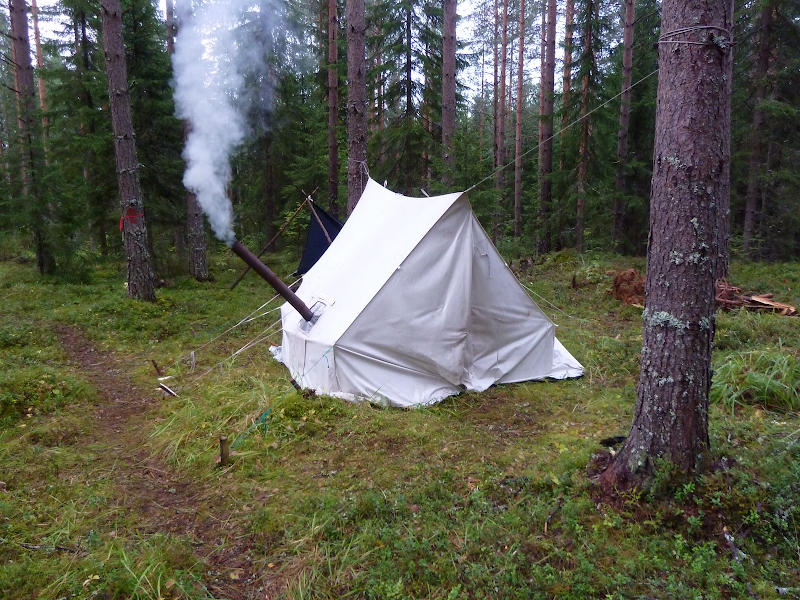

The Trapper tent sans oven I slept in for three nights.

Week two was the forest week. We packed our gear Monday morning and were off to the school forest, an over 1000 ha playground, where we pitched our shelters and got comfy. We learned to make fire, chop wood in a safe way, did orienteering with map and compass, went fishing, learned about ultra heavy gear and the flora & fauna around us. It was a busy but fun week.

I took my Hennessy Hyperlight hammock along and pitched it the first day, but due to a good breeze and me not having the SuperShelter insulation or an under quilt with me, I retired to the Loue shelter (imagine a tipi kind of shelter, but cut in half) I helped pitch during the day. The rest of the nights I went to sleep in a Trapper tent, including a tent oven - which was awesome. Now I am seriously looking at titanium ovens for winter camping, and a suitable tent.

For orienteering the teacher said my tiny Suunto compass was not enough and that we need a baseplate compass. Fact of the matter was, that on the second group orienteering exercise and the solo exercise I didn't even touch my compass, orienteering by the features of the landscape, the map and some common sense. I believe that a compass, while useful, should be used only if you're lost or can't use common sense or the landscape to navigate.
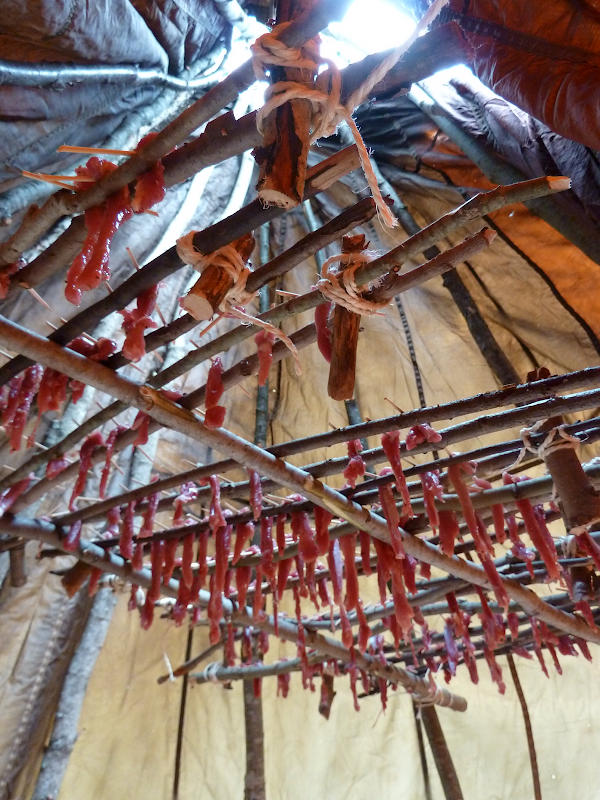

Lamb jerky, dried over the fire.

Week three was great fun. Monday morning started with skinning and butchering two lambs, and then preparing them in different ways - fried heart, kidneys and liver, lamb stew, lamb jerky, lamb on a spit - you name it. Delicious as well. We also made fish, bread from pine bark and normal breads, cheese, and sphagnum moss eggs. Our teacher was truly awesome, a well of knowledge & wisdom with a great sense of humour.


Happy vegetarian - who eats meat he butchered himself! Photo courtesy of Ed Russell.

Week four was the BCU canoe & kayak week. After our spring canoe expedition we will get our BCU two (or three) stars awards, this was the introduction week. If you're into paddling, this week alone will make IWG worth your while.
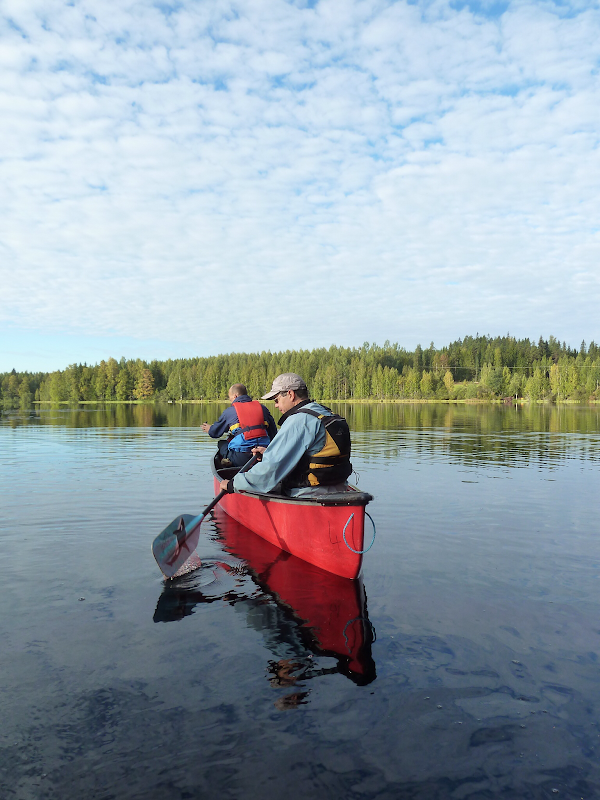

Our BCU teacher showing us the tricks of the trade.

Our teacher was a former student of the course, class of '98 if I remember correctly. Really good teacher who knows his trade with the eyes closed, and also a great personality. Regarding paddling, canoeing is great if you have a good partner, if your partner ain't the same level then I rather paddle alone in a kayak, which is sweet as you can go significantly faster and are independent. That said, a good canoe, a good partner and I choose the canoe over the kayak.

I also had my packraft out on the lake, and both my teachers tried them out; they found it interesting but very different from canoe & kayak, but could see the use. The BCU instructor asked me to take it along on the spring expedition, so it will be interesting to paddle next to the others in my Alpaca.

All the time we are now preparing for our trip to Russia next week Monday. It starts to frustrate me slightly that lightweight and UL gear is still looked at with a raised brow, as I am being used to backpack and communicate with like-minded folks; this is quite a change. Shoes, rubber boots to be precise, and my unwillingness to buy and use a pair, seem to be the biggest concern of some classmates and teachers. And being surrounded by the UH folks all the time makes me question some stuff, like if it really is a good idea to walk with my VFFs or Inov-8s through bogs. But then I remember that I did walk with trailrunners through bogs in Sweden, and am confident again that I will be fine - as I said previously, wet feet should be expected and cherished instead of feared (because fear leads to the dark side; fear leads to rubber boots; rubber boots lead to suffering).
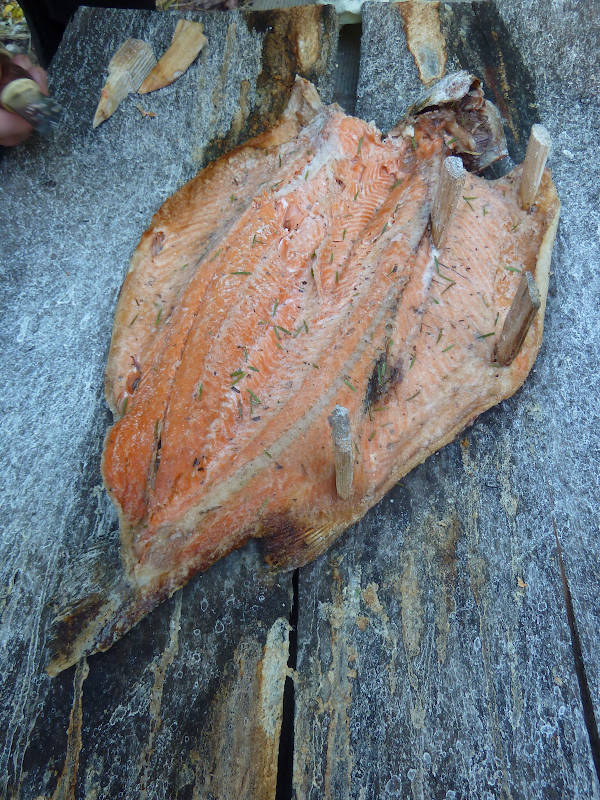

Blazed salmon. Delicious!

That said, I knew that it will be like this, and I keep the UL flag raised high and am confident that I will be able to have a sub five kilogram baseweight for the trip to Russia. Possibly after the trip I might hold a short lecture about lightweight and UL backpacking for the class, at least my teacher asked if I could. I reckon they first want to see if I am able to cope with my gear in Russia, before I "brainwash" the other students =)

Weeks five and six then next week, when we will depart for our two week expedition to Russia. I imagine that there might be quite some interest in my gear for that trip, and as it will be quite a mix of UL and traditional gear (we need to carry an axe and saw) I think it will be interesting to post it and see what my dear readers think about it!

31 Questions, comments, observations:

  1. Ti Goat Vertex tent with a stove would be amazing in winter. You get to have real cold winters and enjoy the snow Hendrik. Be the hight of luxury to have a stove in a tent.

    ReplyDelete
  2. "(because fear leads to the dark side; fear leads to rubber boots; rubber boots lead to suffering)."

    Great stuff Hendrik. Keep waving that flag!

    ReplyDelete
  3. Looks very yummy. How's your reading list? ;-)

    ReplyDelete
  4. The juxtaposition of raw lamb and the Arc'Teryx shirt is great! Keep up the good work of spreading the UL philosophy and avoiding the suffering that is the dark side.

    ReplyDelete
  5. I find it interesting to read about your ultra-lightweight vs heavyweight choices. I can understand this as I'm in the middle between both camps.

    Since starting to read various UL-hikers' blogs I've found out about all the UL stuff and 'oohed and ahhed' at shiny new stuff. I would like to reduce my overall carry weight, but can not justify spending a lot of money to replace perfectly usable hiking and camping gear. However, when I need new stuff, weight is one factor I take into consideration.

    In the last year I've also started reading bushcraft forums and blogs and am amazed at some of the really heavy stuff the 'serious' bushcrafters carry. Heavy rucksacks are the norm - like my partner's old KS100e Karrimror Jaguar (he still uses this!); a selection of knives, axes and/or saws;and cast iron Dutch ovens and cooking tripods (although they don't carry the cast iron any distance!)

    I'm taking on board advice and skills from both camps and tailoring it for different situations. For example, I love having an open fire or cooking on my hobo wood burning stove, but take my MSR Multifuel stove when backpacking in the mountains. For day trips into the woods, I'll carry my tarp, Laplander folding saw and a knife or two, and spend time simply enjoying the woods, but when I venture onto the hill, I'll take stuff to enable me to move quickly.

    ReplyDelete
  6. With your talk about canvas tents and ovens I was starting to worry that you had been coaxed by the dark side, so I'm glad to see you are still leading the rebellion!!

    It's a bit scary that they are so into ultra-heavy. The rubber boots always astound me. It's good you are there to fight the UL fight (and do all the groundwork for future prospective students ;-) )

    I am intrigued by sphagnum moss eggs though...

    And I see you are wearing the Suunto Core - what do you think?

    ReplyDelete
  7. Lightening up...Sep 21, 2010 12:06 AM

    "Because fear leads to the dark side; fear leads to rubber boots; rubber boots lead to suffering"

    Amen to that! =)

    Otherwise the school sounds great! Keep up the good work - and the UL flag high!

    And btw a "real compass" is quite nice for bad weather (heavy snow or mist) and for night orianteering. Do you do night time orienteering in the school?

    ReplyDelete
  8. Henrik,

    Don’t knock the rubber boots!

    I have used running shoes for backpacking since 1984 so I know all the advantages and still use running shoes for my hillwalking and backpacking.

    However I have used rubber boots day after day after day ie months in a wet environment. It is one matter using running shoes for a weekend or a couple of weeks it is another matter working in a wet environment where constant immersion would most definitely give me and many other folk fungi foot problems despite use of anti-fungal talcs etc.

    When not using running shoes I use Le Chameau “All Tracks “ they have excellent traction, whether peat bog, heather moorland or snow - maybe on par to my Inov-8 Mudclaws but much much better than my Inov-8 Terrocs.

    There are rubber boots and then again there are other types of rubber boots!!
    Interesting as usual Hendrik and enjoy Russia.

    Rob fae /Craigellachie

    ReplyDelete
  9. Great to hear about your school days, Hendrik. Keep em coming!
    Using light shoes and getting your feet wet is as everybody using 'the Force' knows, no problem as long as you keep generating body heat enough to counter it. That is when you are on the move. Sometimes moving and sometimes standing still and not knowing when one or the other will start or end makes it more tricky to stay warm with wet feet. Like the comment about working outside in wet situations says.
    What I usually do is bring a pair of really warm socks, prefereably pile or fleece, that I immediately put on underneath a pair of waterproof socks when not being able to stay warm by moving or working hard enough. Like during lectures and maybe when setting up and breaking camp in a group of many people when it is difficult to know how long you will stay passive.
    Good luck with your demonstrations of the lightweight techniques. I am sure that is the only way to convince people that are experienced outdoors people that know little of UL. In my experience they are the people most likely to say "It won't work" without having tried it themselves.
    I used to be like that myself :-)

    ReplyDelete
  10. Hendrik, what place in Russia is the team planning to go? (can't sit quiet without throwing own valuable advices left and right :-))) )

    To the rubber boots issue. Most "hikable" parts of RU are quite a wetland. Much more than anywhere else in Europe and US I have been to. That may explain why "everybody wears them". OTOH, I myself also prefer more, let's say, sportive option; e.g. we did a *real wetland* 20-day trip over Polar Ural and all trips in Kolsky Peninsula in hiking boots. (They were *always* wet; in area like there, no Gore-Tex would help.) With such attitude and without rocky mountains (which you do not find in Russia almost anywhere except quite far to the East), trekking boots should be OK, *unless it is also cold*.

    Thanks BTW for sharing the school experience!

    ReplyDelete
  11. Actions usually speak louder than words. I find that suggesting alternatives to certain ways of thinking don't go too far. It is only when you demonstrate the power of your ideas (Sharing packs while hiking as an example.) that you really get their attention.

    You seem to be doing just fine. Continue to enjoy what your doing and share the knowledge you have. People will come around.

    ReplyDelete
  12. Keep up the good work! As already said, action speaks louder than words... let them see that your gear works as well or better and then they may be converted.

    Spread the joy!

    ReplyDelete
  13. Martin, the Vertex + TiStove would be the ultimate luxury, indeed! It is what I am looking at, but also some lightweoght canvas tents exist, which might even be better (thinking about sparks).

    Thanks Eugene & Lappland Times!

    Lol, Sam! I shall establish the UL beachhead here, so that other can land easily and help me conquer the dark side!

    Swanscot, suiting the different ideas to your own needs is the right move. I read quite a few bushcraft books from the original bushcraft & outdoor folks, and those were the UL backpackers of long ago, travelling very light into the woods. "Serious" bushcrafters which carry 100l packs, Nessmuk would teach them!

    Mark, the Suunto Core is nice. I mainly use it as a clock, though, need to get more familiar with the other options before going to Russia. sphagnum moss eggs are nice, but a good set of hot coals is crucial. By the time other UL students come here, I hope to have established a good foundation!

    Lightening up, we do night time orienteering tomorrow night! I should have a baseplate compass for that, and surely they have their place!

    Rob, sure there are different kinds of rubber boots, a classmate even has some fairly lightweight ones. I still don't think I will need them, the environment we walk in is fjells and forest, and the occasional bog. Should be fine for the nine days we are there, and as we have short days there's plenty of time to dry the feet by the fire! Still, would be very interesting to meet you sometime and go for a walk together - when are you coming the next time to Suomi?

    Jorgen, true - most likely they only start to "believe" once they see me happy and in the best of moods. The warm sock comment is good, might check if I can find a pair till Sunday.

    Konstantin, we go to Paanajarvi National Park, or better said, North east of it. Have you been there and can give some hints on the area? From the map it looks like fjells, old growth forests, some bogs, and with max daily distances of nine km it isn't a lot of hiking! Would be cool if you can tell me more about it, if you've been there!

    Harttj, smart words as usual fromyou - thanks! Just made a short test hike with the gear & food for the trip, about 14kg incl. 2l of water. Was fine, also in the old growth forest. Lets see how they do with their 20kg behemonths!

    Treklightly - thanks for the encouragement! I'm sure a few come around to the light side after carrying their huge backpacks through the area!

    ReplyDelete
  14. Looks like a great course Hendrik although I would have to miss out on the slaughtering part myself. A good wilderness beard you are cultivating there! Come to the UK where you will learn the value of a good compass when the mists roll in!!

    ReplyDelete
  15. Very interesting to read about your experiences, Hendrik. Looking forward to the post-russia report! Take care

    ReplyDelete
  16. Hey Hendrik, I think we've discussed before the fact that at the heart of bushcraft is the "know more, carry less" philosophy. I think I know why many bushcrafters have forgotten this - certainly in the UK at any rate. Here there are so few places that bushcraft can be practised that many bushcrafters just head somewhere and set up camp. That means they can carry in loads of kit. I like what you are doing here - learning about bushcraft and seeing how the knowledge can be applied to make lighthiking better.

    I'll be interested to read how you get on in Russia!

    http://wandering-photographer.blogspot.com/2010/09/ultra-light-bushcrafting.html

    ReplyDelete
  17. I'm very jealous when I read this and confirm once again that I have chosen the wrong job.

    Have fun in Russia!

    ReplyDelete
  18. Just a quick comment about BCU (two and three star) certificates...
    These are something that has started to appear in our paddling clubs (at least in Helsinki region) within last couple years. There have been at least couple weekend courses, where experienced paddlers have had opportunity to go through the tests and get certificates (if they are able to pass all tests).
    What comes to kayak vs. canoe, I guess in lakes and rivers, it is mostly question about what you want to do. Canoe offers more carrying capacity and more freedom to do all kind of stuff, while your floating. I would say that kayak is better, if you need speed or you are facing "big" waves. At least those are the two reasons, why I always pick kayak for paddling trips in Baltic Sea.

    ReplyDelete
  19. This comment has been removed by the author.

    ReplyDelete
  20. (Oops... I just posted with the wrong Google account. Try again:)

    Let's not forget that weight is only an issue as long as you move a lot, typically every day.

    If you don't MOVE through nature, but LIVE in nature, you can use heavier gear. And sometimes you need it. As Jörgen says: if you're standing still you want dry and warm feet. And if you build stuff, dig stuff, and chop stuff up you might want sturdier clothing too.

    So to me there is not an opposition between lightweight and heavyweight in all cases. It depends on what you do out there.

    Having said that: keep waving the flag and try the boundaries of lightweight gear. They are further away than many people realise :)

    ReplyDelete
  21. I find myself tremendously jealous. Course, with that rockin' beard you could probably just skip the course and everyone would believe you had the experience based on that alone.

    ReplyDelete
  22. Lightening up...Sep 22, 2010 01:22 PM

    To Juha Ylitalo (and anyone other who would know):
    - How does the BCU star rating compare to the Finnis paddling instructor / paddling quide (melontaohjaaja / melontaopas) qualification?
    - Do Americans have similar degrees in water vessel quiding? And how do they compare?

    And about rubber boots: The Nokia Finntrim is quite nice though it is quite low. It is made for orianteering, is reasonably light (to be a rubber boot!), really well fitting, has agressive sole and can be equipped with steel studs. =)

    ReplyDelete
  23. Your skool is a lot cooler than my skool!

    ReplyDelete
  24. man,you look like a proper trapper or any finnish woodsman,with that chunk of meat in the other and the puukko in the other hand.

    Did u get my regardas from TA ?
    hilarious old gent,aint he.

    ReplyDelete
  25. Hendrik - about Paanajärvi: I have not been there; that area should be very, very similar to areas in Finland at the same latitude (as it is the same geographical area). Maybe not as wet/boggy as surroundings. You certainly can find some materials on it in English, but here is one from the other side of the border: http://heninen.net/paanajarvi/luonnonpuisto_e.htm

    The only difference from the Finnish side is absence of services. Which may be a nice thing in the end.

    ReplyDelete
  26. Based on information available at http://www.bcu.org.uk/tests-and-awards/personal-performance-awards/paddlesport-start-i-1-to-3-star/ it would seem that BCU two and three star certificates/diplomas is proof about your ability to paddle in various kind of situations, but it doesn't seem to give any indication about what is your ability to teach paddling or to act as guide to others.
    BCU four and five stars means that your qualified to work as leader/guide for the group of paddlers.
    Then they have completely separate set of levels for coaches.

    If you check descriptions on those pages, it would seem that definitions on what goes into which category (three, four, etc. stars) seems to change along the years ...

    ReplyDelete
  27. Lightening up...Sep 27, 2010 10:14 AM

    Thank you Juha! I took a look on the BCU site and it seems that the systems don't quite compare. The Finnish guide seems to compare somewhat to the BCU 4 star guide and the instructor maybe to the BCU 5 star guide but tehre is also the coaching system to mess things up...

    Well, my basic point was to compare the different Finnish wilderness guide programs as the one Hendrik is in grants BCU strats (1, 2 or 3) and some others grant the Finnish guide or instructor qualifications. And some don't grant any paddling degrees or certificates at all.

    ReplyDelete
  28. Hendrik - about Paanajärvi: I have not been there; that area should be very, very similar to areas in Finland at the same latitude (as it is the same geographical area). Maybe not as wet/boggy as surroundings. You certainly can find some materials on it in English, but here is one from the other side of the border: http://heninen.net/paanajarvi/luonnonpuisto_e.htm

    The only difference from the Finnish side is absence of services. Which may be a nice thing in the end.

    ReplyDelete
  29. I find it interesting to read about your ultra-lightweight vs heavyweight choices. I can understand this as I'm in the middle between both camps.

    Since starting to read various UL-hikers' blogs I've found out about all the UL stuff and 'oohed and ahhed' at shiny new stuff. I would like to reduce my overall carry weight, but can not justify spending a lot of money to replace perfectly usable hiking and camping gear. However, when I need new stuff, weight is one factor I take into consideration.

    In the last year I've also started reading bushcraft forums and blogs and am amazed at some of the really heavy stuff the 'serious' bushcrafters carry. Heavy rucksacks are the norm - like my partner's old KS100e Karrimror Jaguar (he still uses this!); a selection of knives, axes and/or saws;and cast iron Dutch ovens and cooking tripods (although they don't carry the cast iron any distance!)

    I'm taking on board advice and skills from both camps and tailoring it for different situations. For example, I love having an open fire or cooking on my hobo wood burning stove, but take my MSR Multifuel stove when backpacking in the mountains. For day trips into the woods, I'll carry my tarp, Laplander folding saw and a knife or two, and spend time simply enjoying the woods, but when I venture onto the hill, I'll take stuff to enable me to move quickly.

    ReplyDelete
  30. Based on information available at http://www.bcu.org.uk/tests-and-awards/personal-performance-awards/paddlesport-start-i-1-to-3-star/ it would seem that BCU two and three star certificates/diplomas is proof about your ability to paddle in various kind of situations, but it doesn't seem to give any indication about what is your ability to teach paddling or to act as guide to others.
    BCU four and five stars means that your qualified to work as leader/guide for the group of paddlers.
    Then they have completely separate set of levels for coaches.

    If you check descriptions on those pages, it would seem that definitions on what goes into which category (three, four, etc. stars) seems to change along the years ...

    ReplyDelete
  31. Looks very yummy. How's your reading list? ;-)

    ReplyDelete