I write the whole nine day trip in one go, so grab a cup of coffee or tea and a cookie!
---
This trip was very different from trips I normally undertake. First off, it was a school expedition within the boundaries of me becoming a wilderness guide, the first of four trips we do with school. It was interesting also to spend pretty much 24 hours together with people you don't know super well, and maybe not get along with very well. Privacy is limited to the time you hurry off to the forest toilet and when you're in your sleeping bag; most of the time you were surrounded by the others, or at least were with your food partner. Nevertheless, it was a good experience, the group bonded together and I think I personally now get along well with all of them in varying degrees.
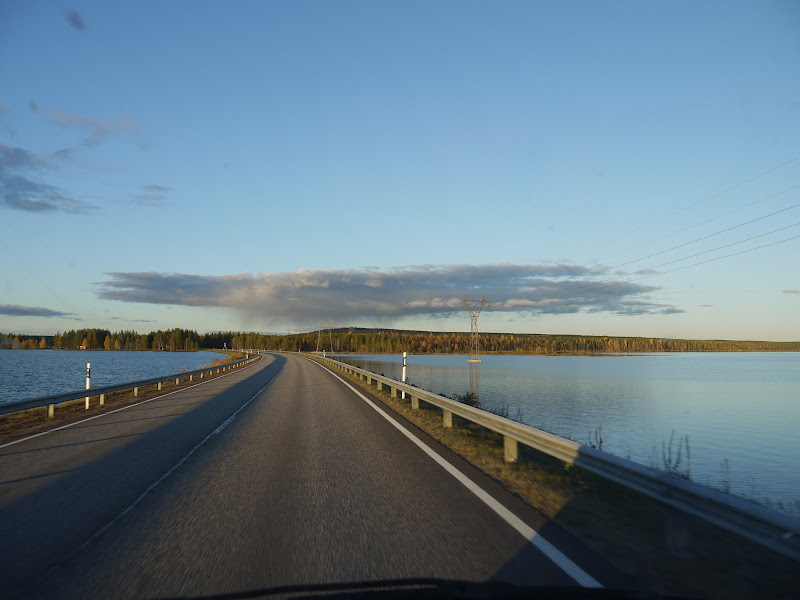
Driving north in Finland.
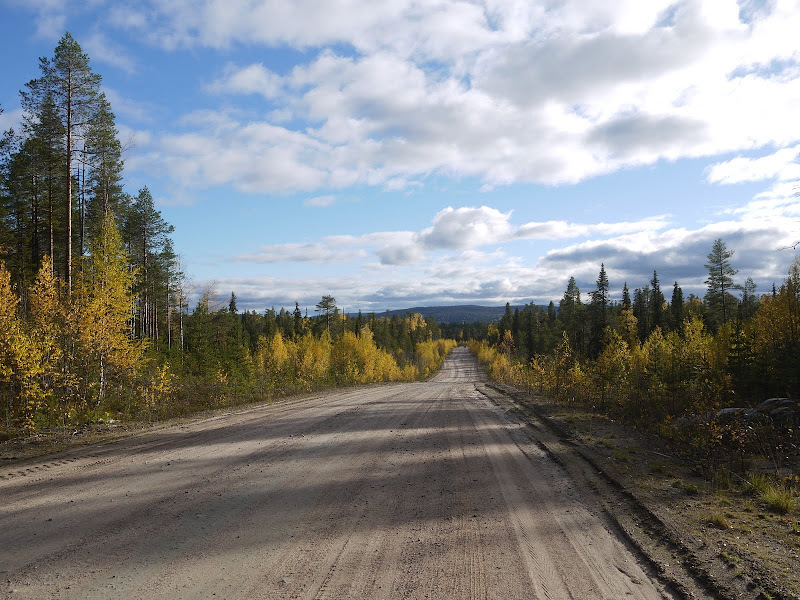
On the road to the National Park in Karelia.
The trip started in Kuru, where we packed up the cars and trailers on Monday morning and then started to drive north to Kuusamo. It was a sunny day and the drive was uneventful, and in the late evening we arrived at the place where we stayed for the night. Tuesday meant getting up early (6 o'clock) to go have breakfast and be early at the border crossing to Russia. It went smooth and without problems on both sides, although the Russian side took a lot longer. Nevertheless, after about two hours we were on the Russian roads to Paajärvi, the small village where the visitor centre of the NP is located and where we needed to collect some documents.
While the Planning Group, who planned the complete expedition, and the teacher took care of the documents, the rest of the group strolled off to the village and took in the local flair. Finland exported their hideous architecture here, grey concrete buildings were lining the streets, but people seemed in a good mood nevertheless and we were welcomed friendly in the shops and café. After a Russian soup lunch the trip to the National Park started, and the quality of the dirt roads decreased the further we travelled.
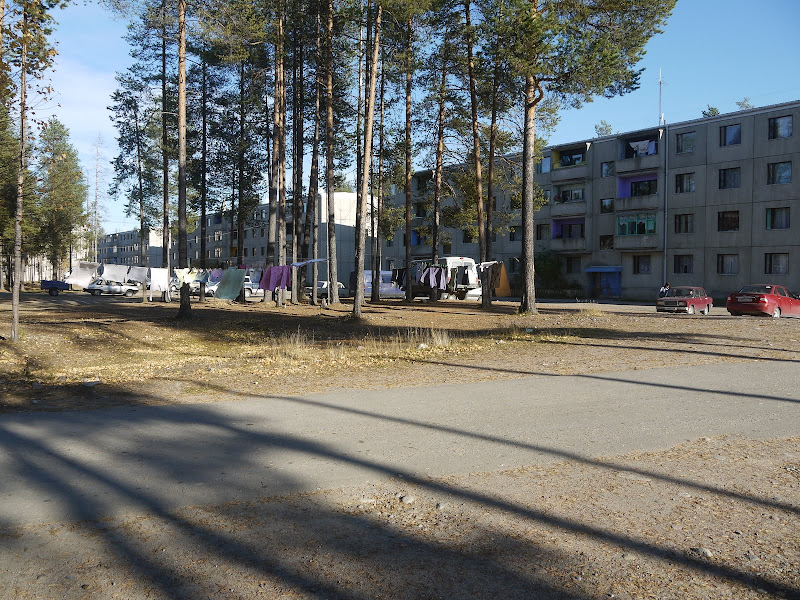
The village Paajärvi, washing day.
The way this expedition would be executed was that the planning group planned a loop of approximately 50 to 55 km, with a food pair being the daily guides and leading the rest of the group on their daily sections, which ranged from four to eight kilometers. The complete trail, except the first few kilometers, would be off trail. My food partner and me would be leading on Day 5, and we decided that he took the morning shift while I took over the afternoon one.
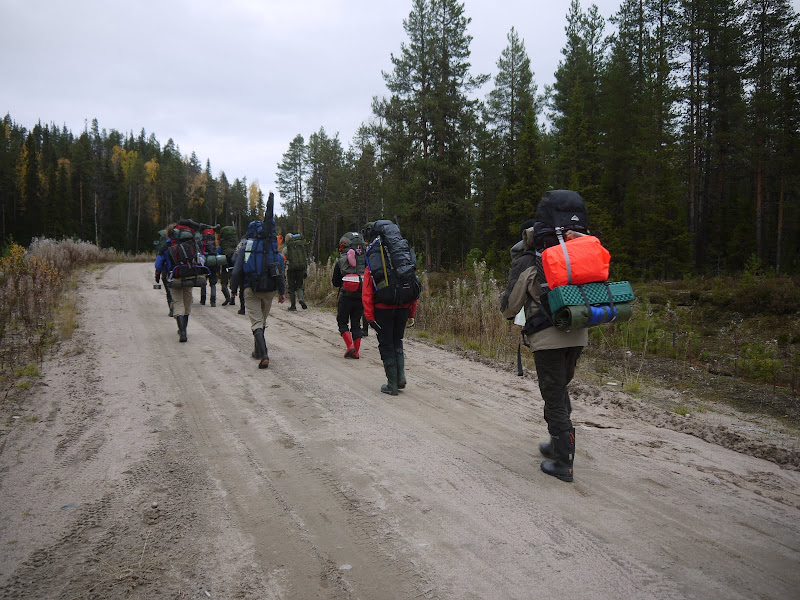
The UH train starts moving - slowly.
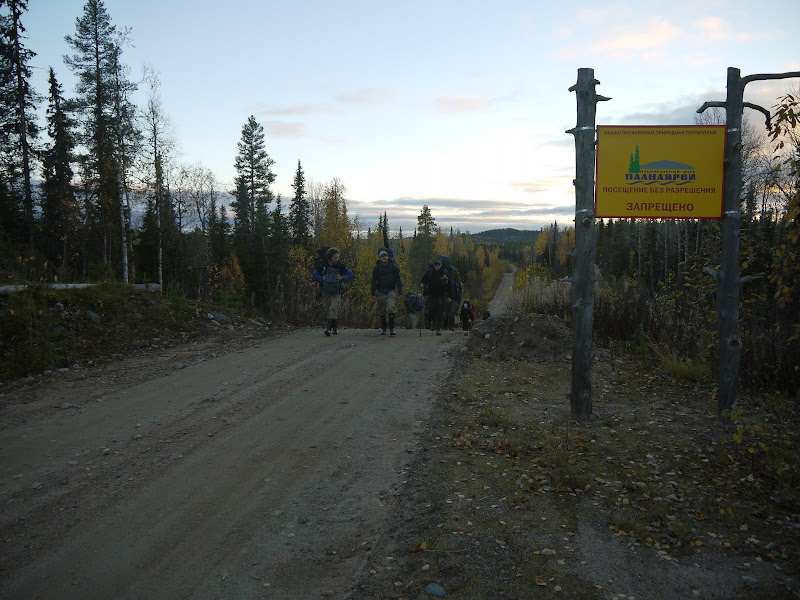
Leaving the National Park behind.
We started well, as the first daily guides forgot to take the Satphones so we had a short break after twenty minutes of walking while some went to pick up the phones. I went ahead with a member of the group who had problems with her 23+ kg backpack, in order to make some good use of the enforced break. We arrived at around 18 o'clock at a good location, and the daily guides designated the common fire place, the toilets and place where to fetch water, and then everyone was allowed to go and search for a camping place.
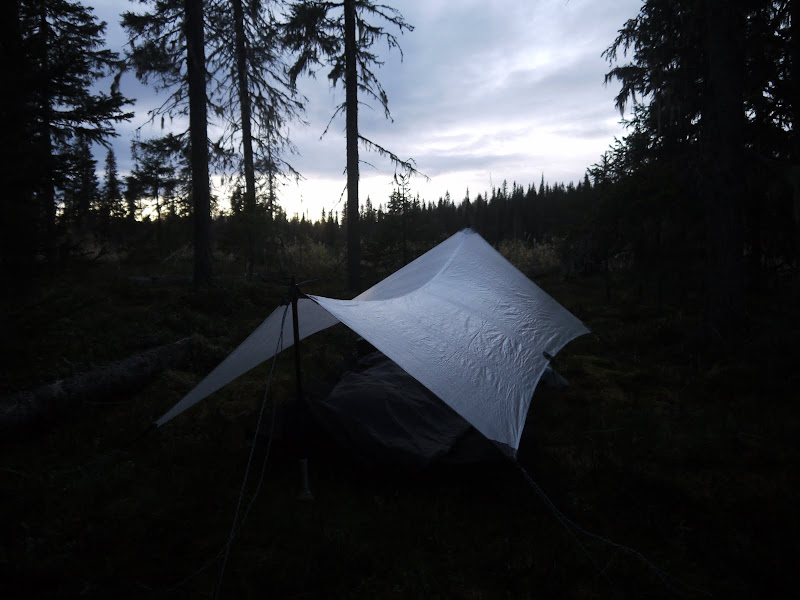
Camp Night 1.
We were supposed to use the school shelters, namely the ET (a 3 x 3 PU tarp) or a Loue (a half round, tipi kinda shelter - see the photos) but I opted for my Hyperlight Mountain Gear Echo I shelter, as I wasn't eager to carry a 800+ g shelter if I had a 112 g cuben tarp. Disadvantage is (from the teacher's/ education POV), that you are not able to make a fire in front of the cube tarp, as cuben burns quite nicely. As I personally don't need a fire in front of my shelter, this was fine for me, but I was asked to consider it for future expeditions. Anyway. The first night there we two small downpours, but as we awoke at six o'clock the sun slowly started to ascend. I made breakfast - Müsli and a cup of Starbucks Via - and packed up, and by 7.30 the 2nd group of Daily Guides welcomed us and told us about the trip ahead.
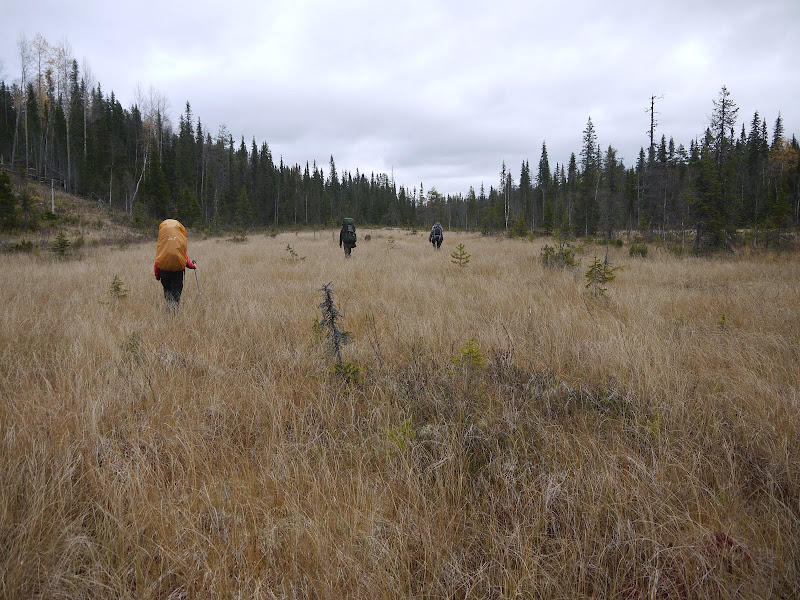
First easy bog crossing.
The first full day had nothing too spectacular landscape wise on the menu, people were trotting along and we had breaks in 30 to 45 minutes intervals, which was very new to me - I usually eat and drink on the go when going alone or with fellow UL backpackers. I also didn't see the logic of stopping just when you had worked up a good rhythm and were warm, but I guess if you carry huge loads that is a different story and you're happy when you can put down the monster on your back.
We crossed a first bog, not difficult, and had lunch. Just as we were finished and started to continue, the first and only shower of the trip came down, for maybe ten to fifteen minutes before it was again sunshine. We walked on, and came through some deforested areas, which was unexpected, but by four o'clock we reached what was too be our camping place for the night, so again we set off to find a camping space after all the stuff was explained.
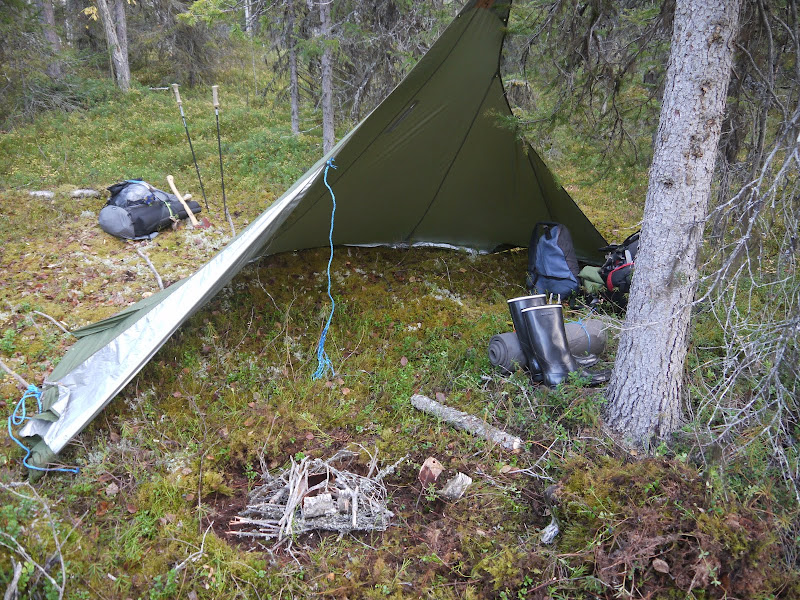
Loue shelter of my food partner.

Loue vs. HMG Echo I.
The evenings were the time of the common fire, where the group gathered around a blazing fire. The Daily Guides then had a chance to self criticize, and then the "clients" had the chance to add to that. After that usually some discussions ensued, which was a nice way to spend the evening - free of TV, music, internet, just human interaction around the fire.
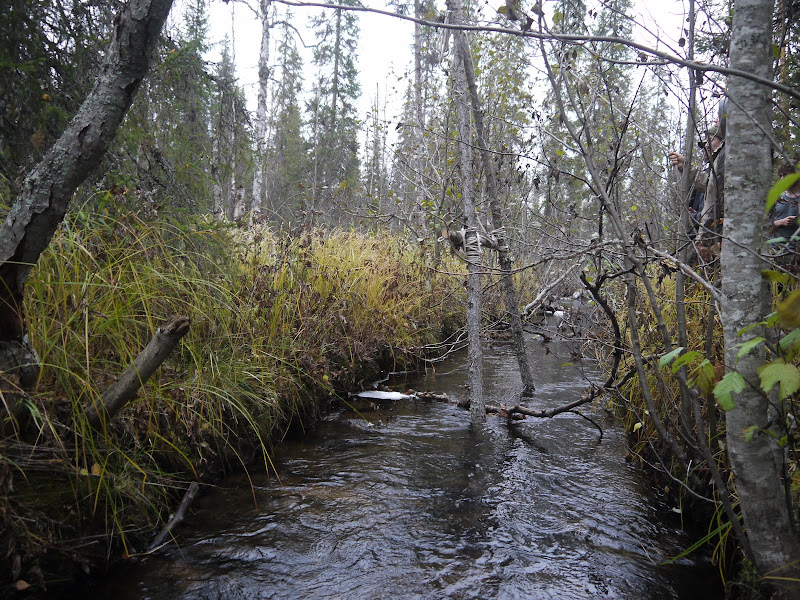
A frame bridge across a stream - education time.
Day two was the super bog day. While the planning group foresaw that we walked around the border of the bogs, our teacher stepped in and we made for the bog - all in the sake of education and showing that one can easily and without problems walk through a bog. This would be a test for me as well, I thought, as I was the only one with trailrunners on the feet. Our Daily Guide was the guinea pig, he needed to find a suitable route and should be the only one to get his feet wet.
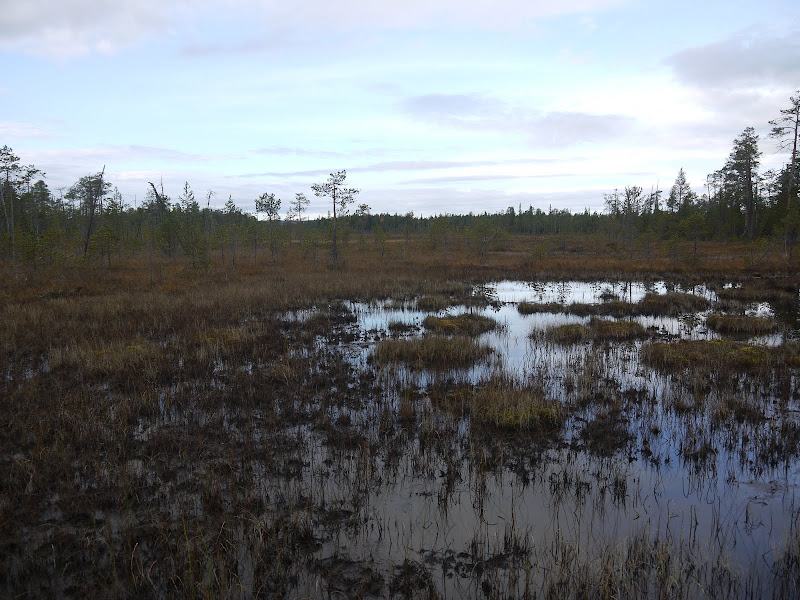
How about some bogs?
I went after the DG, as I felt confident. The Gossamer Gear LT4s which I brought came in handy, as they allowed me to probe the ground in front of me to see if it was solid or soft. The DG made a good job, but at one point made a wrong turn and was stuck with both his rubber boots up to the knee in the mud. I jumped to his aid to grab his backpack and tried to provide some aid to get him out, which, after a while, succeed. Funnily enough, to offer him a solid place to stand, I made a wrong step and was up to my shine in the mud, but I could wriggle myself out just fine. After that it was enough education and we headed for the elevations at the sides, and made the lunch break.
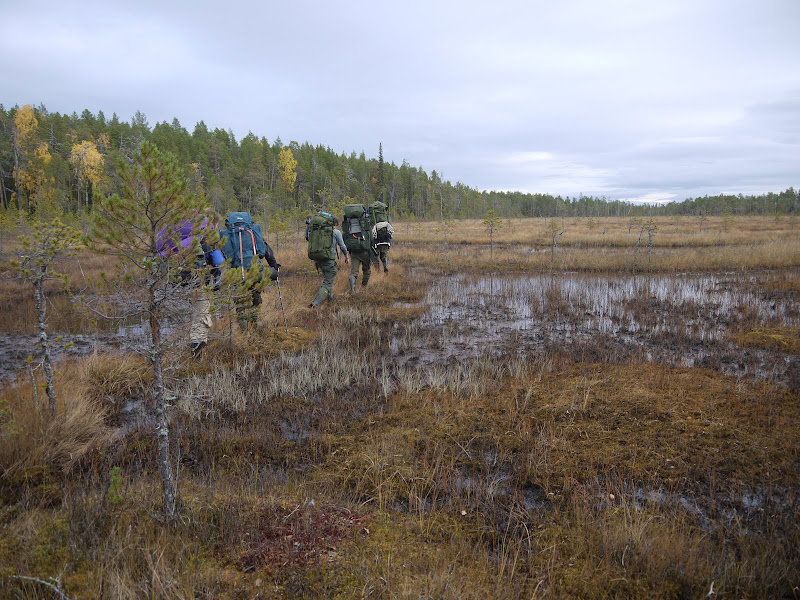
Marching on.

Drying socks, shoes and feet during lunch.

Bogs = Cranberries = Delicious.
Daily Guide number two took over, and lead us along the Levgus river towards campsite number three, where we would stay for two nights - the next day would be a rest day. The trip was slow as the DG had one of the biggest packs, and people became unruly as it was time to find a campsite and we weren't getting there. After a group decision to move to the intended campsite, a good kilometer of where we were, two members of the group took the DG's pack and we made the one kilometer in less than an fifteen minutes. The campsite was great, at the mouth of a river, great view over the lake, plenty of dry driftwood and up on the hill also a nice piece of dry and flat ground for me and my tarp.

View from Campsite three.

Home, Sweet Home.
Friday morning, rest day. I woke up early, saw the sunrise but decided to not bother with going down to the lake and continue sleeping. I woke up later, had a breakfast down by the lake and was thinking "What the heck is that noise? It sounds like a boat." and sure enough, a few minutes later two Russian fishermen arrived in their little motorboat, as surprised to see us as we were to see them. Our Russian classmate had a short chat with them, before they proceeded to lay out their net. As tomorrow would be our guiding day, and my food partner was not too confident about orienteering, a classmate and me went scouting with him the direction we should take tomorrow. The mission was a success, we found the route and he seemed more confident.
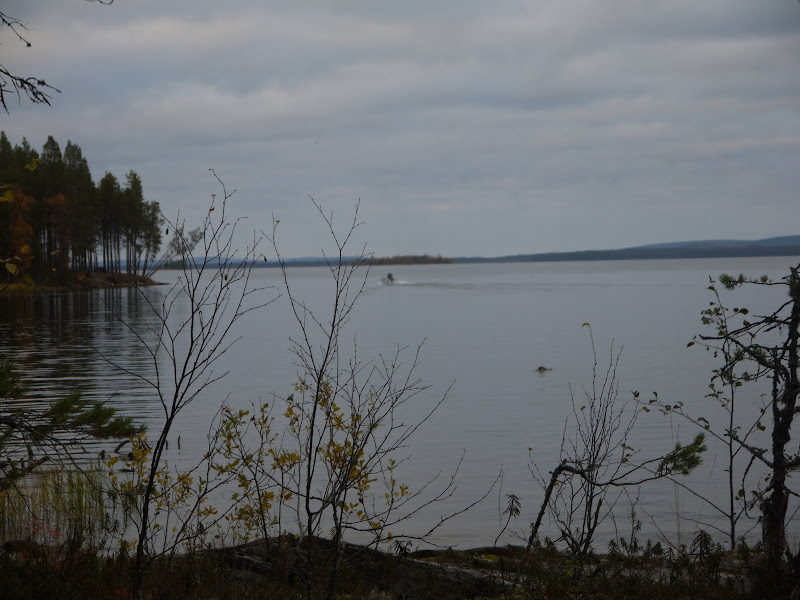
Fishermen taking off.

Nam nam.
In the evening the plan was to build a steam hut, but because the initiator wasn't able to motivate enough people the project didn't succeed. Instead we were sitting around the common fire, drinking hot chocolate with marshmallows, and talking till it was time to hit the hay.
I slept a bit unrestful that night, likely in anticipation of my responsibility as a Daily Guide the following day. I planned to wake up at 5.30 but didn't hear the Alarm of my Suunto Core, and so I was up at 5.55 and going to wake up my partner and then the "clients". At 7.30 the group was together, and after some warm-up exercises and a group hug we started to walk. However, our walk was only short, because as we hit the bay which lead up to the river, the teacher stepped in and it was education time.
The exercise was to construct a raft to shuttle the packs and people across the bay. To construct the raft, we used two backpacks, two CCF mats and three wooden beams as well as a tarp/ groundsheet. I felt the exercise was fairly pointless, as we were a mere 15 minutes walk away from where we could have simply crossed the river on foot without even getting our feet wet and continue our trip. But this was an educational experience, and the "clients" enjoyed the task so it meant to stay positive (which I had problems with, I admit) and carry on. The raft worked well, and we got everyone safe and dry across the bay, after which we continued to the lunch place.
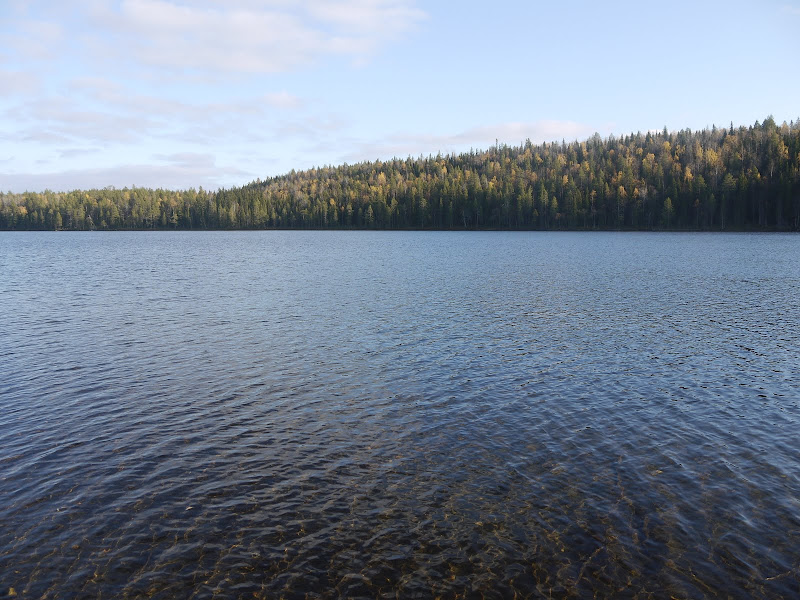
Mountain lake.
After lunch it was my turn to lead, and the route was to ascend Mt. Murtokumvara and descend on the other site to lake Ciprinka. However, one of the clients had severe knee problems, and another clients had back problems, so I needed to look for an easier route. Taking a bearing on a mountain lake, we proceeded. It was a new thing for me to be the leader of such a big group, and needing to cater to so many different needs and wants. However, I was lucky as the sun came out, which helped getting everyone in a good mood and by the time we arrived at the lake people were enjoying the walk.
I kept to the regular breaks, as we were still ascending a fair bit and I didn't want to go to hard on the clients with health problems. But the walk through nice mixed forests was easy, we made good speed, my bearings were spot on and by 16.30 we arrived at lake Ciprinka, we were lounged for a while in the sun before moving a bit further on to the planned camping spot.

Lake Ciprinka with view on Pyainur, the highest elevation in the area.
The requirements for campsites which we got were a) good firewood b) shelter from elements c) enough good pitching spots and d) a view. The camping spot I picked scored high on b), c) and d) though there were some remarks on a) as there was predominately pine around, which sparks a lot. Nevertheless, the clients were happy campers and feedback for me was largely positive at the common fire in the evening, though I was reminded that it was a educational expedition and that thus my frustration with the raft building exercise was not good.
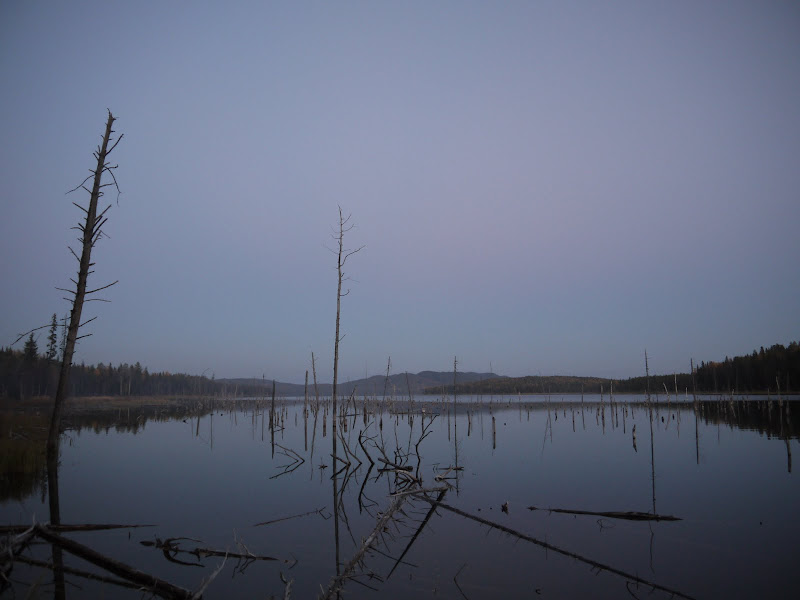
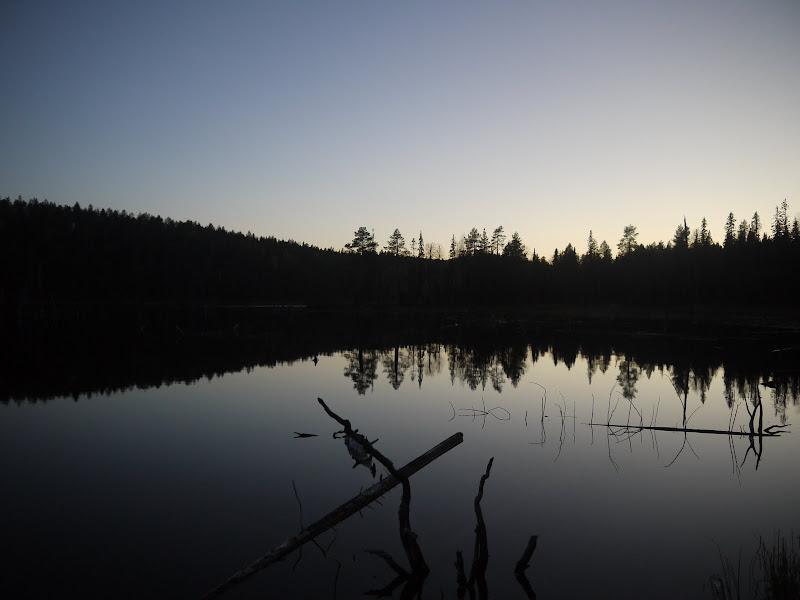
View from campsite four.
I sat around for a long while around the common fire, long after everyone else had gone to sleep, and enjoyed looking at the embers, and the stars above me. It felt good to have mastered everything today, arrived where I wanted with a nice walk through beautiful scenery, and everyone was still healthy.
The wake-up call on day five came, and I soon was eating breakfast and enjoyed the lovely autumn view. The lake lay silent in front of me, and I enjoyed my coffee and müsli so much that I was a few minutes late. We had another warm-up session and group hug, and started our stroll towards campsite five.
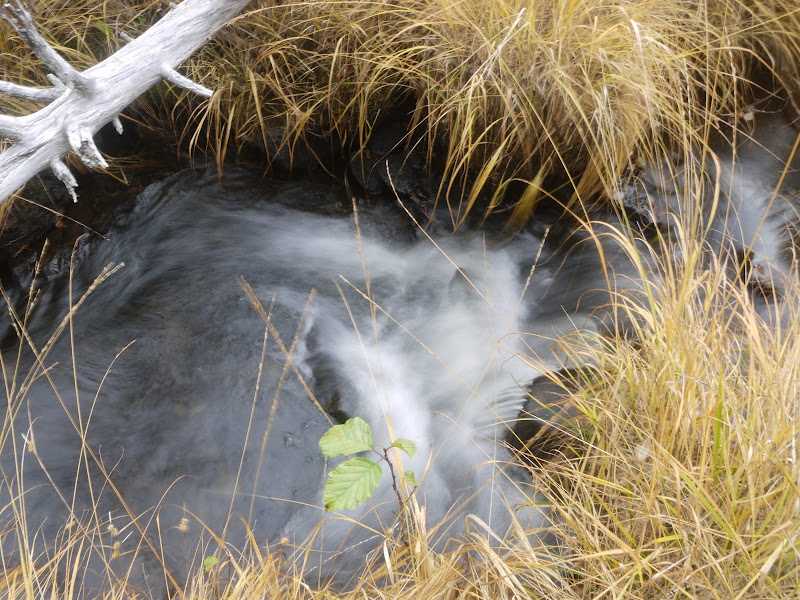
The educational exercise of the day was triangulation, as we came to a spot where we could see the mountain range in front of us. I didn't bother with it and went down the hill to the lake, having a drink of ice cold water and snapped some photos. After a much too long break for my taste we continued, the "trail" went this time over moss-covered boulders which made for interesting walking.
We traversed the boulders without casualties, and started to walk the two or so kilometers till the intended campsite. The going was hard, we were in a very steep area, to the left the lake, to the right the fjell, not many camping places were around. The Daily Guide decided to spread wide to see more of the area and find a suitable spot, and while I and others went ahead to look, we were called back.
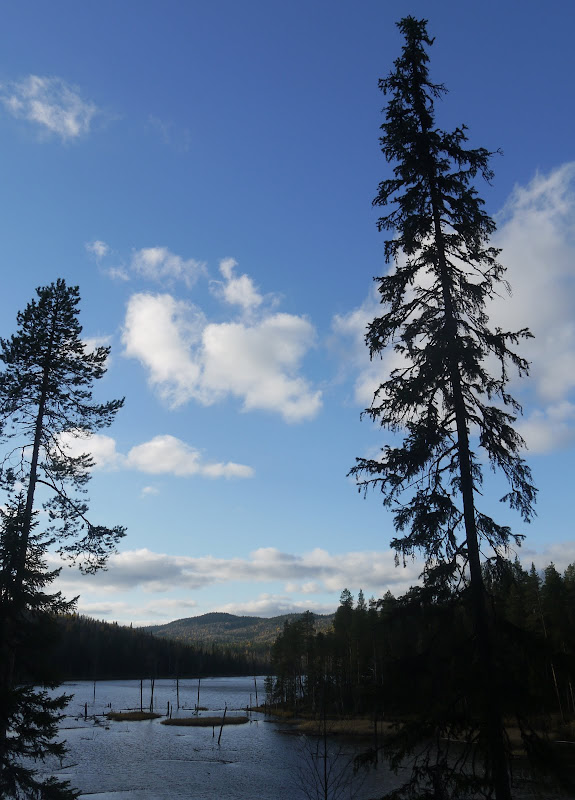
View from camp five.
What was waiting to happen, happened. The "client" with the heavy backpack and knee problems took a wrong step, twisted her calf and was down. Happily one of our classmates is a nurse, who immediately was there and administered first aid. We weren't going anywhere, and camp would be made where we were - searching for a good spot, the groups went off while the patient slowly hobbled to her spot, which her partner was setting up. Cooking dinner, common fire, discussions, hot chocolate, sleeping.
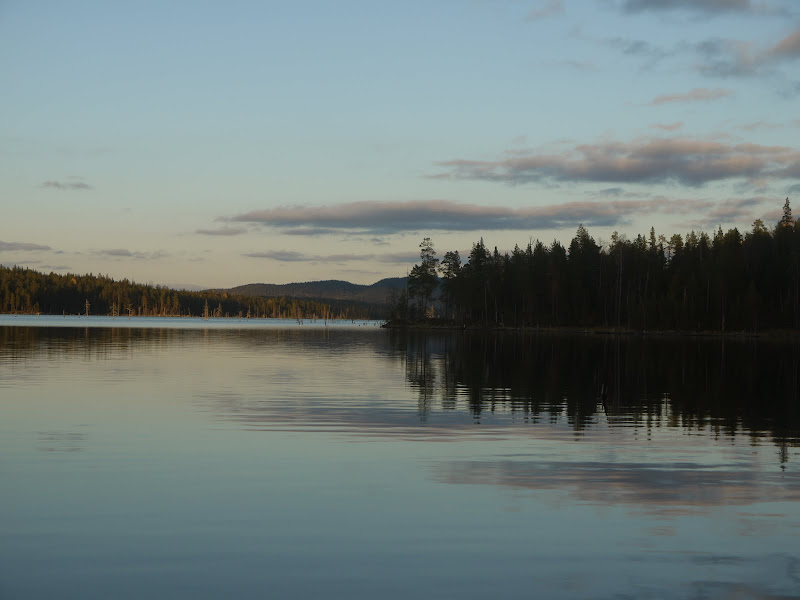
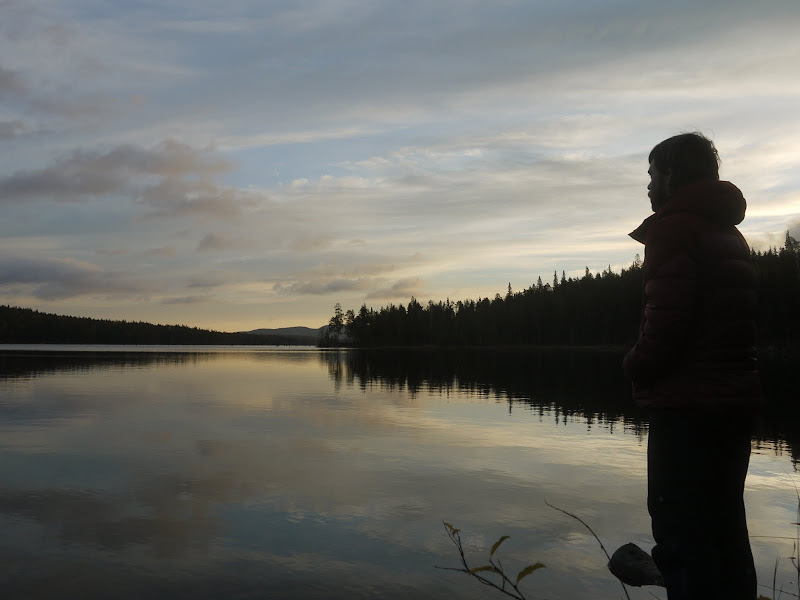
What's the story? Morning Glory.
Monday, rest day. I'm up a tad before 7.30 o'clock, grabbing the camera and descend down to the shore to relish the silence during the sunrise while the others are still sleeping. By the time I am back up at camp, the first ones are getting up, and I join a classmate to boil a cup of water for müsli and coffee. The plan is to go for the top of Pyainur, and by 11 o'clock a group of nine starts ascending. We make the 380m in ascent in a little over two hours, and enjoy the view from the top.

Just beneath the summit.
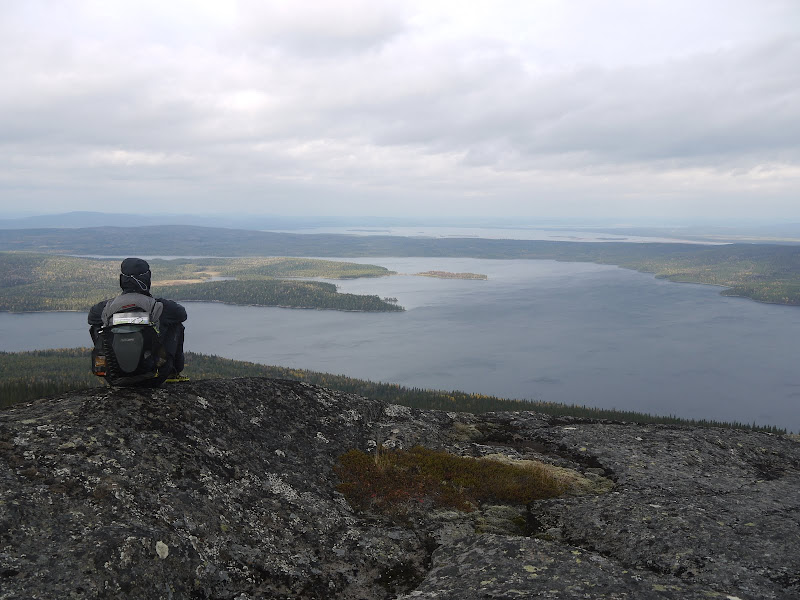
View from the top.
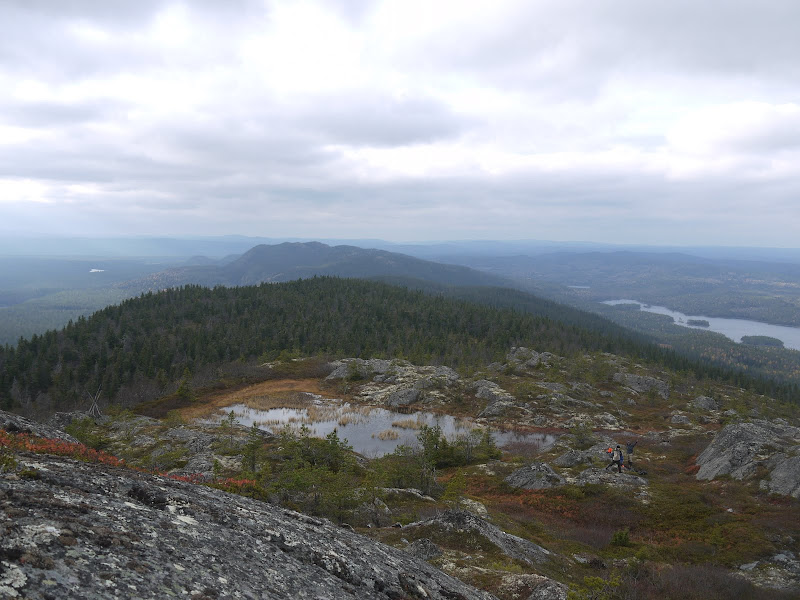
A fine ridge walk.
We take in the view, for me the best part of the whole trip, and after a while move down, out of the strong wind, to a more sheltered location to have lunch. Gas cookers soon are roaring,and luncheons are consumed. I offered my services as the last man as we started up, having an eye out for strugglers and supporting the Daily Guide. We start to walk, and while I wait for our teacher to come he sends me off with the words "I'll catch up with you". As he has been on the way up behind me and didn't get lost, I wasn't worried and started walking; but after a while I don't see him behind me and inform the DG.
Our calls remain unanswered, no surprise with this roaring wind, and after a few minutes of confusion we organize a search line, retracing our steps towards the campsite. We arrive there, but no teacher. The decision is made to commence down to camp, and call in at 16 o'clock to the basecamp and ask if the teacher already has arrived - we guessed he'd just made his way down after he got lost, and that we were treated with another exclusive education experience. The Satphone is a tricky device, and only the fourth try is answered. Yes, he is there, all fine, make your way down. Good, off we go.
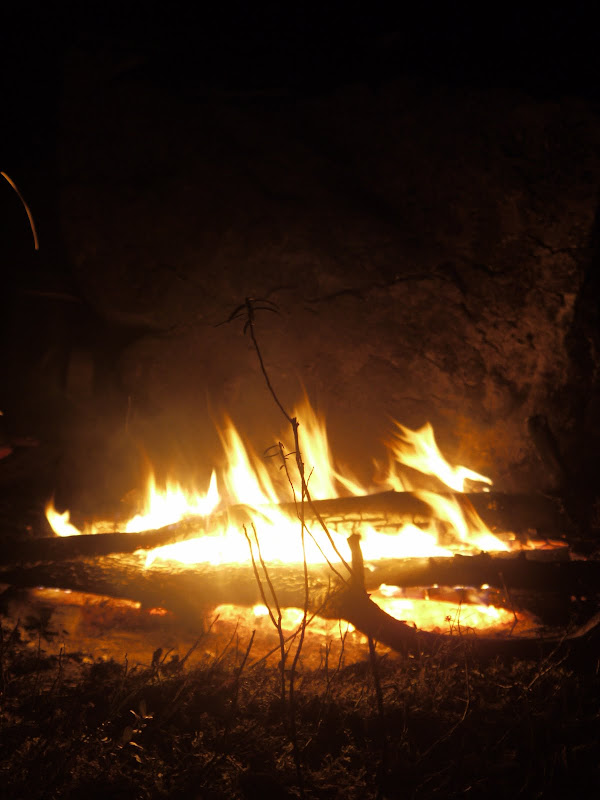
Wilderness TV.
The evening around the campfire brings the news that we'll evacuate to the closest road, and a group of four will go get the cars - the patient won't be able to cover the ten or more kilometers to the cars. Her gear will be split up between the group, and she will only carry her 4 kg (!) Finnish Parachute Troopers backpack. No ridge walk then, as the original plan foresaw.
Wake-up call at six, breakfast, packing, ascending the hill till the lake on the saddle, then continue onwards. A beautiful sunny day, moods are high, the area is gorgeous and the views spectacular. We pass mountain lakes and an abandoned settlement, and by two o'clock we reach our campsite.

Abandoned log house. What is its story?
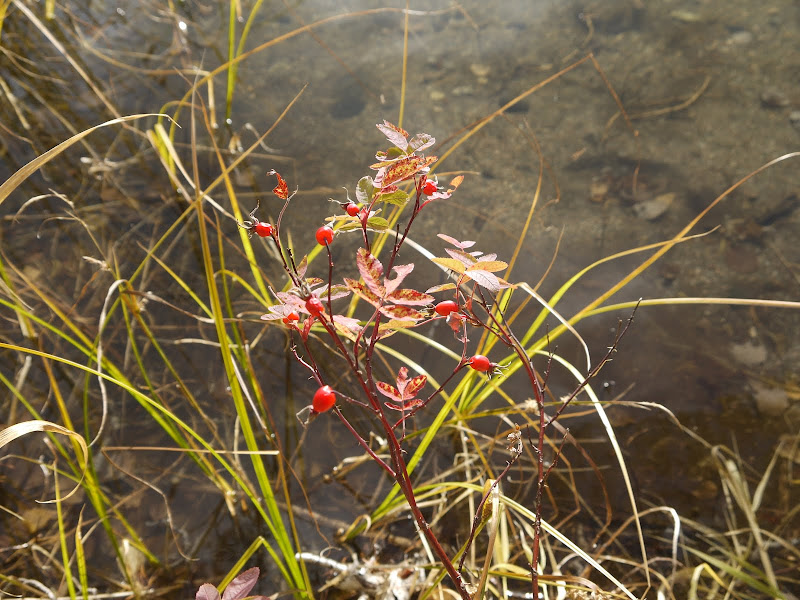
Sun, water, joy.
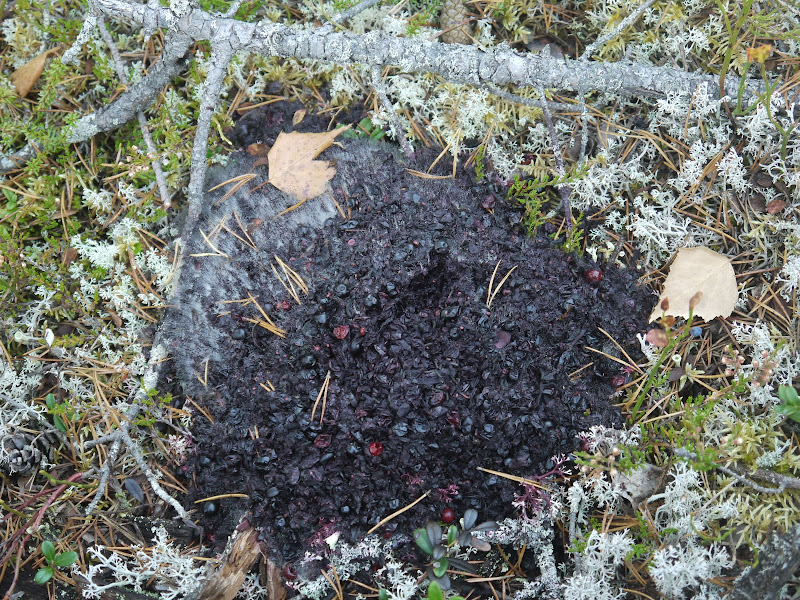
Bear poop.
I pitch high on a ridge, the wind is howling but I want a view. I drop down in the afternoon to have a cup of coffee with my mate, but he needs to make a Satphone call to the group who went to fetch the cars. I drink my cup, have a chat with my room mate and we wait for our friend to come back. After a good 45 minutes I walk to get him, and he lets me know that I should get ready to get the others, they got lost on the way to the cars.
A few calls later - did I mention that Satphones are tricky devices? - we know that they made it to the cars and are now on their way back, but they'd like us to come to the road to pick them up. Dusk is in full swing, and by the time the rescue team starts walking it is dark. We hit the road after a quarter, and a few minutes later we see the headlights of the cars - they made it! We deal out the snacks and jackets we brought, and start to walk back to camp.

The evening community fire is in full swing, as some members imagine to hear a bear. There is plenty of evidence of bears around the campsite - tracks and poop - and so the seed of fear is planted in some, even when the teacher reassures us that it is just the old tree which is creaking in the wind; and that a bear would likely hoof it as soon as he'd smell or see us. It is our last night out in the wild, and with that in mind I wander of to the high ridge on which I have pitched.
I just got comfy in my bivy bag as I hear a "flap, flap, flap". Well, better check that out then. The wind ripped out the peg I drove into the piece of rotten wood, thus out of the bag, re-stake, and back in. The wind goes strong the whole night, and I sleep a bit unrestful, but by the time my alarm goes off I feel fit. The view is magnificent, the stars slowly fading on my right, while I can see the red of dawn on my left - this will be a fine day.
Pyainur at dawn. EPIC.
We have a late start as the sun slowly creeps over the hill, basking our campsite in morning glory while the mist plays on the lake. The short walk to the car goes quick, and soon we pack up the stuff in the car and head back to the parking lot, where we left the trailer. The sun is making us feel warm and happy, though a cold wind is blowing. We sort out the gear, load the trailer and start the ride back to the village, way ahead of schedule.
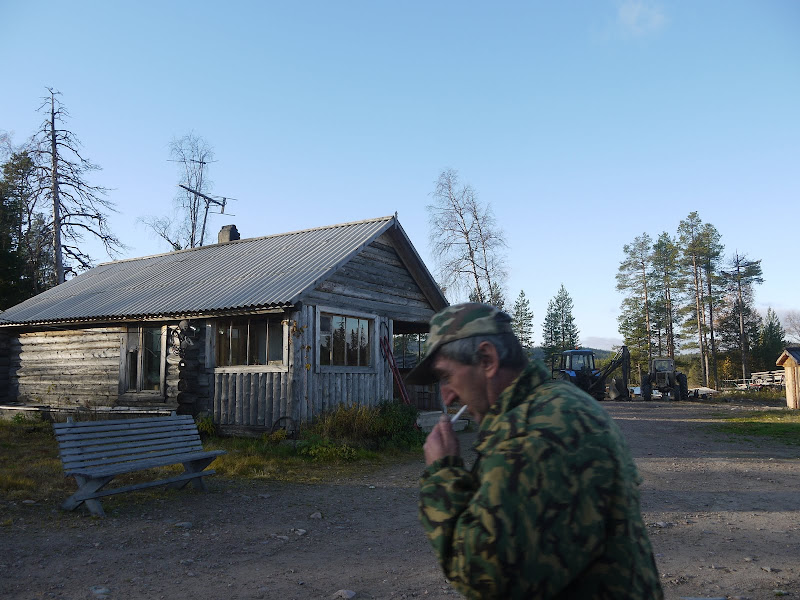
Ranger station at the entry to the National Park.
Half way along the road we are stopped - it is the border zone and you always need to carry your passport and documents. We thought this will be a routine check, but what then ensues is interesting: The visitor centre of the NP forgot to give us an important document, and after an hour of discussing we need to follow the Military Police and the official to the village. Our teacher and our Russian classmate handle the situation very calmly, while the rest of the group hits the shop in Paajärvi and stocks up on Vodka and snacks for the trip. After about five and half hours we are free to continue to Finland, having solved the issue and we only needed to pay a minimum fine - the highest fine would have been deportation to your home country!
We are on the road again, the border crossing goes fine and we arrive just in time in Kuusamo to hit the spa (school pays!) to enjoy sauna, steam bath and hot showers after nine days in the wilderness. After everyone is clean we proceed to the local Pizza place, and after we are fully satisfied we hit the hay. The following day is driving back to the school in Kuru, a boring day of driving a good 800 km, but we also survived that.
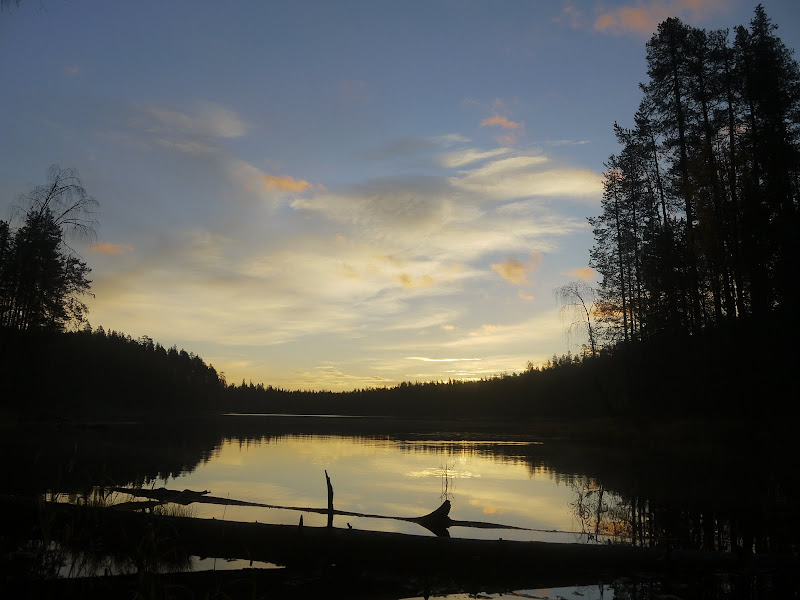
Well, that was Russia, expedition one. It was beautiful landscape-wise, I was not disappointed, though I would have liked to walk some ridges and more kilometers a day, but being in a group it meant going as fast as the slowest member. The group experience was good as well, I learned to think more about others when guiding/ walking and to help out. I reckon some of the others saw that UL and Lightweight backpacking has its benefits, and I was asked to hold a lecture about it in the coming weeks at school =) I'll report on gear (including the gear list) and food during the coming days, and more detailed reviews of a couple of items in the next weeks.
Finally, on the subject of being off grid and not having a phone signal. I wanted to send my girlfriend a message every night to let her know that I am OK, and maybe send the occasional tweet. However, in the complete area - even on top of the fjell Pyainur - I had No Service, thus making it impossible to communicate with the outside world. I honestly can say that I didn't miss anything, it was relaxing to follow the daily routine and not worry about emails, news, work, and so on. I just could be, and that's what the outdoors are for.
---
This trip was very different from trips I normally undertake. First off, it was a school expedition within the boundaries of me becoming a wilderness guide, the first of four trips we do with school. It was interesting also to spend pretty much 24 hours together with people you don't know super well, and maybe not get along with very well. Privacy is limited to the time you hurry off to the forest toilet and when you're in your sleeping bag; most of the time you were surrounded by the others, or at least were with your food partner. Nevertheless, it was a good experience, the group bonded together and I think I personally now get along well with all of them in varying degrees.
Driving north in Finland.
On the road to the National Park in Karelia.
The trip started in Kuru, where we packed up the cars and trailers on Monday morning and then started to drive north to Kuusamo. It was a sunny day and the drive was uneventful, and in the late evening we arrived at the place where we stayed for the night. Tuesday meant getting up early (6 o'clock) to go have breakfast and be early at the border crossing to Russia. It went smooth and without problems on both sides, although the Russian side took a lot longer. Nevertheless, after about two hours we were on the Russian roads to Paajärvi, the small village where the visitor centre of the NP is located and where we needed to collect some documents.
While the Planning Group, who planned the complete expedition, and the teacher took care of the documents, the rest of the group strolled off to the village and took in the local flair. Finland exported their hideous architecture here, grey concrete buildings were lining the streets, but people seemed in a good mood nevertheless and we were welcomed friendly in the shops and café. After a Russian soup lunch the trip to the National Park started, and the quality of the dirt roads decreased the further we travelled.
The village Paajärvi, washing day.
The way this expedition would be executed was that the planning group planned a loop of approximately 50 to 55 km, with a food pair being the daily guides and leading the rest of the group on their daily sections, which ranged from four to eight kilometers. The complete trail, except the first few kilometers, would be off trail. My food partner and me would be leading on Day 5, and we decided that he took the morning shift while I took over the afternoon one.
The UH train starts moving - slowly.
Leaving the National Park behind.
We started well, as the first daily guides forgot to take the Satphones so we had a short break after twenty minutes of walking while some went to pick up the phones. I went ahead with a member of the group who had problems with her 23+ kg backpack, in order to make some good use of the enforced break. We arrived at around 18 o'clock at a good location, and the daily guides designated the common fire place, the toilets and place where to fetch water, and then everyone was allowed to go and search for a camping place.
Camp Night 1.
We were supposed to use the school shelters, namely the ET (a 3 x 3 PU tarp) or a Loue (a half round, tipi kinda shelter - see the photos) but I opted for my Hyperlight Mountain Gear Echo I shelter, as I wasn't eager to carry a 800+ g shelter if I had a 112 g cuben tarp. Disadvantage is (from the teacher's/ education POV), that you are not able to make a fire in front of the cube tarp, as cuben burns quite nicely. As I personally don't need a fire in front of my shelter, this was fine for me, but I was asked to consider it for future expeditions. Anyway. The first night there we two small downpours, but as we awoke at six o'clock the sun slowly started to ascend. I made breakfast - Müsli and a cup of Starbucks Via - and packed up, and by 7.30 the 2nd group of Daily Guides welcomed us and told us about the trip ahead.
First easy bog crossing.
The first full day had nothing too spectacular landscape wise on the menu, people were trotting along and we had breaks in 30 to 45 minutes intervals, which was very new to me - I usually eat and drink on the go when going alone or with fellow UL backpackers. I also didn't see the logic of stopping just when you had worked up a good rhythm and were warm, but I guess if you carry huge loads that is a different story and you're happy when you can put down the monster on your back.
We crossed a first bog, not difficult, and had lunch. Just as we were finished and started to continue, the first and only shower of the trip came down, for maybe ten to fifteen minutes before it was again sunshine. We walked on, and came through some deforested areas, which was unexpected, but by four o'clock we reached what was too be our camping place for the night, so again we set off to find a camping space after all the stuff was explained.
Loue shelter of my food partner.
Loue vs. HMG Echo I.
The evenings were the time of the common fire, where the group gathered around a blazing fire. The Daily Guides then had a chance to self criticize, and then the "clients" had the chance to add to that. After that usually some discussions ensued, which was a nice way to spend the evening - free of TV, music, internet, just human interaction around the fire.
A frame bridge across a stream - education time.
Day two was the super bog day. While the planning group foresaw that we walked around the border of the bogs, our teacher stepped in and we made for the bog - all in the sake of education and showing that one can easily and without problems walk through a bog. This would be a test for me as well, I thought, as I was the only one with trailrunners on the feet. Our Daily Guide was the guinea pig, he needed to find a suitable route and should be the only one to get his feet wet.
How about some bogs?
I went after the DG, as I felt confident. The Gossamer Gear LT4s which I brought came in handy, as they allowed me to probe the ground in front of me to see if it was solid or soft. The DG made a good job, but at one point made a wrong turn and was stuck with both his rubber boots up to the knee in the mud. I jumped to his aid to grab his backpack and tried to provide some aid to get him out, which, after a while, succeed. Funnily enough, to offer him a solid place to stand, I made a wrong step and was up to my shine in the mud, but I could wriggle myself out just fine. After that it was enough education and we headed for the elevations at the sides, and made the lunch break.
Marching on.
Drying socks, shoes and feet during lunch.
Bogs = Cranberries = Delicious.
Daily Guide number two took over, and lead us along the Levgus river towards campsite number three, where we would stay for two nights - the next day would be a rest day. The trip was slow as the DG had one of the biggest packs, and people became unruly as it was time to find a campsite and we weren't getting there. After a group decision to move to the intended campsite, a good kilometer of where we were, two members of the group took the DG's pack and we made the one kilometer in less than an fifteen minutes. The campsite was great, at the mouth of a river, great view over the lake, plenty of dry driftwood and up on the hill also a nice piece of dry and flat ground for me and my tarp.
View from Campsite three.
Home, Sweet Home.
Friday morning, rest day. I woke up early, saw the sunrise but decided to not bother with going down to the lake and continue sleeping. I woke up later, had a breakfast down by the lake and was thinking "What the heck is that noise? It sounds like a boat." and sure enough, a few minutes later two Russian fishermen arrived in their little motorboat, as surprised to see us as we were to see them. Our Russian classmate had a short chat with them, before they proceeded to lay out their net. As tomorrow would be our guiding day, and my food partner was not too confident about orienteering, a classmate and me went scouting with him the direction we should take tomorrow. The mission was a success, we found the route and he seemed more confident.
Fishermen taking off.
Nam nam.
In the evening the plan was to build a steam hut, but because the initiator wasn't able to motivate enough people the project didn't succeed. Instead we were sitting around the common fire, drinking hot chocolate with marshmallows, and talking till it was time to hit the hay.
I slept a bit unrestful that night, likely in anticipation of my responsibility as a Daily Guide the following day. I planned to wake up at 5.30 but didn't hear the Alarm of my Suunto Core, and so I was up at 5.55 and going to wake up my partner and then the "clients". At 7.30 the group was together, and after some warm-up exercises and a group hug we started to walk. However, our walk was only short, because as we hit the bay which lead up to the river, the teacher stepped in and it was education time.
The exercise was to construct a raft to shuttle the packs and people across the bay. To construct the raft, we used two backpacks, two CCF mats and three wooden beams as well as a tarp/ groundsheet. I felt the exercise was fairly pointless, as we were a mere 15 minutes walk away from where we could have simply crossed the river on foot without even getting our feet wet and continue our trip. But this was an educational experience, and the "clients" enjoyed the task so it meant to stay positive (which I had problems with, I admit) and carry on. The raft worked well, and we got everyone safe and dry across the bay, after which we continued to the lunch place.
Mountain lake.
After lunch it was my turn to lead, and the route was to ascend Mt. Murtokumvara and descend on the other site to lake Ciprinka. However, one of the clients had severe knee problems, and another clients had back problems, so I needed to look for an easier route. Taking a bearing on a mountain lake, we proceeded. It was a new thing for me to be the leader of such a big group, and needing to cater to so many different needs and wants. However, I was lucky as the sun came out, which helped getting everyone in a good mood and by the time we arrived at the lake people were enjoying the walk.
I kept to the regular breaks, as we were still ascending a fair bit and I didn't want to go to hard on the clients with health problems. But the walk through nice mixed forests was easy, we made good speed, my bearings were spot on and by 16.30 we arrived at lake Ciprinka, we were lounged for a while in the sun before moving a bit further on to the planned camping spot.
Lake Ciprinka with view on Pyainur, the highest elevation in the area.
The requirements for campsites which we got were a) good firewood b) shelter from elements c) enough good pitching spots and d) a view. The camping spot I picked scored high on b), c) and d) though there were some remarks on a) as there was predominately pine around, which sparks a lot. Nevertheless, the clients were happy campers and feedback for me was largely positive at the common fire in the evening, though I was reminded that it was a educational expedition and that thus my frustration with the raft building exercise was not good.
View from campsite four.
I sat around for a long while around the common fire, long after everyone else had gone to sleep, and enjoyed looking at the embers, and the stars above me. It felt good to have mastered everything today, arrived where I wanted with a nice walk through beautiful scenery, and everyone was still healthy.
The wake-up call on day five came, and I soon was eating breakfast and enjoyed the lovely autumn view. The lake lay silent in front of me, and I enjoyed my coffee and müsli so much that I was a few minutes late. We had another warm-up session and group hug, and started our stroll towards campsite five.
The educational exercise of the day was triangulation, as we came to a spot where we could see the mountain range in front of us. I didn't bother with it and went down the hill to the lake, having a drink of ice cold water and snapped some photos. After a much too long break for my taste we continued, the "trail" went this time over moss-covered boulders which made for interesting walking.
We traversed the boulders without casualties, and started to walk the two or so kilometers till the intended campsite. The going was hard, we were in a very steep area, to the left the lake, to the right the fjell, not many camping places were around. The Daily Guide decided to spread wide to see more of the area and find a suitable spot, and while I and others went ahead to look, we were called back.
View from camp five.
What was waiting to happen, happened. The "client" with the heavy backpack and knee problems took a wrong step, twisted her calf and was down. Happily one of our classmates is a nurse, who immediately was there and administered first aid. We weren't going anywhere, and camp would be made where we were - searching for a good spot, the groups went off while the patient slowly hobbled to her spot, which her partner was setting up. Cooking dinner, common fire, discussions, hot chocolate, sleeping.
What's the story? Morning Glory.
Monday, rest day. I'm up a tad before 7.30 o'clock, grabbing the camera and descend down to the shore to relish the silence during the sunrise while the others are still sleeping. By the time I am back up at camp, the first ones are getting up, and I join a classmate to boil a cup of water for müsli and coffee. The plan is to go for the top of Pyainur, and by 11 o'clock a group of nine starts ascending. We make the 380m in ascent in a little over two hours, and enjoy the view from the top.
Just beneath the summit.
View from the top.
A fine ridge walk.
We take in the view, for me the best part of the whole trip, and after a while move down, out of the strong wind, to a more sheltered location to have lunch. Gas cookers soon are roaring,and luncheons are consumed. I offered my services as the last man as we started up, having an eye out for strugglers and supporting the Daily Guide. We start to walk, and while I wait for our teacher to come he sends me off with the words "I'll catch up with you". As he has been on the way up behind me and didn't get lost, I wasn't worried and started walking; but after a while I don't see him behind me and inform the DG.
Our calls remain unanswered, no surprise with this roaring wind, and after a few minutes of confusion we organize a search line, retracing our steps towards the campsite. We arrive there, but no teacher. The decision is made to commence down to camp, and call in at 16 o'clock to the basecamp and ask if the teacher already has arrived - we guessed he'd just made his way down after he got lost, and that we were treated with another exclusive education experience. The Satphone is a tricky device, and only the fourth try is answered. Yes, he is there, all fine, make your way down. Good, off we go.
Wilderness TV.
The evening around the campfire brings the news that we'll evacuate to the closest road, and a group of four will go get the cars - the patient won't be able to cover the ten or more kilometers to the cars. Her gear will be split up between the group, and she will only carry her 4 kg (!) Finnish Parachute Troopers backpack. No ridge walk then, as the original plan foresaw.
Wake-up call at six, breakfast, packing, ascending the hill till the lake on the saddle, then continue onwards. A beautiful sunny day, moods are high, the area is gorgeous and the views spectacular. We pass mountain lakes and an abandoned settlement, and by two o'clock we reach our campsite.
Abandoned log house. What is its story?
Sun, water, joy.
Bear poop.
I pitch high on a ridge, the wind is howling but I want a view. I drop down in the afternoon to have a cup of coffee with my mate, but he needs to make a Satphone call to the group who went to fetch the cars. I drink my cup, have a chat with my room mate and we wait for our friend to come back. After a good 45 minutes I walk to get him, and he lets me know that I should get ready to get the others, they got lost on the way to the cars.
A few calls later - did I mention that Satphones are tricky devices? - we know that they made it to the cars and are now on their way back, but they'd like us to come to the road to pick them up. Dusk is in full swing, and by the time the rescue team starts walking it is dark. We hit the road after a quarter, and a few minutes later we see the headlights of the cars - they made it! We deal out the snacks and jackets we brought, and start to walk back to camp.
The evening community fire is in full swing, as some members imagine to hear a bear. There is plenty of evidence of bears around the campsite - tracks and poop - and so the seed of fear is planted in some, even when the teacher reassures us that it is just the old tree which is creaking in the wind; and that a bear would likely hoof it as soon as he'd smell or see us. It is our last night out in the wild, and with that in mind I wander of to the high ridge on which I have pitched.
I just got comfy in my bivy bag as I hear a "flap, flap, flap". Well, better check that out then. The wind ripped out the peg I drove into the piece of rotten wood, thus out of the bag, re-stake, and back in. The wind goes strong the whole night, and I sleep a bit unrestful, but by the time my alarm goes off I feel fit. The view is magnificent, the stars slowly fading on my right, while I can see the red of dawn on my left - this will be a fine day.
Pyainur at dawn. EPIC.
We have a late start as the sun slowly creeps over the hill, basking our campsite in morning glory while the mist plays on the lake. The short walk to the car goes quick, and soon we pack up the stuff in the car and head back to the parking lot, where we left the trailer. The sun is making us feel warm and happy, though a cold wind is blowing. We sort out the gear, load the trailer and start the ride back to the village, way ahead of schedule.
Ranger station at the entry to the National Park.
Half way along the road we are stopped - it is the border zone and you always need to carry your passport and documents. We thought this will be a routine check, but what then ensues is interesting: The visitor centre of the NP forgot to give us an important document, and after an hour of discussing we need to follow the Military Police and the official to the village. Our teacher and our Russian classmate handle the situation very calmly, while the rest of the group hits the shop in Paajärvi and stocks up on Vodka and snacks for the trip. After about five and half hours we are free to continue to Finland, having solved the issue and we only needed to pay a minimum fine - the highest fine would have been deportation to your home country!
We are on the road again, the border crossing goes fine and we arrive just in time in Kuusamo to hit the spa (school pays!) to enjoy sauna, steam bath and hot showers after nine days in the wilderness. After everyone is clean we proceed to the local Pizza place, and after we are fully satisfied we hit the hay. The following day is driving back to the school in Kuru, a boring day of driving a good 800 km, but we also survived that.
Well, that was Russia, expedition one. It was beautiful landscape-wise, I was not disappointed, though I would have liked to walk some ridges and more kilometers a day, but being in a group it meant going as fast as the slowest member. The group experience was good as well, I learned to think more about others when guiding/ walking and to help out. I reckon some of the others saw that UL and Lightweight backpacking has its benefits, and I was asked to hold a lecture about it in the coming weeks at school =) I'll report on gear (including the gear list) and food during the coming days, and more detailed reviews of a couple of items in the next weeks.
Finally, on the subject of being off grid and not having a phone signal. I wanted to send my girlfriend a message every night to let her know that I am OK, and maybe send the occasional tweet. However, in the complete area - even on top of the fjell Pyainur - I had No Service, thus making it impossible to communicate with the outside world. I honestly can say that I didn't miss anything, it was relaxing to follow the daily routine and not worry about emails, news, work, and so on. I just could be, and that's what the outdoors are for.