Over the holidays I read a post by Jake “Don´t Panic” Dow on
Going stoveless. He and his girlfriend hiked the PCT without a stove of any sort, quite a task in itself, and doing the whole thing without carrying a stove and food for cooking makes it even more interesting. But is going stoveless really lighter, more convenient and as easy as just leaving your stove at home?
Before we set off on cooking vs. no cooking, I'd like to know from you, my valued readers, how many hot meals and/ or beverages you have per day when you hike:
I myself am in the two to three camp. I have a hot breakfast (my MYOMüsli) and even more important than that, a hot cup of coffee. Yes, I'm addicted to caffeine (I can do and have done without, though I enjoy a good tasting cup of coffee in the morning to start my day), and prefer to enjoy my fine java beans hot. Iced coffee is another story (and only really possible in winter with proper snow unless you carry ice with you, which ain't UL I imagine) but cold coffee is somehow "not my cup of tea". The same goes for cacao - I prefer my chocolate hot! Anyway. That's one warm meal to start my day.
Which brings us to meal number two. Even in the summer I often eat a hot cup of ramen noodles/ MYOG tomato-lentil-soup/ pasta/ whatever. Maybe it is the deep-engrained habit of having a hot meal for lunch. [
Off topic: I remember as I was maybe seven or eight that Mom, Dad, my brother and me had a discussion about hot vs. cold lunch. My mom is Dutch and my dad was German, and both had different habits: Mom has grown up with a cold lunch - bread, salad, cheese, spreads, etc. - while dad was used to a hot lunch. In a family meeting the question was if we continue to eat a cold lunch, or a hot lunch. We decided to eat a hot lunch, and somehow that has stayed with me since. Further Offtopic: Finnish Students enjoy one of the best lunch systems in the world: A State subsidized lunch which includes salad, a hot meal (choice of two to three different ones) and two beverages for 2,40€. After six years of studying a hot lunch has become very common, and has continued to be the norm in my working life.] Maybe it is just that I feel a warm lunch gives me more "power" to continue/ fuel my body after an good morning hike. Maybe it is that I feel a warm meal is lighter and easier to prepare than a cold meal. I also feel a second cup of coffee or tea helps with digestion and relaxation - I'm usually not in a hurry. However, I'm also just as often as having a hot lunch not having any lunch at all, and just munch more GORP, snacks, chocolate and müsli bars or even a sandwich should I have one. So this is a 50/50 situation, where I'd guesstimate both warm and cold are equally often the case.
Dinnertime. If I'm not consuming one of my
MYOG Meals, you most usually will see me eat one out of a variety of
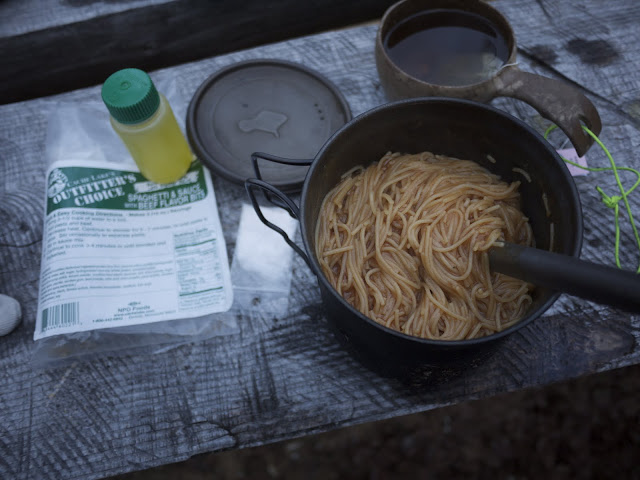
Freeze-Dried Meals. I have sat next to people who have cooked meals in the evening, and have felt envious with the tasty smells wafting through the air, up my nose, while me eating my Freeze-Dried Meal (Sorry, there's no Freeze-Dried Meal that can beat a cooked meal in my experience - yes, even Fuizion and Real Turmat). Imagine you're sitting there, eating your with cold water hydrated Freeze-Dried Meal while a mate with a stove is eating something he cooked? I can picture a rampage and slaughter at camp. Surely a reason to camp stealthy, far from anyone who possibly would cook something!
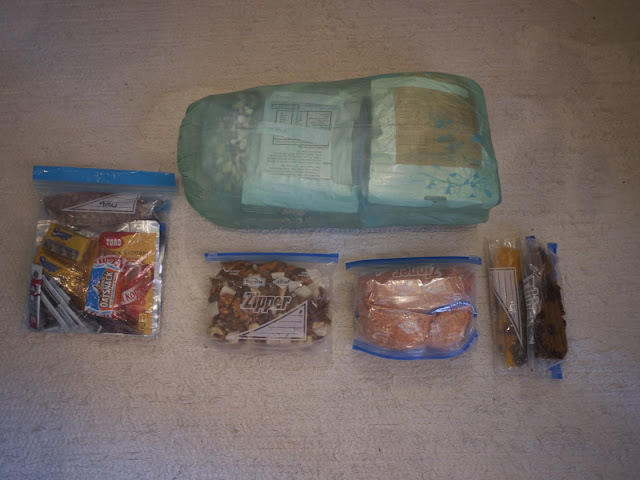
It's all mental, though - just as much as leaving behind the pair of spare clothes, the tent and the luxury hygiene set when you decided to go UL and now walk for a week in the same clothes, sleep under a tarp and your hygiene set is a mini dropper bottle of Dr. Bronners, a toothbrush and a 60 cm x 40 cm towel. So going stoveless would just be the logical next step in the pursuit of a lighter backpack and a more enjoyable outdoor experience.
Which brings us to weight savings: The weight of your stove vs. food which doesn't need to be cooked. My hypothesis is that even with a UL stove which is used to boil water for rehydrating food and a cup of coffee/ tea/ hot chocolate it should be lighter to go with a stove than go stoveless. I'm entering the realm of
Turnerism here, and will rely on statistics, so it is nothing for the faint-hearted. I'll start with a real-life food list: ten days, the full set of breakfast, lunch, snacks and dinners, all which need to be re-hydrated; as used on my packrafting/ canoeing/ kayaking expedition in May.
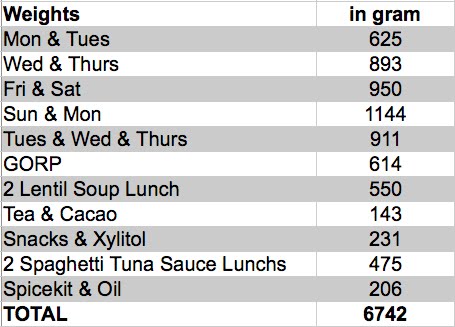
6742 gram for the food on the trip. I carried a Backcountry Boiler incl. stuff sack with me, which is 282 gram [There obviously are lighter alternatives than the Backcountry Boiler, but they would require a pot and often a source of fuel other than wood which would add carried weight]. I will assume all "cooking" has been done in Freezer bags, so there's no need for a pot. Both with stove and without stove I surmise that a cup would be used to consume the beverages, so I leave this out.
If we assume that the stoveless hiker eats exactly the same food as the hiker with stove, he would in this case have saved 282 gram for the stove. That's substantial already in the UL universe. What we can't weight, however, is the satisfaction/ happiness/ tastiness of hot food vs. cold food (This assumes that hot food is tastier than cold food, a fact which is difficult to prove).
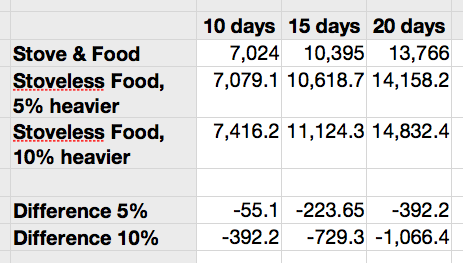
From the article mentioned in the beginning, I take that at least the lunch consisted of a Bagel sandwich with cheese and hummus, which definitely sounds tasty. However, it also sounds heavier than a bag of ramen (which also can be eaten cold, though seems to have a texture which ain't easily consumed). If we assume only a 5% increase in weight over the stove-lunch for the bagel, cheese and humus, the stoveless hiker is already carrying heavier food than his mate with a stove - only 55 gram heavier, but nevertheless. One can extrapolate this further to 15 days (stoveless 224 grams heavier) to 20 days (stoveless 392 grams heavier) and so on, though I think you get my point. The stoveless hiker would need to rely a lot on dehydrated food to keep the equation in his favour, add something more tasty and fresh and you add weight which quickly will make hiking with a stove being lighter. If he really has the weight scale with him, the stoveless hiker always could carry 282 grams (the weight of the chosen stove in this example) of extra tasty food with him and remain at the same level than the hiker with a stove.
But would it be possible for the stoveless hiker to save even more weight than the weight of the stove, while eating at least as tasty food (again, to define tasty we enter the realm of personal preferences. I, for example, still dislike Brussels sprouts and make a face when my wife brings them home and makes me eat them =)?
Raw foodism is gaining popularity, and would be the perfect stoveless hiking diet - if not raw fruits, vegetables, nuts and seeds would be the foundation of this diet. While the latter two are popular among UL backpackers for their low weight and high calorie count, the former two are rarely found on a UL backpackers food list. Sure, dehydrated fruits are light and tasty, but dehydrated veggies? Jack writes that mashed potatoes are easy and tasty when spiced up with Fritos and/ or spices. I believe that, and hence think it should be possible, with the help of dehydrated meats and fish (beef jerky, salmon jerky) to make a rather tasty stoveless diet which is much lighter than the stove diet - maybe not for a thru-hike, but at least for a long weekend or a week (I like variation). I believe the biggest thing here is again mental: The decision to leave the stove at home, to resign from the hot coffee and tea, and to be content with your cold, lighter stoveless diet isn't probably easy if you're at home planning a trip.
Furthermore, this also doesn't consider the question of which season you're out backpacking. In summer it is probably less troublesome to go hiking without a stove, move on to winter (I'm not talking about the crappy winter we have here at the moment, but proper winter with frozen lakes and rivers, -20°C and a meter of snow under your skis) and I'd say going without a stove is close to being suicidal. Unless you know where to find an open water source to get water, you'll need a stove to melt snow, and at -20°C or lower that hot cup of chocolate and hot soup really is something you want. At those temps none-dehydrated foods also start to stick together [the water in the food freezes, to be correct], and trying to separate or cut of a slice of cheese is a tough task; the same goes for bread, spreads, butter and so on. Thus I'd conclude that stoveless hiking belongs firmly into the warm seasons, where water is easily available and food doesn't freeze rockhard.
I'm really happy to have read about Jake's approach, and can see myself trying stoveless hiking sometime next year in the summer, but for the majority of my trips, I probably will continue to bring a stove and enjoy hot food and drinks. While I believe it is possible with a lot of discipline to create a really light stoveless Menu which is tasty, I'm convinced that it is on average lighter to go with an UL stove and dehydrated food, as I reckon it will be tastier and give more (mental) energy.
How about you - are you curious to try out stoveless backpacking, or maybe even are a stoveless backpacker? Or is the mental challenge to leave a stove behind, and the hot cup of coffee, something you're just nor yet ready to do?
Edit: Read Jake's take on stoveless backpacking as well - some interesting viewpoints there.
Over the holidays I read a post by Jake “Don´t Panic” Dow on
Going stoveless. He and his girlfriend hiked the PCT without a stove of any sort, quite a task in itself, and doing the whole thing without carrying a stove and food for cooking makes it even more interesting. But is going stoveless really lighter, more convenient and as easy as just leaving your stove at home?
Before we set off on cooking vs. no cooking, I'd like to know from you, my valued readers, how many hot meals and/ or beverages you have per day when you hike:
I myself am in the two to three camp. I have a hot breakfast (my MYOMüsli) and even more important than that, a hot cup of coffee. Yes, I'm addicted to caffeine (I can do and have done without, though I enjoy a good tasting cup of coffee in the morning to start my day), and prefer to enjoy my fine java beans hot. Iced coffee is another story (and only really possible in winter with proper snow unless you carry ice with you, which ain't UL I imagine) but cold coffee is somehow "not my cup of tea". The same goes for cacao - I prefer my chocolate hot! Anyway. That's one warm meal to start my day.
Which brings us to meal number two. Even in the summer I often eat a hot cup of ramen noodles/ MYOG tomato-lentil-soup/ pasta/ whatever. Maybe it is the deep-engrained habit of having a hot meal for lunch. [
Off topic: I remember as I was maybe seven or eight that Mom, Dad, my brother and me had a discussion about hot vs. cold lunch. My mom is Dutch and my dad was German, and both had different habits: Mom has grown up with a cold lunch - bread, salad, cheese, spreads, etc. - while dad was used to a hot lunch. In a family meeting the question was if we continue to eat a cold lunch, or a hot lunch. We decided to eat a hot lunch, and somehow that has stayed with me since. Further Offtopic: Finnish Students enjoy one of the best lunch systems in the world: A State subsidized lunch which includes salad, a hot meal (choice of two to three different ones) and two beverages for 2,40€. After six years of studying a hot lunch has become very common, and has continued to be the norm in my working life.] Maybe it is just that I feel a warm lunch gives me more "power" to continue/ fuel my body after an good morning hike. Maybe it is that I feel a warm meal is lighter and easier to prepare than a cold meal. I also feel a second cup of coffee or tea helps with digestion and relaxation - I'm usually not in a hurry. However, I'm also just as often as having a hot lunch not having any lunch at all, and just munch more GORP, snacks, chocolate and müsli bars or even a sandwich should I have one. So this is a 50/50 situation, where I'd guesstimate both warm and cold are equally often the case.
Dinnertime. If I'm not consuming one of my
MYOG Meals, you most usually will see me eat one out of a variety of
Freeze-Dried Meals. I have sat next to people who have cooked meals in the evening, and have felt envious with the tasty smells wafting through the air, up my nose, while me eating my Freeze-Dried Meal (Sorry, there's no Freeze-Dried Meal that can beat a cooked meal in my experience - yes, even Fuizion and Real Turmat). Imagine you're sitting there, eating your with cold water hydrated Freeze-Dried Meal while a mate with a stove is eating something he cooked? I can picture a rampage and slaughter at camp. Surely a reason to camp stealthy, far from anyone who possibly would cook something!
It's all mental, though - just as much as leaving behind the pair of spare clothes, the tent and the luxury hygiene set when you decided to go UL and now walk for a week in the same clothes, sleep under a tarp and your hygiene set is a mini dropper bottle of Dr. Bronners, a toothbrush and a 60 cm x 40 cm towel. So going stoveless would just be the logical next step in the pursuit of a lighter backpack and a more enjoyable outdoor experience.
Which brings us to weight savings: The weight of your stove vs. food which doesn't need to be cooked. My hypothesis is that even with a UL stove which is used to boil water for rehydrating food and a cup of coffee/ tea/ hot chocolate it should be lighter to go with a stove than go stoveless. I'm entering the realm of
Turnerism here, and will rely on statistics, so it is nothing for the faint-hearted. I'll start with a real-life food list: ten days, the full set of breakfast, lunch, snacks and dinners, all which need to be re-hydrated; as used on my packrafting/ canoeing/ kayaking expedition in May.
6742 gram for the food on the trip. I carried a Backcountry Boiler incl. stuff sack with me, which is 282 gram [There obviously are lighter alternatives than the Backcountry Boiler, but they would require a pot and often a source of fuel other than wood which would add carried weight]. I will assume all "cooking" has been done in Freezer bags, so there's no need for a pot. Both with stove and without stove I surmise that a cup would be used to consume the beverages, so I leave this out.
If we assume that the stoveless hiker eats exactly the same food as the hiker with stove, he would in this case have saved 282 gram for the stove. That's substantial already in the UL universe. What we can't weight, however, is the satisfaction/ happiness/ tastiness of hot food vs. cold food (This assumes that hot food is tastier than cold food, a fact which is difficult to prove).
From the article mentioned in the beginning, I take that at least the lunch consisted of a Bagel sandwich with cheese and hummus, which definitely sounds tasty. However, it also sounds heavier than a bag of ramen (which also can be eaten cold, though seems to have a texture which ain't easily consumed). If we assume only a 5% increase in weight over the stove-lunch for the bagel, cheese and humus, the stoveless hiker is already carrying heavier food than his mate with a stove - only 55 gram heavier, but nevertheless. One can extrapolate this further to 15 days (stoveless 224 grams heavier) to 20 days (stoveless 392 grams heavier) and so on, though I think you get my point. The stoveless hiker would need to rely a lot on dehydrated food to keep the equation in his favour, add something more tasty and fresh and you add weight which quickly will make hiking with a stove being lighter. If he really has the weight scale with him, the stoveless hiker always could carry 282 grams (the weight of the chosen stove in this example) of extra tasty food with him and remain at the same level than the hiker with a stove.
But would it be possible for the stoveless hiker to save even more weight than the weight of the stove, while eating at least as tasty food (again, to define tasty we enter the realm of personal preferences. I, for example, still dislike Brussels sprouts and make a face when my wife brings them home and makes me eat them =)?
Raw foodism is gaining popularity, and would be the perfect stoveless hiking diet - if not raw fruits, vegetables, nuts and seeds would be the foundation of this diet. While the latter two are popular among UL backpackers for their low weight and high calorie count, the former two are rarely found on a UL backpackers food list. Sure, dehydrated fruits are light and tasty, but dehydrated veggies? Jack writes that mashed potatoes are easy and tasty when spiced up with Fritos and/ or spices. I believe that, and hence think it should be possible, with the help of dehydrated meats and fish (beef jerky, salmon jerky) to make a rather tasty stoveless diet which is much lighter than the stove diet - maybe not for a thru-hike, but at least for a long weekend or a week (I like variation). I believe the biggest thing here is again mental: The decision to leave the stove at home, to resign from the hot coffee and tea, and to be content with your cold, lighter stoveless diet isn't probably easy if you're at home planning a trip.
Furthermore, this also doesn't consider the question of which season you're out backpacking. In summer it is probably less troublesome to go hiking without a stove, move on to winter (I'm not talking about the crappy winter we have here at the moment, but proper winter with frozen lakes and rivers, -20°C and a meter of snow under your skis) and I'd say going without a stove is close to being suicidal. Unless you know where to find an open water source to get water, you'll need a stove to melt snow, and at -20°C or lower that hot cup of chocolate and hot soup really is something you want. At those temps none-dehydrated foods also start to stick together [the water in the food freezes, to be correct], and trying to separate or cut of a slice of cheese is a tough task; the same goes for bread, spreads, butter and so on. Thus I'd conclude that stoveless hiking belongs firmly into the warm seasons, where water is easily available and food doesn't freeze rockhard.
I'm really happy to have read about Jake's approach, and can see myself trying stoveless hiking sometime next year in the summer, but for the majority of my trips, I probably will continue to bring a stove and enjoy hot food and drinks. While I believe it is possible with a lot of discipline to create a really light stoveless Menu which is tasty, I'm convinced that it is on average lighter to go with an UL stove and dehydrated food, as I reckon it will be tastier and give more (mental) energy.
How about you - are you curious to try out stoveless backpacking, or maybe even are a stoveless backpacker? Or is the mental challenge to leave a stove behind, and the hot cup of coffee, something you're just nor yet ready to do?
Edit: Read Jake's take on stoveless backpacking as well - some interesting viewpoints there.
Food for Thought: Stoveless backpacking
The coffee is my hanging point as well. I boil for coffee and instant oats(consumed directly from bag). Lunch is cold unless my brother is amidst my companions. If he's making Ramen, then so am I. Dinner always hot.
ReplyDeleteI will admit that for short overnights in 70F weather, I go stove-less. The weight of a deli-made sandwich with a cereal heavy GORP for breakfast and a MetRx meal replacement bar for lunch isn't substantial. That allows for more time walking. Which is key to opening up options for short window trips. Great post, BTW.
Stoveless backpacking - sure it's doable, but why? I could see the usefulness for some competitions lasting a few days, when the main point is to get energy into the body in a short time, but for normal outings I do take the time to enjoy the nature and naturally also take the time to enjoy tasty food.
ReplyDeleteI probably could do without hot meals for some time (my usual workday lunch is in fact usually a cold salad), but I think there is a certain life quality in hot food. And a cup of hot coffee in the morning and afternoon not only tastes great, but also represents the freedom to just enjoy the moment.
"My hypothesis is that even with a UL stove which is used to boil water
ReplyDeletefor rehydrating food and a cup of coffee/ tea/ hot chocolate it should
be lighter to go with a stove than go stoveless."
I disagree with the hypothesis. If we put the mental part aside for a moment, what matters are calories per gram and mixture of nutrients and only that. It's possible to save the weight of a stove (and probably the fuel and the pot too) by just eating cold snacks. Cold snacks can be tasty and give enough energy and nutrients even for very demanding endeavours. If one just wants as light pack as possible, then cold food with highly specialized diet is a natural outcome, in my opinion. You could even do a winter trip without a stove (two guys skied about two weeks on Greenland icecap after a stove failure melting 2L of water per person per day with body heat). But...
Then there is the mental side. I like a big mug of hot beverage or a big pot of steaming hot food. And this doesn't make going any lighter: I need a stove, a pot (at least a mug or heavier hot-water-cabable bottle) and usually fuel too. So it's heavier but I like it, so why not? I also like fresh food on a hike and often pack for example cheese and apples which also add weight but I can handle it.
In summertime I usually have a cold breakfast or müesli that I can eat either cold or hot. If there's a sunshine and +30C inside my tent, I prefer the cold option and if it's -2C and windy I really prefer hot start for the day (both can happen in Lapland in summer). Previously I always made a hot lunch during the day but it was too much of a hassle so I've now switched to cold lunches. Typically it's a flapjack bar with some salami or beef jerky and maybe some dry bread. It's easy, gives enough energy and if it's really cold or I just want to, I can brew myself a hot beverage. In the evening I have enough time and shelter to prepare a nice hot meal and a hot cup of cocoa for the evening so then I cook. In cold winter conditions I like to have a hot lunch and hot beverages during the day to help me staying warm and for that I use thermos bottles (way too much hassle to put up a tent in the open fjell and start melting snow, etc.)
So, as a conclusion I'd say that it depends. As everything does. Food and cooking systems, as all gear, excist to serve a purpose and whether they work or not depends on how well they fulfill the need. You just have to define your (wants and) needs.
For those understanding Finnish there are some posts about a two-week stoveless hike on the fjells in late autumn as a test hike. It's a nice blog in general: http://karskinen.wordpress.com/2011/08/11/ruokalista-2011/
IMO, UL is not just about having the lightest gear, much of it is in ourselves. We seek the limits of our comfort, and carry the minimum gear to keep us within this limit. Every day we learn techniques that help us to keep these limits of comfort withless material, and every day we go down these limits of comfort.So, of course it's a way to reduce gear if you can tolerate the disadvantages. This one, simply, I know isn't for me.I'm just not willing to give up my hot meals, and especially my hot drink in the sunset(One of my favourite moments). These are things that allow that I enjoying when I go out. FOR ME, like Peter say, why? I don't want do it. But why not for you?I could give other examplesWhy we need a refuge? we can build something with natural elements such branches.Or directly, why we need to carry food? we can hunt, pick mushrooms, berries, roots.
ReplyDeleteI have yet to learn how to make my food light and tasty even with a stove. :) There are many recipes in English but most of them have some ingredients that are either unavailable or expensive in my country.
ReplyDeleteAs for the stoveless backpacking... with a stove you use hot water to dehydrate your food, but without a stove you kinda dehydrate it within your mouth or within your body, which means you need to drink more. And this means that you either need to carry more water or you spend more time at camp chewing your meals. Also, without a stove you have less options of beverages (no tea, no coffee, no soup, etc.). I mean, you would want to drink something other than water, and there would be less options without a stove.
I find that for 3-season outings weight of my stove plus fuel is several times less than weight of my food (6-10 times), which is less than accuracy of my food consumption prediction. I mean, I never know exactly how much food do I need, I can only estimate it with some error. And this error is of the same magnitude as weight of a lightweight stove plus fuel. So I don't feel I need to leave my stove at home for weight saving.
By the way, in October I was trekking the Lycian Way (Turkey) and one of my friends ate only raw fruits there (grapes, plums, melons, ...). He needed about 5 kg of them per day! Good thing there was a possibility for fruits resupply every 2-3 days :)
Thanks for the great blog tip, Jaakko.
ReplyDeleteI agree with you, Peter - I like to enjoy nature and tasty food, and find a hot meal outdoors adds life quality.
ReplyDeleteStill, stoveless hiking is an interesting topic, hence my mental excursion into the realm of it =)
I disagreed and proofed my hypothesis already wrong myself, so no reason to disagree with me ;)
ReplyDeleteOne probably could go backpacking and just life on olive oil. I'm sure there's cold snacks which are tasty and give plenty of energy, but can they be a lot lighter than going backpacking with a stove? I'm on the fence, really. I was considering the possibility of melting snow with bodyheat in winter, (2l per person per day in winter is way too little, btw) but don't think it is comfortable or easy - theoretical one would need more energy to compensate the cold next to the body, which results in more food, which if it is dehydrated means more water... =) Though practically it is possible, as the link you posted showed.
Going UL is all mental. So going stoveless is just the next mental step to take. As you and other point out here, the question is why? In pursuit of an even lighter pack? "Easier" cooking?
btw, apples and fresh fruits in summer are excellent - I sometimes carry some on the day I start. Tasty!
(to be continued...)
More or less agree with the previous posts. Stoveless backpacking will probably remain a special activity, quite well fit for summer, short trips and contests. I.e. when stopping isn't a problem or when stopping isn't an alternative.
ReplyDeletePersonally, if I go camping with bushcraft friends, we make alot of coffee, like continious coffee - but on the other hand we do it with a coffee pan and a fire, so that's essentially stove-less. During winter camping though, my own experience clearly tells me to eat and drink hot bevrages. I tend to get cranky if my energy runs low so having tasty food is clear win. I haven't done the math, but I'm quite certain there's a significant differece between having hot food in your belly that warms you while giving energy versus a cold mass effectivly cooling you down. For me, this is very obvious in the morning, when the mental and physical state between a hungry and fed Daniel, is huge. Also, I do like to have a cup of hot water before bedtime...
I couldn't use your survey Hendrik, as it didn't have an option for 'sometimes'. :)
ReplyDeleteOn a short trip, i often leave the stove behind, and carry sandwiches, scotch eggs, pork pies, etc.
For longer trips, 'real' food is too heavy, and i like a hot coffee in the morning, and a hot meal at night.
" in the pursuit of a lighter backpack and a more enjoyable outdoor experience."
ReplyDeleteSo the lighter it is, the more enjoyable, is the brain function here :) ? The only joy is the lightness. Get rid off cameras, clothing, packs etc, go primitive and nude, Hendrik :),thats light !!!!!!!!!!!!!!!!!!!!!!!!!
Why carry any food then , why not carry just concentrated energy gel or similar. Why does food have to taste good, if its only supposed to be lightweight? Is there some type of masochism among UL crew, as there is among the rubberboot & tubular frame pack crowd as well :).
Stoveless hiking...umh....well its doable but i´d choose to carry some type of metal container to cook and boil in anyway, and build up a campfire. I can surely do without a heated food, thats not a problem but i think that i feel a whole lot more comfortable eating a hot meal anyway. Especially in winter, i think going without stove OR reliable firemaking gear and skills to gather wood and build a fire, its very STUPID to hike without stove. You can eat snow and ice but id rather melt em and drink em warm, by any means.
Have you considered those flameless heaters, they dont weight a thing. But you cant recycle em and they are all thrash after use.
That mental energy as you call it, is an important thing. If it wouldnt be, id hike with 4 meters of barbwire wrapped around my legs.
I think that my main point was math vs. reality, just the same that you wrote in the post. For me, it means going with a stove. Or to be presice, to have a way to make a hot meal and hot beverages at least twice a day. But I've gone a step towards cold meals to make my day routine more enjoyable and I don't feel that I lost any comfort or enjoyment doing so. It's the same with variation. I thought that I need a lot of it but next time I go out for three weeks in a row, I take only three dinner options instead five, two breakfast options instead of three and so on. Little steps...
ReplyDeleteThough, the comparison in the post was kinda in favour of going with a stove as the stove used was relatively light wood burning one. Wood is not always an option so it would add the weight of the fuel. If thinking that wood is plenty, we could just think about using open fires all the time and only carrying a 40 gram titanium mug to boil water... And then there was the point of carryign the fresh food anyway on long trip with regular resupplies, stove or not. And another point might be that the average weight of the backpack matters more than the starting weight (though for simplicitys sake this is usualy quoted and compared). The stove will be in the rucksack all the time weighting the same weight throughout the hike. The difference caused by heavier food (per day) decreases as the days pass by and in a perfect world at the end of the last hiking day, all food should be eaten and the difference would be only because of carrying a stove or not...
(And the Greenland thing was more of an curiosity than an advice. to my knowledge it was a situation were the guys decided to sacrifice the comfort as they couldn't afford evacuation from the point they were when the stove broke and their insurance would've covered only medical evacuations. Tough guys.)
kkkkkkk k k
ReplyDeleteI'm sure that stoveless backpacking can be lighter. Not only lighter, also simpler. You just have to eat. No cooking or hydrating. The key is to select the correct foods and get used to eating cold meals.
ReplyDeleteI have never had any stove and I've backpacked happily trips of up to 20 days without a hot meal. You can see both the trips and gear-food lists in my blog (there is a google translator widget on the top left).
http://mikel-salazar.blogspot.com/
Possible? Yes. Desirable? Maybe (some adventure racers choose this route). For me? No. I like my morning coffee blast and a hot chocolate (with Mintuu of course...) in the evening before bed. A warm meal in the evening posses an unquantifiable weight of well being and contentment. But I have moved away from hot breakfasts in all but real winter conditions. My MYOMuseli tastes good hot or cold.
ReplyDeleteAlso, could having at least a metal cup and fire lighting capabilities be useful in managing a first aid situation?
Generally, people go without stove for its convenience, its not too much of an weight saving here.The convenience thing is something kicking in especially on long hikes, after several weeks or even months.I know that good food keeps the spirit high outdoors, but cold food does not have to be bad. Its something you have to go out and try for yourself. Might be hard to get for Internet-hikers I know ;)And yes, it is not recommended in the wintertime with reeeaaaal snow and ice!
ReplyDeleteHendrik, my view is that it is possible to reduce some weight going backpacking without a stove , I don't think it is much in reality and as you say in winter it is probably dangerous. Hot food and a drink to my mind is a great moral boost after a long day and therefore worth the extra weight. I tend not to have a hot meal during the day, while it is looks like you do. I wonder if this is because maybe in Finland, you may have more shelter in the forests, rather than most windswept mountain tops I hike in the UK where operating a stove is a pain - is this too simple an explanation ?
ReplyDeleteLunch for me consists mainly of cold couscous + vegetables or similar, snack bars and nuts/seeds with water for a drink. Sometimes ( it seems more and more!) I eat on the hoof as it is slinging it down with rain.
Evening meal is always hot for me ( freeze-dried in the main). I just take a Ti Mug weighing 50g to boil water for this and I could not live without a cup of tea in the morning. In the UK, it is quite easy to go stove less and still have hot food. On trails such as the 287 mile Pennine Way, it is quite easy to walk and camp from one pub to the next with just the weight of a credit card ! To cut down on some food weight, I sometimes drop down to a pub every few days.
Stoveless for me if I was to try it, would be short summer hikes. I would not try this time of year.
Hmm, yes and no in regards to the bias in favour of a stove. You could take a 50 gram alcohol stove system and 200 g of fuel for 10 days and would be lighter than the Backcountry Boiler. But I picked the Backcountry Boiler because I don't need extra fuel and a pot with it, so you're right. I learned that you can make a fire pretty much anywhere in Finland, even at low temps, and thus could be fine with a pot alone.
ReplyDeleteYeah, food weight decreases while the stove while always be carried. Too many variables are now entering the field... =)
And the Greenland thing was certainly interesting, showing what's possible!
UL backpacking is in my opinion ALL about mental matters. The traditional backpacker tries to re-create the safe four-wall environment he's used to in civilization, while a UL backpacker sleeps outdoors in his bivy, doesn't mind being a bit smelly and has the skills to go light =)
ReplyDeleteI like how you're taking this thought further - which probably brings us right into "Bushcraft" territory, where people hunt and gather their food and build a shelter from natural materials. Good thinking!
btw, nothing beats a hot chocolate with a bit of Minttu while watching the sun set!
I know what you mean, Sergiy - best to adapt local recipes for your hiking trips. I once went looking for corn spaghetti, which seems easy to find in the USA, but I needed to visit three different stores to find them, and they costed 6€ for 500 gram :-O
ReplyDeleteWithout a stove you can rehydrate your meals on the go - that's how Jake and his gf did it: Put the meal in a empty jar, add water, continue hiking for 30 to 60 min, pitch shelter and eat! And coffee, soup and tea could be also consumed cold. But I'm obviously with you - I rather carry my light stove and have a warm meal and drinks instead of cold food and coffee.
Your Turkey trip sounds awesome! And about 5 kg of fruits per day - WOW! Do you have photos of that? Did your friend have digestion problems?
haha Mike :D
ReplyDeleteI imagine another variable to enter in this is how often one can visit a Pub along the trail. From reading UK blogs I sometimes get the feeling they're every few kilometers and to carry food and a stove isn't really necessary!
I'm also getting grumpy when winter camping and there's not a hot beverage waiting for me at breakfast, lunch and dinner!
ReplyDeleteThe math of how the individual metabolism reacts to hot or cold food, now there we enter proper scientific grounds which would need to be researched in field studies. As you suggested it, please start the trials :D
I think that you're on the right lead with the the simple explanation. The weather is the main reason why I swapped to cold lunches. Operating a stove on open fjells in foul weather sucks as do unnecessarily long breakes.
ReplyDeleteYou can also go stoveless and still ahve hot food relatively easily in Finland too. There is the option of making a fire (maybe a limited option but still there) and using the wilderness huts (also limited) that often have a wood stove and a gas burner and even some pots and pans. A bit restrictive but with good route planning it would easily give a possibility for one hot meal a day or so even if not carrying a stove.
Dropping to a pub and resupplying every few days doesn't appeal to me at all. On my hikes (the week+ long ones that I really like) I seek to get away from the "civilization" and thus dropping to a village for a pint kinda ruins my week-long retreat from the troubled world and turns it into two "weekend trips". On very long hikes resupplying would be mandatory and maybe even desirable though three weeks with not much touch with so called civilazations was a bliss. :)
The lighter it gets, the more enjoyable becomes the outdoor experience would be the hypothesis, yes. I have heard of people, though, who swear they happily carry 40+ kg of stuff through the outdoors and are having a great time.
ReplyDeleteThe question was more of an cold dehydrated meals vs. warm dehydrated meals, and Jake as well as me talked about tastiness. I think most people prefer the food with some taste. And lightweight food can taste very good - you should try it sometimes ;)
I also prefer to carry a stove and/ or pot. Especially in Finland one can get away with only carrying a pot, as you're practically able to make a fire almost everywhere.
Flameless heaters? No idea, do you have a link? Although if you can't recycle them and need to throw them in the trash, I'm not sure I'd use them.
Four meters of barbwire :D
How is life in Kuru?
Think I will start wiv a stove for tea and hot dinner and brekkie :-)
ReplyDeleteTony / Yoda
Hola Mikel, I tried to find the list you mentioned, but Google's Translator is rubbish. Hit me with a link - habló un poquito Español que puedo practicar si leer su lista! I'm very curious to read about your Menu and how you did it, under which conditions (looks like a summer HRP trip?).
ReplyDeleteI will give it a try in the summer - I'm especially curious about mi sa's Menu, as he says he went with foods which didn't need to be hydrated. My MYOMüsli works great hot and cold - but if I'm already boiling water for my cup of coffee, I might as well boil a bit extra for my Müsli. At least that has been my reasoning there.
ReplyDeleteI think a metal cup and fire making skills (especially the latter) are very important in a FA situation.
I think convenience is really in the eye of the beholder. If one finds it tedious to make a fire/ push a piezo ignition on a gas stove/ light a match to fire up a alcohol stove, then yeah, not needing to do that certainly has its benefits. As I wrote above, I'm certain there's times and places for going stoveless and I will give it a try in the next summer.
ReplyDeleteHendrik, thanks for linking my own feeble explanation. As usual, I always rewrite the post in my head afterwards. What I failed to point out is how my own "research" into stoveless menus fits into my strategy towards getting lighter. A hiker could strip his gear list(including food) to nothing and then add back to his/her comfort level. It seems that I would have come up with the same conclusions while spending significantly less. I live in a much warmer climate, where day hikes do not require warm food. So eating light versions of calorie packed foods is easy on a day hike. Now start adding days to the trip. Weight begins piling up, and the menu looks way less fulfilling. That's where I add the stove and more options. My contention is simply that I was trained to approach this from the wrong direction. From heavy and gear laden down to light and fast. What if we taught from light and fast up to desired comfort?
ReplyDeleteDifficult in England not come across a village with a pub after a 3 or 4 days walking, we do not have the great wild expanses as in other partsof Europe. Quite possible to do this in Scotland, for example the trail to Cape Wrath, I think you could go 11 days without finding a pub or shop. I am not one for walking from pub to pub, don't get me wrong, but I still love my walking even if I go through a village or two on the way.
ReplyDeleteHei Mark, actually I think you're on to something there with the local conditions of different areas. If you go hiking in a National Park, Wilderness Area or similar in Finland, you are never really far from a shelter with a dedicated fireplace and a full wood hut. That obvious makes it very inviting to have a warm lunch. But probably just as many have a cold lunch - your couscous + veggies, for example, sounds tasty!
ReplyDeleteNice that you confirm that in the UK there's often the possibility to have a hot lunch in a Pub along the way - I was wondering that with @c8ada8ab63840b5f0733c0c5de0c573f and because that's the general impression I have from hiking in the UK =)
Ah yeah, Jaakko agrees with me =) Good point, that, with the huts with gas stoves and pans & pots.
ReplyDeleteDropping back in to civilization would for me be less about food (although, a Pizza wouldn't go uneaten!) but more for a nice cold beer and possibly a sauna :D
I did a wild camp last year without a stove and have done so before. People feel its part of the experience, which I totally get as I do like cooking when camping, though I tend to prefer just boiling water for pre-prepared freezer bag type meals. In summer you can easily wild camp with just a sandwich, soft drinks, snacks etc really and save on the weight of cooking kit and fuel.
ReplyDeleteHendrik, see my reply to Jaakko. Difficult in England to go too many days without hitting a village. Much easier in Scotland to really get away from it all.
ReplyDeleteI normally have 2-3 hot coffees in the morning, a cold lunch — and a big hot meal after dark.
ReplyDeleteI'll carry a stove, even if it is (slightly) heavier.
An interesting and controversial post as always, Hendrik! I've done some climbs in summer without a stove, and I can quite happily live for days on Snickers & carb gel, but given the chioce I'll always throw the stove into the pack. And in winter, I don't think you should set foot out of the door (even for a day trip) without one.
ReplyDeleteInteresting discussion! I agree with the above points that it's easiest to do when it's warm and that the primary reason is more aesthetic/style than pure weight savings.
ReplyDeleteI've experimented with no-cook food while hiking a long trail and one other so far neglected (and potentially minor!) benefit is that it simplifies resupplying in town. While Heet (a gas line antifreeze commonly used to fuel alcohol stoves) is quite common, it's not everywhere. It's quite satisfying to be able to lightly touch civilization at some distant outpost, resupply out of a vending machine, and then head back into the woods.
I'm not sure if the word would be 'primal' or 'feral' :)
I've found the same to be true - but then thought about it, compared with earlier trips and so on. Quite often it's not convenience, but laziness - imo. I often think, "nah, let it be, I'll eat the cold food" and it's ok, no problems. But when I eat a hot dinner, I feel much more refreshed. Pumps up the morale, which is often like 70% of a trip..
ReplyDeleteHehe... off I go. I'll put the food in - a nice pocket i found inside my door. Danke schön.
ReplyDeleteJust like the wet feet...take the cold turkey and try it.
ReplyDeleteHow to measure if the food is tasty enough: Simple, if you can eat enough of it, it's tasty enough - the rest of the taste is just luxury, just like two wall tent etc. That is at least if everything else is already chosen according to the rule "mandatory for survival" vs. "not mandatory for survival".
Cold menu has some benefits:
+bars are easy to pack
+cold meal allows to eat while walking, so you can cover more distance.
+you can always have "fresh" energy as you are eating more often
+bread is good and tasty
On the negative side there is:
-bars are almost always sweet, so I cannot eat that for longer than a day or two.
-bars that are not sweet taste like they are not meant for human consumption (ie. I cannot eat them)
-jerky and salami might be easy to eat, but not to digest when walking. Too much burping.
-bread is far from tight energy
-Maximum distance has never been the thing for me
I tried it, but didn't like it. Too spartan for me, life is too short to eat crappy foods - and I feel the same applies for most of the "just add water" type adventure meals too as I prefer to dry up my own foods. Too bad my own meals take quite a lot of space :(
http://perkelesblog.blogspot.com/2009/08/hot-pack-flameless-heater-wayfarer.html
ReplyDeletehttps://www.solutionfoods.fi/cat/product_catalog.php?c=4
The only down side of those are that you can ue it once. BUT, i think theyre usefull in some cases when you cant use stove nor fire, and in winter. You can use it when storm cuts electrics in suburban homes, you can heat your cocoa with it in train,etc :). I have used those a few times in long distance ski trips too, when the pauses are short. My buddies started to open their packs, dig in for gas stoves and pots,when i just poured cold water from themos flask,to by dehydrated meal pouch, shutted it and dropped it in the flameless heatter and waited for a few minutes, and then i had a quick Hot meal, and i could use rest of the pause to take a nap or piss,when others were making food and dish to be washed when i had finished already. Yes, you can have a cold snack too, indeed but i liked it better hot than cold.
"One probably could go backpacking and just life on olive oil."
ReplyDeleteOr maybe leave the food completely home for a overnighter :) It's probably easier as 100% olive oil diet will give you diarrhea.
But 80-90% of the calorie intake from fat is proven to be possible. At least if you increase the amount of fat in the diet slowly. But for me, for some reason high fat foods just behave better in my body when consumed warm.
I agree with you - in summer it is comfortably possible. The question, if we want to take this under a gram-weenie POV, is - can it be lighter than bringing a light stove? For an overnighter a nice sandwich or two won't matter, though for longer trips without resupplies I doubt it is possible to bring sandwiches which stay fresh (actually, probably it is just fine and possible if you take special bread, cheese, sausages et al =). Thanks for commenting!
ReplyDeleteWhy is indead the question - not only why go without stove when I can go reasonably light with a stove. Also: why do I go out at all? It seems beside the different seasons and latitudes the reasons and expectations when going on a hike are quite numerous.
ReplyDeleteLooking at a hike from a sportive/performance perspective then stove-less is a good idea - preparing and cooking food, cleaning pots afterwards is all completely lost time, taskwork to avoid as much as possible. Hiking is the _one_ good activity, everything else is unnecessary disturbance.
I prefere my hikes from a more meditative, Zen-perspective and breaks or cooking is in equal measure part of my desired experience - pick up wood, cooking, eating, cleaning - everything is as simple as: Chop wood, carry water.
At home my food is mostly stove-less prepared but on a hike, outdoors, I really enjoy and look forward to every part of the cooking, having tea-breaks 3 times/day ;). My body needs the break anyway, so why not celebrate it with something to enjoy? And off course that depends on the weather ...
Maybe it is still this 30.000 year old gen that makes me feeling at home with only a small fire and a pot, waiting for the food to be ready while looking attentively around :)
I could go without stove, but I don't want to! It is part of the beauty - a fire, a teapot, a kuksa, a nice landscape, some birds, falling or sprouting leaves ... obviously tastes differ.
I find even on normal trips that I just can't find the motivation to eat more Snickers, Mars, and other bars. They come out my ears, as we say in the Netherlands. I guess that's my mental boundary, right there...
ReplyDeleteGood to know there's people out there who're even more in need of caffeine than me, Rick!
ReplyDeleteA good point, Nick. That's why I picked a wood stove - I can re-supply on the trail for fuel! If it would just be that simple everywhere (we're rather blessed with forests here in Finland =)
ReplyDeleteGood Pro & Con list there, Antti. I'm like you with the bars - always take too much. The burping of Salmai and Jerky consumption, well, I don't remember having those problems =)
ReplyDeleteWhat own meals do you make that they take so much space?
I'm envious! I'm looking to buy a wood burning stove as well and with the Backcountry Boiler getting its production kinks worked out and a titanium Bush Buddy in the works, I feel spoiled for choice.
ReplyDeleteMost of my meals are based loosely on a recipe I could eat anytime, like for example meat soup, chicken in wine or pasta with minced meat (four walls with me, eh?). I just dry the ingedients and get suitable Knorr etc. sauce. Of course I select meals that can be made quickly.
ReplyDeleteThe problem area are the vegetables - dired potatoes, dried beans, dried wok vegetables etc., as they are not packing nicely. Especially the dried up potatoes are nasty as they are so sharp that they break the freezer bag in the process if I sqeeze them and unfortunately I happen to like them. It would make things easier if I cut them smaller but it also takes quite a lot more work while preparing them.
The meal done this way easily takes up twice the volume of a reiters bag, even more as I usually want to eat a bit more than the amoung from one reiters portion.
The space they require is irrelevant for a few days trip, but sometimes I have the luxury of having 14-16 days unsupported walk where the volume difference starts to be a significant.
Well, I also like sitting at camp watching the wilderness around me. Cooking isn't a tedious chore for me either (cleaning up maybe a bit). So hiking isn't the one good activity =)
ReplyDeleteI think you pointed it out well, from how people approach hiking in itself. Some like it more relaxed, for others as many kilometers as possible is the goal, while again others like a mix of both or something completely different. And that's the beauty, isn't it - everyone can do what he likes, and there's no right way (only the light way ;). All the best for 2012, Sabine!
Just a side note: I was amazed when our teacher (in the guide course) told that he pre-makes all his sandwiches for even week+ long trips in the evening prior to leaving. Two sandwiches a day so for a week 14 sandwiches with butter, cheese and salami (metvursti). In the backpack. Even in summer! I haven't had the guts to test my guts with that... (And I also like to have the extra butter for example for mushrooms or fish.)
ReplyDeleteLots things are not necessary Hendrik. Sleeping mats where deemed bulky and not needed by Hamish Brown on his Munros trip. He went without but took a stove. Double walled tents are not needed and some think a compass is not either. I think those who leave a compass at home are either amazing at navigation or idiots. I tend to lean towards idiots.
ReplyDeleteIf you wanted to walk the West highland Way you could spend a lot of money buying hot food in cafes and pubs as you walk. No stove would be needed. If you took a stove you could wild camp on the way and have a nice view with your meal.
Go to more wilder areas in the Highlands, or stay high and there is no option to buy food. So no stove or one is the choice. Hot food and drinks are nice and a boost when its damp and cold - so I always take a stove. Even on a hot summer weekend. Weight saved is pointless vs the feel good value a warm brew in the morning and warm meal in the evening has to offer.
I often go without a stove in summer for a one or two night trip. I don't think I'd like it for a week. "Ultralight" stoves are not real convenient -- teeny pots, fiddly alcohol stoves, Esbit, etc. I'm kinda tired of trying to cook pasta in a 0.9 liter pot.
ReplyDeleteGreat article. Very thorough. I have a twist on the issue, though. When I go for a few days I leave the stove behind. Not everything that is dried needs to be reconstituted in boiling water. Some things like powdered soup mixes, instant oatmeal and almost anythig freeze dried will soften up in cold water. Nuts, dried fruit and berries, granola, jerky, etc. are probably staples of most hiker diets already, but if you want to go simple and light try not cooking something you would normally cook. It saves a lot of time setting up, cooking and cleaning up that you can use to just enjoy hanging out or putting more miles under your feet. You have to limit yourself and be smart about it. (Rice and beans, for example, just don't seem to work on this plan!) I'm going to try an extended trip this summer without a stove and see how it works out.
ReplyDeleteStoveless is not for everyone. I first tried it on the CDT and because of the convenience of shopping I have continued using it. I plan for 2# per day of food at the grocery store and because I am shopping as I go, it just makes it easier in the store. I also have food allergies and so shopping can now and then be stressful. I only ship food for long distance hikes(greater than 500 mi) when there is no a grocery. When doing a weeklong, I bring the stove and have coffee in the morning and cook the evening supper. So what I am discussing is on the longer trips. I tested it again on the AT for 1000 miles this last summer. The advantages: go into the store and walk out with the correct number of pounds of food. Nice. And, when the rain pours down in the evening , I can stay in my tent and in the sleeping bag if need be and just open the food sack and eat. When the weather is good, I will join the group for dinner and eat what I have. Also not having to fuss over getting fuel in town just makes one less stop in town; I usually cook with alcohol.
ReplyDeleteI do still cook on shorter trips and I do enjoy preparing the hot, dinner meal.
Maybe you should break the pasta to make it easier to cook pasta in a 0,9 l pot? I use a 1,1 l pot and find it just fine (though yeah, it can get a bit small sometimes, especially if I use a lot of water =)
ReplyDeleteThanks Tim! Re-hydrating foods in cold water is certainly an option (it is what jake and his girlfriend did on the PCT), though I wonder how tasty some of the meals will be? As most of my meals are cooked and eaten from a bag, the dishwashing usually isn't a big problem either, and my cup I can rinse with a bit of water. Though next summer I certainly I will give stoveless backpacking a go, and I will be curious to hear how your extended trip will go!
ReplyDeleteWhat I do for pasta and it works great is to boil the pasta to ala dente and then dehydrate it. It works really good that way
ReplyDeleteHey thanks for sharing this post. Great useful advice. That’s awesome. Really I load up about 40 lb of junk in my 4 lb load up, band another 7 lb of junk to the outside of said load up and hit the pathway for a excellent lengthy instantaneously vacation. I can see you cringing. Normally published from storage and then ticked off as I go. I've discovered if I do not do this, I ignore things like camcorders, less difficult or eyewear. I then gather everything into the extra area, with two or three different dimension packages, and perform out what I 'need' to take and what I can depart behind. I try for the tiniest load up I can as that makes me to go light. I have a great Hardshell Backpack
ReplyDelete