That I prefer quilts shouldn't surprise you. That I prefer them even in the depth of winter shouldn't either. Now if you're looking for winter quilts, you got two options:
- Combine a three-season down quilt with a synthetic quilt to create a flexible system which can be adapted to the circumstances
- Buy a dedicated winter quilt
I decided to combine both approaches to find out what works best for me.
Inevitably
Katabatic Gear came up on top for me (no surprise, really, as I did interview the owner,
Aaron Martray from Katabatic Gear not too long ago) and off I was checking what they had on offer. Back then the
Katabatic Gear Sawatch quilt was their warmest quilt (the
Blackwelder came later in 2011) and soon after a 2011 model with the new attachment system arrived on my doorstep, just in time for some
Wilderness Guide Winter Expedition fun.
Hover over the photos to see smart descriptions!
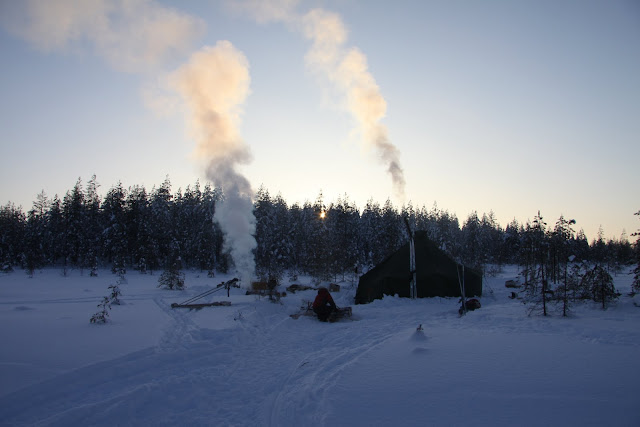
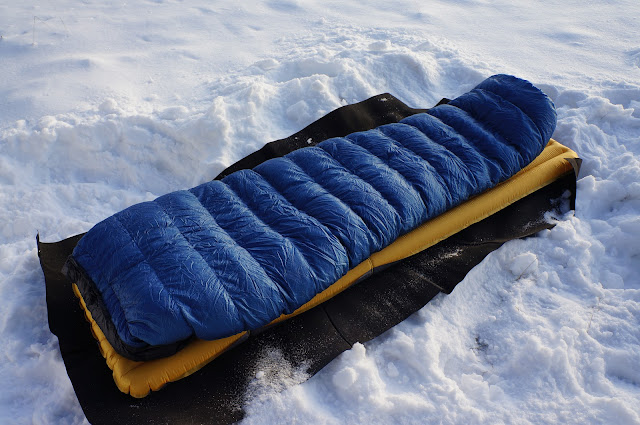
While that trip didn't end well, it was an exceptional awesome opportunity to test my winter sleep system. Katabatic Gear advertises the Sawatch as their three-season workhorse, which is fine to about -10°C (or 15°F in some illogic system). The first night we had -31°C, and then -36°C for a couple of nights. I'm happy to report that with a smart system the Sawatch was keeping me toasty in those temperatures (Before you ask: I was wearing a
200er Woolpower Baselayer, the BPL Cocoon Hoody and pants, two Buffs, 800er Woolpower Socks, on a
Multimat CCF and inflatable pad cocooned up in a Laufbursche Tyvek bivy, in a big Finnish Army tent - don't ask!). Lets take a look at the Sawatch then.
Weight
The Sawatch has 425 gram of 850 cuin down (nowadays you get 900 cuin down!), filled in continuous baffles which allow you to shift the down around as you please. The Shell Material is Pertex Quantum Ripstop .85oz/yd and the lining material is Pertex Quantum Taffeta 1.0oz/yd, which results in the following measured weight for my regular length Sawatch:
- 695 gram Sawatch quilt
- 009 gram two cords
- 015 gram webbing
- 017 gram stuff sack
Trail-weight (includes cords and stuff sack) is thus 721 gram.
Features &
Function
The Pertex outer is "snowproof" which means a light dusting of snow (as seen in the video, for example) doesn't go through and wets the down. You can blow or brush it off simply. The inner lining is nice soft, does not irritate my skin and warms up quickly. It lofts quickly and overall feels better than the
GoLite Ultra 20° I have used for well over two years now. The Sawatch has lost little down, sometimes one looks through the shell material, but they're easy to pull back in.
Onwards to details: Aaron has developed a
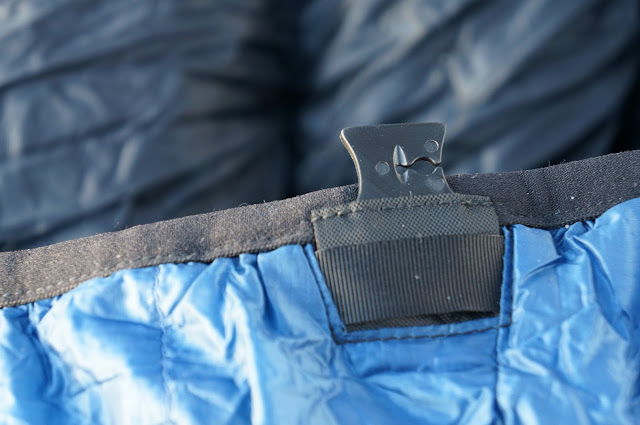
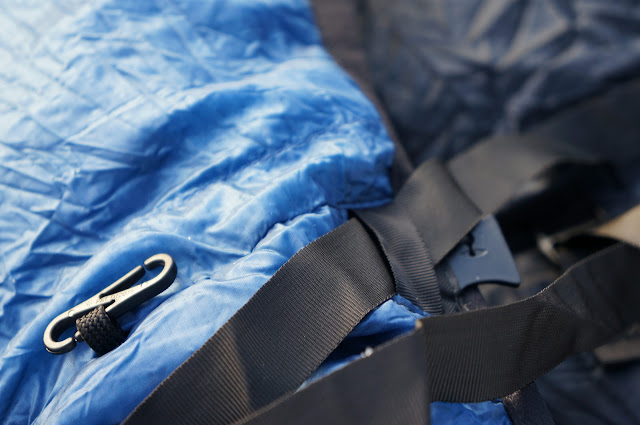
Cord Clip Attachment System, which means you wrap two cords around your mat (it works with 2 cm thick inflatables and 9 cm thick winter mats - the cord is plenty long) and then clip the Sawatch in. The clips come with two settings: One lose one, in which you can move the quilt as you want, and a tight setting, in which you move the clip system one notch further and it sits tight. This eliminates drafts in real life situations, but clipping them into the tightest setting, while in the quilt, is sometimes rather hard: You're laying down and then try to push the clip system in the tightest notch next to you, while being under the quilt. With the lower one I just clip it in before I slid in, but the upper one is amusingly hard. But better that than drafts. I was worried that I would find the cord annoying while sleeping, but even with just a thin baselayer on I didn't notice it.
The real benefit of them clips is that they keep the quilt in place, which is especially useful if you belong to the tossing and much-moving-in-your-sleep category of sleepers. It minimizes, if not even eliminates the possibility of the quilt moving to the side, allowing for drafts to make you cold. I find it much preferable to the tuck-the-quilt-underneath-you technique which I employed with the Ultra 20°, because if you move with such an arrangement then I somehow always let some cold in/ warmth out.
Then there's those clip rings thingys a bit further up the side of the quilt. If you're such a tosser at night that you manage to unclip the cord from its super-tight setting, then Katabatic Gear recommends you clip the cord into those clip rings thingys. They don't lock down and are free running, but you create a rather thick puffy barrier between the mat, quilt and yourself that getting drafts should be impossible. Well, unless go sleep walking. In practice I never managed to unlock the cord from the clip once tightly secured
You also can use it without the cord system, as the Sawatch comes with two
webbing straps. These you could wrap around the pad if you're inclined, but I prefer to just lay on the mat with the webbing underneath me, pulled tight. This works especially well if you're sleeping in huts, where drafts usually are less of a problem. It also has a third strap a bit above where the footbox ends, which can't be removed, except with scissors. As it has not much function in my opinion, that might be its logical end.
The bottom opening of the quilt (the hole!) has an
elastic band sewn in around it, which should prevent gaps and drafts at the sleeping pad level. It is a bit of extra attention to detail and innovative thinking, which makes Katabatic Gear stand apart from its competitors.
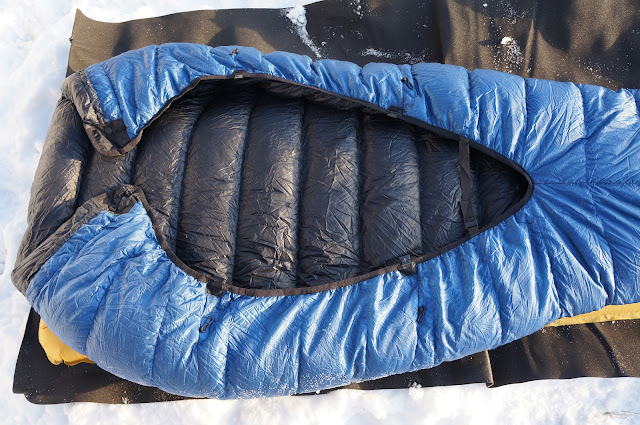
The cut then is what Katabatic Gear calls a "
Differential Cut". What that means is that the outer is cut wider than the inner liner fabric, resulting in a larger circumference of the shell than of the liner. The result is that when you pull the quilt tightly around you, you do not crush the down from the inside on, as it has enough space to loft. Add in
continuous baffles - they go from side to side, or down in the footbox they go all the way around. The benefit is that you can move the down around. The question here is if this is an advantage or a disadvantage: In non-continuous baffles the down stays where it is, but in the here used continuous baffles the down can - voluntarily and in-voluntarily - move around. Obviously it is annoying if the down move in-voluntarily away from where you want it, but on the other hand it gives you the chances to use the quilt in varying conditions: On a warm night in low elevation you can move the down to the side, making it less warm, while if you go up a mountain and have a cold night coming, you move the down evenly around. Obviously if it is warm enough you just could pull the quilt down as well, but that works only to some extent.
Another feature of the Sawatch is its
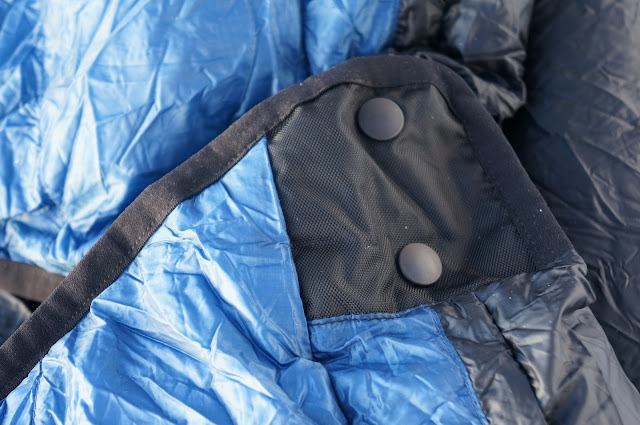
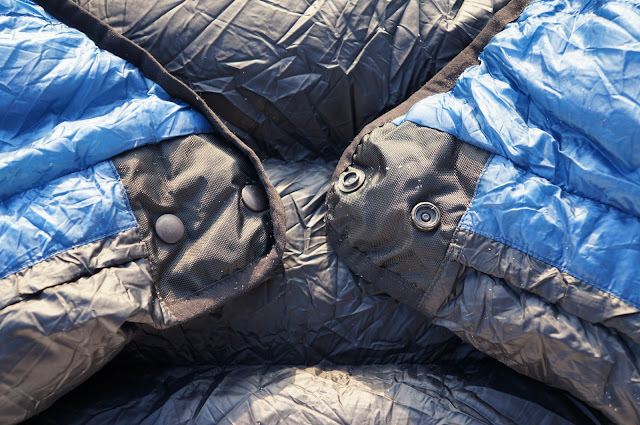
down collar. It is awesome, one of the best details on this quilt. A nice, thick puff around the collar eliminates drafts on the hole of the quilt which most often lets cold in and warmth escape; the hole where your head sticks out. To keep that puffy collar in place there's two buttons to connect the opening, practically closing it. And to top things off, there's a drawcord which allows you to tighten the collar so that it fits well around your neck. The buttons are a bit hard to open and close when you close it around your neck, but it's not a major issue (close them first, easy, and stick your head through the hole). The drawcord would be better located on the side in my opinion, as with it being on top the cord tends to slide in your face/ neck which is annoying; though you can just pull it inside after you have closed it and it is out of the way.
The Sawatch has a
trapezoidal shaped footbox which has
overstuffed baffles. That means even without a pair of
GooseFeet down booties you still should have warm feet; which can be like feet should be without decreasing the loft (by pushing it inside, the trapezoidal shape is somewhat ergonomic/ anatomically). I do prefer to have my down booties on, though, and they fit well in there. The footbox is otherwise closed and can not be opened, and as discussed above has continuous baffles.
As mentioned in the video, the Sawatch comes with a proper, massive organic cotton storage sack. It is sweet to see that there's a relatively new cottage which pays attention to all the details: A big storage sack to store your fine quilt uncompressed; and to top things off made of organic cotton, which shows that the outdoors in which we hike, ski, packraft and bike are valued. Thumbs up. That'd be it on the details.
Technical Innovations &
Quality
I think it is great to see that there's a new (less than three years old) cottage, which comes to market with a very well developed product, which in my opinion beats the offerings of many other quilt manufacturers out there - just read through the features above. Not only that, but Aaron also listens to his customers and improves on the design where needed. The end result is one of the most well-thought-out quilts currently on the market, perfectly made. I probably should notice that the craftsmanship is superb and the Sawatch makes an overall superior impression than the Ultra 20° which I have used previously (still using it, btw). It is Made in Colarado, USA.
Sustainability & Recyclablity
Shall think and add in.
Time
I used the Sawatch last year over two weeks in the field. Three nights with temperatures well over -30°C, and I was toasty. I had, thanks to pulling a
Fjellpulken pulka, also my BPL Coccon synthetic quilt with me, in case the Sawatch on its own wouldn't proof warm enough. That concern was unfounded, and I didn't need to combine the two quilts yet to create the über-winter quilt system. In those cold winter nights there was also no problem with dew freezing inside the quilt, something which rather surprised me. Or at least not enough to make the down collapse, something some of my classmates couldn't say. But remember that this is a three-season quilt, so don't be stupid and take this to Siberia in January.
I'm taking it in February for a week to the North and in March on a one-week skiing/ snowshoeing trip. I will add further findings to this review, should there be any.
Competing products
Nunatak Arc Alpinist. $426, a bit less warm, a bit lighter.
enLIGHTened equipment Epiphany. $410, a bit less warm, a lot lighter, VBL integrated.
Having used the GoLite Ultra 20° and having seen its follower, the 3-Season quilt, I'm not confident to include it here. While cheaper it is not in the same warmth class as the Sawatch or the two above.
What others say
BPL reviewed it and gave it a Highly Recommended. It's written by Roger Caffin, which is in my opinion the best and most credible BPL Reviewer, so it are high acclaims.
Bottomline
The Sawatch quilt packs down small, lofts quickly, is toasty warm, has a bunch of well-thought-out details, and comes in a range of sizes from Small to Long Extra Wide. Get yours if you're in the market for a three-season quilt which can be pushed with a well-thought-out system well into winter.
Where to get it
At
Katabatic Gear directly. $420 in Regular length.
Updates
- 15.02.2012 - added a Video
Future Updates
---
VIDEO coming in the first Update of this Living Review---
---Filling in the gaps---
---Also in the next update: Possible fixing of my rubbish English (as in grammar and spelling and syntax)---
Disclaimer: You can find it there on the right in the side bar. Read it. Additionally I don't recommend going out in the blistering cold without sufficient back-up - that'd be moronic. So be smart. Finally, this quilt was provided free of charge to me and I was held at gunpoint to write a honest review, with all the good, bad and ugly details. I succeeded.
That I prefer quilts shouldn't surprise you. That I prefer them even in the depth of winter shouldn't either. Now if you're looking for winter quilts, you got two options:
- Combine a three-season down quilt with a synthetic quilt to create a flexible system which can be adapted to the circumstances
- Buy a dedicated winter quilt
I decided to combine both approaches to find out what works best for me.
Inevitably
Katabatic Gear came up on top for me (no surprise, really, as I did interview the owner,
Aaron Martray from Katabatic Gear not too long ago) and off I was checking what they had on offer. Back then the
Katabatic Gear Sawatch quilt was their warmest quilt (the
Blackwelder came later in 2011) and soon after a 2011 model with the new attachment system arrived on my doorstep, just in time for some
Wilderness Guide Winter Expedition fun.
Hover over the photos to see smart descriptions!
While that trip didn't end well, it was an exceptional awesome opportunity to test my winter sleep system. Katabatic Gear advertises the Sawatch as their three-season workhorse, which is fine to about -10°C (or 15°F in some illogic system). The first night we had -31°C, and then -36°C for a couple of nights. I'm happy to report that with a smart system the Sawatch was keeping me toasty in those temperatures (Before you ask: I was wearing a
200er Woolpower Baselayer, the BPL Cocoon Hoody and pants, two Buffs, 800er Woolpower Socks, on a
Multimat CCF and inflatable pad cocooned up in a Laufbursche Tyvek bivy, in a big Finnish Army tent - don't ask!). Lets take a look at the Sawatch then.
Weight
The Sawatch has 425 gram of 850 cuin down (nowadays you get 900 cuin down!), filled in continuous baffles which allow you to shift the down around as you please. The Shell Material is Pertex Quantum Ripstop .85oz/yd and the lining material is Pertex Quantum Taffeta 1.0oz/yd, which results in the following measured weight for my regular length Sawatch:
- 695 gram Sawatch quilt
- 009 gram two cords
- 015 gram webbing
- 017 gram stuff sack
Trail-weight (includes cords and stuff sack) is thus 721 gram.
Features &
Function
The Pertex outer is "snowproof" which means a light dusting of snow (as seen in the video, for example) doesn't go through and wets the down. You can blow or brush it off simply. The inner lining is nice soft, does not irritate my skin and warms up quickly. It lofts quickly and overall feels better than the
GoLite Ultra 20° I have used for well over two years now. The Sawatch has lost little down, sometimes one looks through the shell material, but they're easy to pull back in.
Onwards to details: Aaron has developed a
Cord Clip Attachment System, which means you wrap two cords around your mat (it works with 2 cm thick inflatables and 9 cm thick winter mats - the cord is plenty long) and then clip the Sawatch in. The clips come with two settings: One lose one, in which you can move the quilt as you want, and a tight setting, in which you move the clip system one notch further and it sits tight. This eliminates drafts in real life situations, but clipping them into the tightest setting, while in the quilt, is sometimes rather hard: You're laying down and then try to push the clip system in the tightest notch next to you, while being under the quilt. With the lower one I just clip it in before I slid in, but the upper one is amusingly hard. But better that than drafts. I was worried that I would find the cord annoying while sleeping, but even with just a thin baselayer on I didn't notice it.
The real benefit of them clips is that they keep the quilt in place, which is especially useful if you belong to the tossing and much-moving-in-your-sleep category of sleepers. It minimizes, if not even eliminates the possibility of the quilt moving to the side, allowing for drafts to make you cold. I find it much preferable to the tuck-the-quilt-underneath-you technique which I employed with the Ultra 20°, because if you move with such an arrangement then I somehow always let some cold in/ warmth out.
Then there's those clip rings thingys a bit further up the side of the quilt. If you're such a tosser at night that you manage to unclip the cord from its super-tight setting, then Katabatic Gear recommends you clip the cord into those clip rings thingys. They don't lock down and are free running, but you create a rather thick puffy barrier between the mat, quilt and yourself that getting drafts should be impossible. Well, unless go sleep walking. In practice I never managed to unlock the cord from the clip once tightly secured
You also can use it without the cord system, as the Sawatch comes with two
webbing straps. These you could wrap around the pad if you're inclined, but I prefer to just lay on the mat with the webbing underneath me, pulled tight. This works especially well if you're sleeping in huts, where drafts usually are less of a problem. It also has a third strap a bit above where the footbox ends, which can't be removed, except with scissors. As it has not much function in my opinion, that might be its logical end.
The bottom opening of the quilt (the hole!) has an
elastic band sewn in around it, which should prevent gaps and drafts at the sleeping pad level. It is a bit of extra attention to detail and innovative thinking, which makes Katabatic Gear stand apart from its competitors.
The cut then is what Katabatic Gear calls a "
Differential Cut". What that means is that the outer is cut wider than the inner liner fabric, resulting in a larger circumference of the shell than of the liner. The result is that when you pull the quilt tightly around you, you do not crush the down from the inside on, as it has enough space to loft. Add in
continuous baffles - they go from side to side, or down in the footbox they go all the way around. The benefit is that you can move the down around. The question here is if this is an advantage or a disadvantage: In non-continuous baffles the down stays where it is, but in the here used continuous baffles the down can - voluntarily and in-voluntarily - move around. Obviously it is annoying if the down move in-voluntarily away from where you want it, but on the other hand it gives you the chances to use the quilt in varying conditions: On a warm night in low elevation you can move the down to the side, making it less warm, while if you go up a mountain and have a cold night coming, you move the down evenly around. Obviously if it is warm enough you just could pull the quilt down as well, but that works only to some extent.
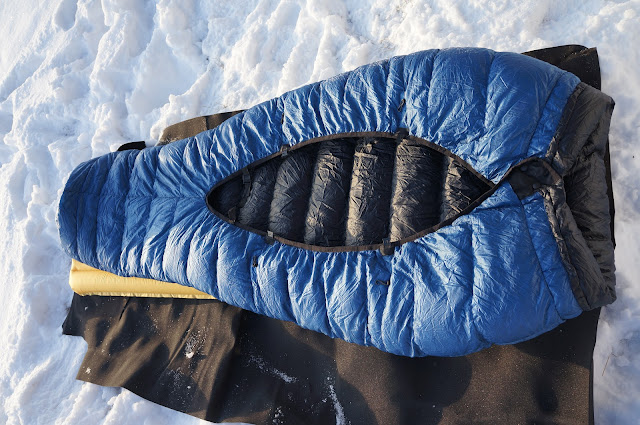
Another feature of the Sawatch is its
down collar. It is awesome, one of the best details on this quilt. A nice, thick puff around the collar eliminates drafts on the hole of the quilt which most often lets cold in and warmth escape; the hole where your head sticks out. To keep that puffy collar in place there's two buttons to connect the opening, practically closing it. And to top things off, there's a drawcord which allows you to tighten the collar so that it fits well around your neck. The buttons are a bit hard to open and close when you close it around your neck, but it's not a major issue (close them first, easy, and stick your head through the hole). The drawcord would be better located on the side in my opinion, as with it being on top the cord tends to slide in your face/ neck which is annoying; though you can just pull it inside after you have closed it and it is out of the way.
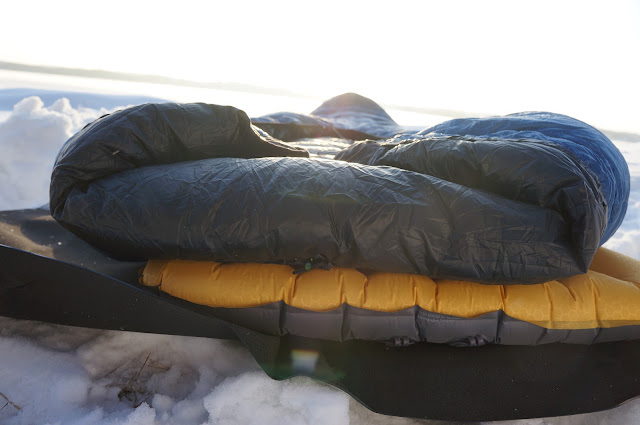
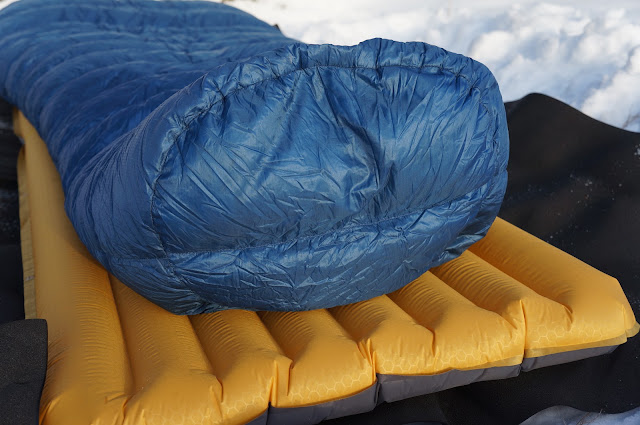
The Sawatch has a
trapezoidal shaped footbox which has
overstuffed baffles. That means even without a pair of
GooseFeet down booties you still should have warm feet; which can be like feet should be without decreasing the loft (by pushing it inside, the trapezoidal shape is somewhat ergonomic/ anatomically). I do prefer to have my down booties on, though, and they fit well in there. The footbox is otherwise closed and can not be opened, and as discussed above has continuous baffles.
As mentioned in the video, the Sawatch comes with a proper, massive organic cotton storage sack. It is sweet to see that there's a relatively new cottage which pays attention to all the details: A big storage sack to store your fine quilt uncompressed; and to top things off made of organic cotton, which shows that the outdoors in which we hike, ski, packraft and bike are valued. Thumbs up. That'd be it on the details.
Technical Innovations &
Quality
I think it is great to see that there's a new (less than three years old) cottage, which comes to market with a very well developed product, which in my opinion beats the offerings of many other quilt manufacturers out there - just read through the features above. Not only that, but Aaron also listens to his customers and improves on the design where needed. The end result is one of the most well-thought-out quilts currently on the market, perfectly made. I probably should notice that the craftsmanship is superb and the Sawatch makes an overall superior impression than the Ultra 20° which I have used previously (still using it, btw). It is Made in Colarado, USA.
Sustainability & Recyclablity
Shall think and add in.
Time
I used the Sawatch last year over two weeks in the field. Three nights with temperatures well over -30°C, and I was toasty. I had, thanks to pulling a
Fjellpulken pulka, also my BPL Coccon synthetic quilt with me, in case the Sawatch on its own wouldn't proof warm enough. That concern was unfounded, and I didn't need to combine the two quilts yet to create the über-winter quilt system. In those cold winter nights there was also no problem with dew freezing inside the quilt, something which rather surprised me. Or at least not enough to make the down collapse, something some of my classmates couldn't say. But remember that this is a three-season quilt, so don't be stupid and take this to Siberia in January.
I'm taking it in February for a week to the North and in March on a one-week skiing/ snowshoeing trip. I will add further findings to this review, should there be any.
Competing products
Nunatak Arc Alpinist. $426, a bit less warm, a bit lighter.
enLIGHTened equipment Epiphany. $410, a bit less warm, a lot lighter, VBL integrated.
Having used the GoLite Ultra 20° and having seen its follower, the 3-Season quilt, I'm not confident to include it here. While cheaper it is not in the same warmth class as the Sawatch or the two above.
What others say
BPL reviewed it and gave it a Highly Recommended. It's written by Roger Caffin, which is in my opinion the best and most credible BPL Reviewer, so it are high acclaims.
Bottomline
The Sawatch quilt packs down small, lofts quickly, is toasty warm, has a bunch of well-thought-out details, and comes in a range of sizes from Small to Long Extra Wide. Get yours if you're in the market for a three-season quilt which can be pushed with a well-thought-out system well into winter.
Where to get it
At
Katabatic Gear directly. $420 in Regular length.
Updates
- 15.02.2012 - added a Video
Future Updates
---
VIDEO coming in the first Update of this Living Review---
---Filling in the gaps---
---Also in the next update: Possible fixing of my rubbish English (as in grammar and spelling and syntax)---
Disclaimer: You can find it there on the right in the side bar. Read it. Additionally I don't recommend going out in the blistering cold without sufficient back-up - that'd be moronic. So be smart. Finally, this quilt was provided free of charge to me and I was held at gunpoint to write a honest review, with all the good, bad and ugly details. I succeeded.
Katabatic Gear Sawatch Quilt
Thanks for a nice review. A quilt of 721 g at those temperatures, impressive! Did you have anything else around your head than the hood of Cocoon and the Buffs?
ReplyDeleteI have a lighter Palisade quilt from Katabatic. I have used it at around 3 °C wearing just a baselayer with no problems, plan to test it in colder conditions with VBL clothing and extra insulation (hood!). Features essentially the same: great collar with fiddly button, great footbox, and the clip system works most of the time. I share your opinion of scissors and the strange third strap. Haven't figured out any use for it yet.
Funny. Just a couple of nights ago I was testing a few pieces of new gear, including a quilt and a yellow inflatable mat (Exped Synmat UL, right?). My experience with HG Burrow 20 was not as successful as yours with Sawatch, though. Guess, I need to do a homework studying your pictures of the attachment thingies and start a little DIY project :(
ReplyDeleteI am impressed. I can't imagine being warm at -30*C even with puffy clothing on. My old Nunatak Arc Alpinist isn't what it once was ever since it got some serious tears (since patched but I don't really trust the patches) but I don't think I ever took it below -12*C or so with modest clothing. You're right the original GoLite Ultra 20, to say nothing of the current model which looks like puffy, would definitely not be warm enough. I've used mine with minimal clothing down to -10 to -5*C certainly but even with puffy clothing I can't imagine going much colder because blocking drafts would be tough especially around the neck.
ReplyDeleteMoro Juuso, kiitos for the comment! Great to hear that there's also at least one other Katabatic Gear quilt here in Suomi!
ReplyDeleteMerino Buff on head + Cyclon Buff around neck and back of head + Cocoon hood was all. I had my head on a Multimat inflatable pillow, though!
What kind of VBL clothing do you have (bought or MYOG?)?
Hei Sergiy, yeps, that's a SynMat UL 7 - hoover over the photos to see the description!
ReplyDeleteI think you won't find those plastic thingys on sale (I might be wrong). They're also sewn in between the inner and outer, so you should know what you're doing when you attempt that mod - not that your flat is filled with down ;)
Much of the being warm in the cold also has to do with
a) having a warm meal before going to sleep
b) staying well hydrated
c) having a good sleep system - mats, bivy, clothes et al.
I used the Ultra 20° in the cold, and minimal temps - till maybe -5°C with puffy clothes - it is fine. After that it doesn't work anymore - I once had it collapse on me at a -12°C night. Not fun.
ReplyDeleteAs I wrote Sergiy Sosnytskiy - much of being warm at those temps has to do with a
a) having a warm meal before going to sleep b) staying well hydrated c) having a good sleep system - mats, bivy, clothes et al.
Only if these all work well together one can have a good nights sleep, even in the very cold =)
Hendrik, I did not mean exactly the same type of attachment, I meant any kind of attachment. The problem certainly was neither a or b. The problem was that without any kind of attachment between the quilt and the synmat I always had a gap between them, from one side or another. Now I'm on a fence whether to make some kind of mod, or to try to return the quilt. I'm afraid that a mod would not help much due to the quilt being rather narrow. Neither do I like the idea of returning it, one of the reasons being that I see no wider alternatives within my budget...
ReplyDeleteCaffin did not use it much and the single stud vs two to make it the highest award BPL can give is a joke. It is a great quilt. But I have sold mine and moved on from where many are with quilts.
ReplyDeleteI think quilts should open right out and that includes the footbox. Quits are idel when being able to cover different temperature ranges. To be able to be opened out to dry fast etc. For me the Sawatch can meet some of those needs - but not all. Footbox is too deep. The Footbox cant be opened out like my MLD Spirit quilt.
The Sawatch is still superb. Warm and the weight to ratio is up there with the best. Build wise the construction is superb and the materials top class. Down collar is again a standout design point.
I still think the cord attachment is fiddly and a bit annoying but I can, and did put up with it. It aslo does not work as well on mats like you used. The ridges on the air mat make it more fiddly to get the quilt tight down to the mat Vs a flat air pad, or mat. Hence you tucked under. Getting the cord stop to sit on the ridge of the air mat channel is a pain while getting into the quilt to sleep. In fact its a mark down from excellent on a overall score for me.
Width wise they now come in wide and this is a must if you side sleep or move about a lot when sleeping for me. Also it makes the quilt more useable. A wide version without the cord clip being used would be nice I think. Side sleep, move about and no hassle with the cords. In truth the Sawatch is a top bag in many ways. It somehow sits between true quilt as I see it and a true top bag with the cord system. But that is my view.
A good review but not conclusive review Hendrik as we have more to come from your planned updates. As for the winter sleep system its really cleaver and well thought out.
One final point that is not a wood burning stove bellowing out smoke from that pipe sticking out of the big tent is it?
I think Caffin, besides Chenault (and Jordan), are the only credible BPL reviewers. Comparing this quilt to other quilts on the market, I find their Highly Recommended correct.
ReplyDeleteI don't agree that they should be open. It is a question of personal taste, and hence it is good that there are different makers on the market which suit different tastes & requirements. I'm also happy with the "deep" footbox; while being able to open it flat might prove beneficial for drying, should that be needed, I found it not difficult to dry it as it is. Having a footbox which can be opened on the other hand might create coldspots.
The attachment system is fiddly, but it is better than any other system on the market, and even better than no way to keep it in place whatsoever. I'm slim, so the normal width is fine for me, even on the side, though I agree, it is good that they're now available in extra wide for those who prefer that =)
We had on night two and three a stove in the big tent, yes, but it heated only the immediate vicinity (about 50 cm) around it up, the rest of the tent was cold - at -36°C not a surprise. It was OK to try to dry socks and garments, but in my opinion we could just as well have not bothered with it. Too bad, a warm tent would have been cozy at those temps!
Chenault likes Paclite! We will give him the benefit of the doubt on that. Caffin is great but to assume a stud will fail and then upgrade a final score based on another is not realistic. A single stud worked fine. I know as I used it for many nights. We will see with BPL reviews. Will was good in my opinion - he got out and tested kit up in the mountains and is all-round respected. Ryan is best blending back into the shadows for me as he only creates division. I am hoping the new guys do well. Good luck to them.
ReplyDeleteStove wise I am not surprised in that cold it heated little. I would like one those pyramid tents with the titanium stoves. That would be nice winter wild camping.
A TiGoat Vertex plus (TiGoat or Four Dogs) TiStove, yes, that would be sweet. Been pondering that for a while, but the cost is quite high. I'm gonna use the Laufbursche Laavu (or two!) in March for a week, should be interesting to see - a 506 gram enclosed shelter with massive space!
ReplyDeleteWhat's wrong with Paclite? Use my Haglöfs OZO made of Paclite still every week, great smock, great material! Chenault also get stuff out and puts it through hard stuff, and isn't afraid to call things like they are.
Will was OK. Maybe my critiscm comes from the fact that he seemed to demand/ downgrade ratings because frameless packs didn't have stays! That made me always giggle =)
Having used Paclite in very bad weather I am not one who slates it as harsh as some. But it's not that good. eVent is way better but needs to be cleaned more.
ReplyDeleteFrameless packs work as I have found out. But have limits based on the hip-belt, shoulder strap interaction. Have fun in March with that Laufbursche Laavu . Looks an amazing bit of kit.
Hendrik, thanks for a very detailed and informative post. I am looking at the possibility of a UK 3 season version of the Katabatic quilt and this was most helpful. Hendrik, your English is excellent, but I must say that sometimes things get lost in translation - "If you're such a tosser at night that you manage to unclip the cord from
ReplyDeleteits super-tight setting, then Katabatic Gear recommends you clip the
cord into those clip rings thingys". - is very funny !! :) I mustn't laugh, my German is terrible and my Finnish non- existent !
This is good Hendrik as I'm right there with you. I upgraded from my Nunatak Alpinist to the Sawatch Wide w/ 3oz. overfill last month. So far I'm extremely pleased. Nunatak craftsmanship is exemplary, but I think Katabatic is putting out a better product/value overall, it's just polished down to the last stitch and the design is forward thinking. Aaron has some details and unique touches that set his quilts apart from the quilts that I've used in the past. What I wanted, the reason I parted with my Nunatak Alpinist, was a 3+ season quilt that could easily be stretched into New Mexico winters; the generous 58" of width and the smartly designed variable taper in the Katabatic fits me better than my Alpinist did. Fending off drafts and cold spots will be a non issue, neither will layering.
ReplyDeleteHaving owned bags from Western Mountaineering, Jacks R Better (*ahem...not pleased with their products), Stateless Society, Nunatak, the Katabatic is hands down the the winner in terms of quality and bang for the buck. Although I do believe the pricing jumped quite a bit around the holidays, before then I'm not sure how the guy was making any money his pricing was so good.
I first though I wouldn't comment as I have no experience of using quilts in winter but it has troubled my for a while so: What do you thing would be the comfortable limit of the sleeping system you used if there wouldn't have been a tent with a stove (but still expecting an enclosed shelter)? I read that the stove didn't warm the tent especially well (which is surprising as in the army we had around +20C in those tents with -30C outside) but it probably still had quite an effect as allready two people sleeping in Hilleberg Keron 3 GT pump up the inside temp by few degrees compared to the outside temp. Did you have a thermometer inside the tent near where you slept? The system just seems inceredibly light to handle -36 Celsius that I find it hard to believe, but on the other hand, I have no first hand experience.
ReplyDeleteThe stove is probably also part of the reason why there was no moisture frozen in the quilt. Moisture just happens if sleeping in very cold but dry and a bit warmer air helps a lot to dry things out.
Hendrik,
ReplyDeleteIf the video is still in production, I would be thankful if you would include episodes of you (or other model) getting into the quilt, turning from one side to another (or, maybe, from back to belly) inside the quilt, and getting out of it.
Unfortunately, my Palisade has only been used once in Finland. At about -15 °C, in fact, but inside a Tunturisusi sleeping bag...
ReplyDeleteVBL pants and shirt from Warmlite: cheap and reasonably light but make you look like a weird spaceman or something. VBL socks from RBH: excellent.
Have you tried your Loke with the Sawatch? The great hood should help in colder temps (really works in windy conditions, by the way). But as you survived from the trip you described, your system has really proven itself.
Hei Euegene, nice to read your insights; especially in terms of other quilt makers. As I was looking for a good summer quilt I was wondering between Katabatic and Nunatak, but after your comment I am pretty sure it is going to be the former. Indeed pricing went up recently, but they're still cheaper than many competing products.
ReplyDeleteWhat was wrong with JRB quilts?
Hei Mark, glad to be of help! I am aware what "tosser" means in the UK, tough I think if one reads it with what I mean in mind it shouldn't be misunderstood (but it probably still is rather humourous ;)
ReplyDeleteIt's shot and in editing, and I hope to finish it soon. So I think yo will need to do with what comes =)
ReplyDeleteMaybe -20°C to -25°C? Really difficult to estimate; and I had a synthetic quilt for layering on top with me if it would have been too cold. When I go north soon I reckon I will take this setup (minus synthetic quilt) and will see how far it can go. Will probably do a post on it soon; guess it is of interest to those who go out in winter!
ReplyDeleteI have no idea why the stove did little to warm the tent; maybe it was too tiny? We were 11 people in there, and I know that at least one guy had his Haglöfs Goga Downquilt frozen from condensation inside of it (he dressed rather stupidly).
That must have been hot, a Palisade inside a Tunturisusi!
ReplyDeleteWhere did you find VBL pants rom Warmlite? At least I can't find them on their website; the shirt is cheap indeed - you can get 11 Warmlite shirts for the price of one RBH Designs shirt!
Might give what you suggested a try, the Loke's hood is indeed superb, so that might be a good combo. It is just a lot heavier than the BPL Cocoon Hoody.
They provide the pants custom made if you send them an email - at least they used to. My pair was huge although I provided my bodily dimensions. Easy to fix, though, with a little sewing, which I have yet to do as they work fine even when generously sized as the fabric is really thin so goes unnoticed under other garments.
ReplyDeleteIn comparison to RBH fabric (at least to their socks, I don't [yet] have other garments from them), that of Warmlite's is really thin, theres no intrinsic insulation; just a "fuzzy" inner and VBL outer. Makes it more flexible, I think, as you can adjust the insulating layer individually. Also a wicking base layer is easy to add (I think synthetic mesh fabric à la Aclima could be ideal). The low price makes Warmlite great for experimenting with VBLs.
Hendrik - yes I was only having a joke with you - but it did make me laugh :) Once again thanks for excellent post.
ReplyDeleteHendrik, how do I get ahold of you? I was wondering if you would read and give me your opinions on a backpack prototype I designed. I will put the link here, and would really appreciate any feedback you could give me.
ReplyDeletehttp://blessedoutdoors.blogspot.com/2012/01/perfection-in-backpack-form.html. Thanks in advance!
Hendrik,
ReplyDeleteMy first introduction into quilts was with the JRB Hudson River, at the time I didn't know any better and was in the process of learning how to use quilts properly. I quickly learned with the Hudson what I liked in a quilt and also what I despised in a quilt. My biggest criticism with the JRB Hudson was the lack of width in the shoulders, a tight 46" across the chest didn't leave much room for adjustment and supplemental layering, even for a slim guy. Side sleeping? Forget about it! What good was a narrow bodied draft inducing quilt to me? No good.
The footbox design on the JRB quilts failed to work with my cold feet, the adjustable footbox design was the culprit in my case. I never found the need, even in mild weather, to open up the footbox and use the quilt as a top blanket, so that was an unnecessary weight addition and compromise for me in the Hudson quilt. Personally, I think an adjustable footbox design used in a quilt rated to 20F is a serious compromise in warmth. If anything a quilt of that rating should be overstuffed in the footbox. JRB construction reflects their pricing, you get what you pay for. A quick search on BPL leads you to a handful of negative experiences from JRB users who have had issues with excessive down migration and underfilled baffles. I wouldn't recommend a JRB quilt to anyone, not when there are higher quality options for comparable price to be found through Zpacks, Enlightened Equipment, and Katabatic.
I was fortunate to order my Sawatch right before the price hike, when the prices were almost a steal. I'm looking forward to taking this out with me in 2012.
Got a Sawatch a few months ago. Although I couldn't test it in critical temperatures, I am happy to read your experiences luckily accord with my estimating the bag could be used down to around -30°C with down clothing similar to yours. We will see how it works out during the Helventinjärvi tour :) Which bag will you be using for that trip, btw?
ReplyDeleteIn any case, one should surely bring some backup if intending to use the bag below its temp rating. Don't do without! Either more clothing and maybe a VBL, or/and an overbag. To be able to wear more puffy clothing, I chose a wide Sawatch. I'm 1,80m tall, weighing around 74kg. "Wide" is perfect for me, since it leaves plenty of room when needed. Yet it is important to note I do not find it too large: If room is not needed, the attachment system can be used to pull the quilt under you, and thus tightly around you. I love it.
I can only support your comments on the manufacturing quality of the bag. Katabatic work looks&feels most excellent!
Thank you for another review well done. Are you a side or back sleeper? How do you think the Sawatch would work for side sleeping?
ReplyDeleteI side sleep most of the time but think with a warm enough quilt, with enough girth to cover my bottom arm which would jut out a bit from an inflatable pad, I'd be fine.
Hey Hendrik, Any chance you can give us some shots of packed size relative to say a Laufbursche Huckepack?
ReplyDeleteInteresting that it would keep you warm when it is really cold outside. With a sleeping bag you would need a bag weighing closer to 2 kg, at least in XL size, to be warm in -30°C. The quilt obviously depends on you having a full set of down clothes on the body, but you would probably bring the same clothes anyway, even when using an ordinary sleeping bag. I guess for a longer trip there could be the aspect of the down insulating less due to collecting moisture faster when being used both during the night and on breaks during the day.
ReplyDeleteActually I was wearing a set of synthetic insulation garments in the quilt - the BPL Cocoon Hoody & Pants. I could have worn my Sir Joseph Koteka (Down) Jacket, but I didn't feel it was necessary. The benefit of synthetic garments is that they still are warm when moist; and I used the down jacket during the day and in camp.
ReplyDeleteThanks EJ. I move a lot in my sleep, and sleep on my side, back, belly - it works for me well. With the Ultra 20° I sometimes woke up because of a draft, that hasn't been the case with the Sawatch. If you'd get a Sawatch in Wide I reckon you should be fine - maybe ask Aaron via Email?
ReplyDeleteI will try, Ben!
ReplyDeleteHei Hofnarr, I will be using this quilt on our trip! It seems there will be quite a few Katabatic Gear quilts on that trip - really looking forward to see the Blackwelder!
ReplyDeleteI will see how far it goes when I'm in Lapland in two weeks and report back. -20°C should be no problem, me thinks.
ReplyDeleteIt was death standing wood, very dry as well. So probably a too small stove (it was rather tiny, yeah).
Never wear more than one pair of socks. Really thick socks, though, or thin socks + down socks =)
I don't get it!? Seems overly fiddly to me. Sure, it's a bit lighter than say a Western Mountaineering Versalite [905 g, -12C - full mummy sleeping bag], but the Versalite is a much warmer bag and you just yank it out of the stuff sac and toss it on your mat. In cold weather, I'd prefer to save weight somewhere else. Alternatively, you could go with a lighter mummy bag and just where an extra layer in the bag. I have to say, this kind of set-up makes no sense to me. An open bivy in that thing [while saving 180 g] seems like it would be a really cold night.
ReplyDeleteI doubt the Versalite is warmer, Michael. You also can yank the Sawatch out of the stuff sack and lay under it - the "fiddly" cords are not needed, but do work very well as draft stoppers. I have done open bivys in this quilt - which are imo much superior to the majority of sleeping bags - and it is comfy warm. Maybe try a quilt, then you might get it?!
ReplyDeleteHi Hendrik ... I still don't see the point of a quilt for this temperature rating [15 F/9.4 C]. In warm weather, quilts make total sense.
ReplyDeleteThere's no way the Sawatch is warmer than the Versalite as a stand alone product. For starters, the Versalite is a 10 F bag and the Sawatch is a 15 F. Additionally, the Versalite is a mummy bag with a hood and proper draft tube along the zipper. With the Sawatch, you have to do several things correctly to approach that 15 F rating - i.e. eliminate the potential for convective heat loss [with no zipper, draft tube, or hood]. I'm just using the Versalite as an example because WM makes very high quality, accurately rated bags. Based on your review, it appears to me that the Sawatch requires a lot of fiddly steps to ensure a warm night of sleep ... all to save 180 grams [if compared to the 10 F WM Versalite]. You mention above having to use: "Merino Buff on head + Cyclon Buff around neck and back of head + Cocoon hood was all. I had my head on a Multimat inflatable pillow, though! ..." All that stuff weighs something as well. Plus, you'd need to have a really good down/synthetic mat as well. I can usually get away with a Neoair. In a mummy bag, you strip off your outerwear and climb in ... no extra hoods or parkas or fiddling with draft cords. 180 grams is a meagre weight savings for what appears to be a lot of hassle plus you have to bring several other items to make-up for the lack of hood, zipper etc. Chopping weight from things like tents or switching from Fritschi Diamir to Dynafit ski bindings would represent better ways to lighten a winter load in my humble opinion. Come summer though a quilt would be very nice indeed. Anyway, I'm not trying to be a bother, I just wanted to state an alternate opinion. I live in Canada and I'm always looking for ways to reduce weight/bulk when backcountry skiing/climbing, your site certainly offers-up many good ideas/alternate solutions.